

A civil case may involve valuable property, a disputed gift, years of family conflict, and documents that appear strong. Yet the entire case can end before evidence begins if the plaint fails a basic legal test. This is why Rejection of Plaint in Pakistan is one of the most important subjects for litigants, advocates, law students, and anyone preparing to file or defend a civil suit.
At the same time, Rejection of Plaint in Pakistan under Order VII Rule 11 of the Code of Civil Procedure, 1908 is not a shortcut for defeating every difficult claim. A weak case is not automatically a dead case. Where the plaint raises disputed facts, fraud, forgery, ownership, possession, or another triable issue, the court may have to frame issues and record evidence instead of closing the courtroom door at the start.
This complete guide to Rejection of Plaint in Pakistan explains the four statutory grounds, the correct judicial test, the latest Supreme Court principles in PLD 2025 Supreme Court 302, the difference between rejection, return, and dismissal, the remedies available after rejection, and practical steps for both sides.
Table of Contents
IRAC Analysis of Rejection of Plaint in Pakistan
| IRAC | Legal Position |
|---|---|
| Issue | When may a civil court terminate a suit at the initial stage by rejecting the plaint under Order VII Rule 11 CPC? |
| Rule | The plaint may be rejected where it discloses no cause of action, the relief remains undervalued after an opportunity to correct it, the required court fee remains deficient after an opportunity to supply it, or the suit appears from the plaint to be barred by law. |
| Analysis | The court must read the plaint meaningfully, ordinarily accept its material allegations as true for this limited inquiry, ignore disputed defence pleas, and determine whether the defect is fatal or requires evidence. Admitted material may be considered, but a mixed question of law and fact should normally proceed through issues and evidence. |
| Conclusion | Rejection is justified only when a statutory defect is clear on the face of the plaint and cannot properly be resolved through trial. A doubtful, disputed, or curable matter should not be summarily terminated. |
Rejection of Plaint in Pakistan: Judgment at a Glance
| Point | Details |
|---|---|
| Case | Ahmed Ali Talpur v. Sub-Registrar Latifabad, Hyderabad and others |
| Citation | PLD 2025 Supreme Court 302 |
| Bench | Muhammad Ali Mazhar and Syed Hasan Azhar Rizvi, JJ. |
| Decision Date | 24 December 2024 |
| Main Dispute | A son claimed ownership of a Hyderabad bungalow through an oral gift from his father; the father alleged fraud and forged signatures. |
| Trial Court Result | Plaint rejected under Order VII Rule 11 CPC. |
| Supreme Court Result | Rejection set aside; case remanded for evidence and decision on merits. |
| Core Principles | No piecemeal rejection; weakness of proof is not absence of cause of action; admitted material may be considered; mixed questions require issues or trial; the court may act suo motu but must hear the plaintiff and record reasons. |
Applicable Law and Leading Precedents
Rejection of Plaint in Pakistan is mainly governed by the following provisions and authorities:
| Law or Case | Relevance |
|---|---|
| Order VII Rule 11 CPC | Provides the four principal grounds for rejection. |
| Order VII Rule 12 CPC | Requires the judge to record reasons for rejection. |
| Order VII Rule 13 CPC | Explains that rejection does not automatically bar a fresh plaint, subject to the continuing legal defect. |
| Section 2(2) and Section 96 CPC | Treat rejection as a decree and provide the ordinary appellate route. |
| Sections 148 and 149 CPC | Relate to enlargement of time and making up court-fee deficiency. |
| Court-Fees Act, 1870 | Governs court fee, subject to provincial amendments. |
| Suits Valuation Act, 1887 | Governs valuation for jurisdiction and related objections. |
| Limitation Act, 1908 | A time-bar visible from the plaint may attract Rule 11(d). |
| PLD 1984 SC 289 | Leading authority on opportunity to supply deficient court fee. |
| PLD 2025 SC 302 | Central authority on piecemeal rejection, admitted material, mixed questions, suo motu power, hearing, and reasons. |
For Rejection of Plaint in Pakistan, the Supreme Court held that if even one prayer is maintainable, the plaint cannot be rejected in parts. It also clarified that a weak evidentiary position does not mean that the plaint discloses no cause of action. Where authenticity, fraud, forgery, and the legal effect of documents require proof, summary rejection may wrongly leave the parties without a remedy.
What Is Rejection of Plaint in Pakistan?
A plaint is the formal statement through which a plaintiff brings a civil claim before a court. It states the material facts, cause of action, jurisdiction, valuation, court fee, relief, and other required particulars. Rejection of Plaint in Pakistan means that the court refuses to proceed with that plaint because it suffers from one of the legal defects mentioned in Order VII Rule 11 CPC.
The controlling federal text can be checked through the official Code of Civil Procedure, 1908 on Pakistan Code. Pakistan Code identifies the CPC as under review, so lawyers should also verify relevant Gazette notifications and provincial amendments applicable to the forum. (Pakistan Code)
The purpose of Rejection of Plaint in Pakistan is important, but it is a drastic procedural power because it can end the suit before a regular trial. Its object is to stop a stillborn, legally barred, or fundamentally incompetent claim from consuming years of judicial time. But it must not be used to decide contested facts, compare rival evidence, or conduct a mini-trial at the pleading stage.
The 4 Legal Grounds for Rejection of Plaint in Pakistan
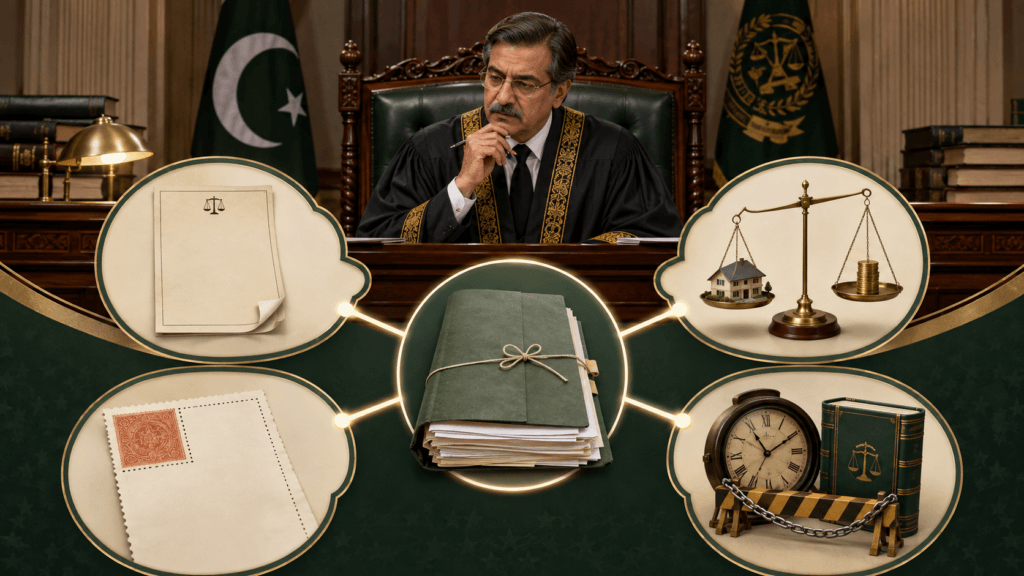
Order VII Rule 11 contains four principal grounds. Each ground has a different test, and the court should not merge them into a vague conclusion that the suit is “not maintainable.”
Ground 1 in Rejection of Plaint in Pakistan: No Cause of Action
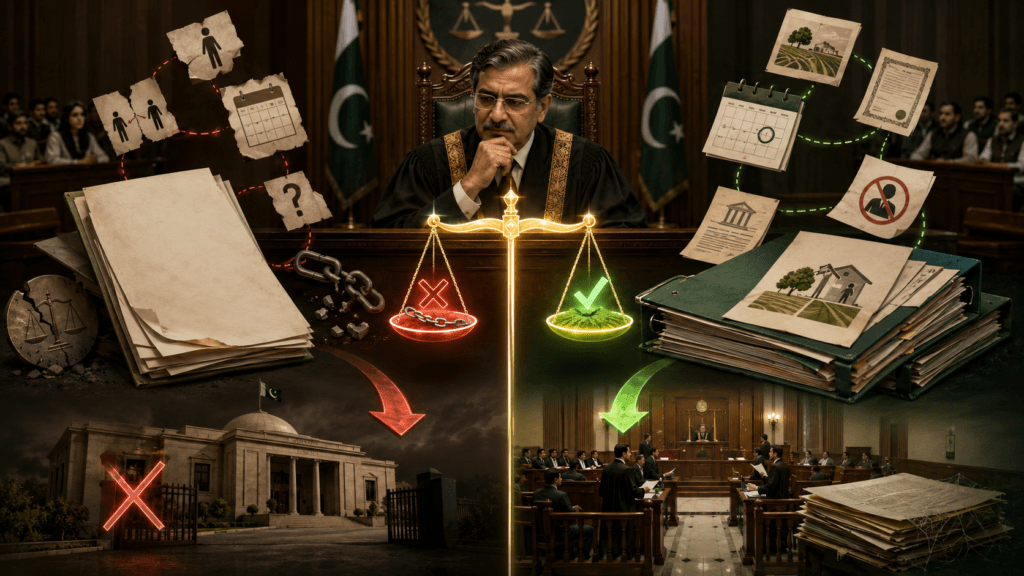
A cause of action is the bundle of material facts that gives a person a legal right to seek relief from the court. The plaint must show:
- A legally recognizable right.
- An act, omission, denial, or threat affecting that right.
- The defendant’s connection with the alleged wrong.
- A subsisting right to approach the court when the suit is filed.
For Rejection of Plaint in Pakistan on this ground, the question is not whether the plaintiff will ultimately prove the case. The limited question is whether, assuming the material facts pleaded are true, the law can grant any relief.
Rejection of Plaint in Pakistan creates an important distinction between a missing cause of action and a case that may simply fail on proof:
| Situation | Legal Effect |
|---|---|
| Plaint discloses no cause of action | It may be rejected under Order VII Rule 11(a). |
| Plaintiff has pleaded a cause but may fail to prove it | Evidence is required; the plaint should not be rejected merely because proof appears weak. |
| Cause of action has not yet accrued | The suit may be premature, depending on the pleaded facts and relief. |
| Right once existed but was no longer subsisting when suit was filed | The plaint may face rejection if the defect is apparent from its own statements. |
The Supreme Court in PLD 2025 SC 302 emphasized that a dearth or weakness of proof does not justify a finding that no cause of action is disclosed. It further stated that the plaintiff must show both infringement of a right and a subsisting right to seek relief at the time of filing.
Simple Example
A plaintiff says that he owns land, identifies the disputed mutation, states when he learned of it, explains how the defendant denied his title, and asks for declaration and cancellation. These facts disclose a cause of action even if the defendant has stronger documents. Whether the plaintiff proves fraud or ownership is a matter for evidence.
By contrast, if the plaint narrates no denial, no threatened injury, no disputed transaction, and no legal wrong by the defendant, it may disclose no cause of action.
Ground 2: The Relief Is Undervalued
In Rejection of Plaint in Pakistan, a plaintiff must properly value the suit for court jurisdiction and, where applicable, for court fee. An incorrect valuation does not always permit immediate rejection.
The court must first determine that the relief is undervalued, direct the plaintiff to correct it within a fixed time, and then examine whether the direction has been obeyed.
Rejection of Plaint in Pakistan under clause (b) normally requires three steps:
- The court identifies the correct or required valuation.
- The plaintiff receives a clear opportunity and fixed time to correct it.
- The plaintiff fails to comply.
The Suits Valuation Act, 1887 is available on the official Pakistan Code website. Valuation and pecuniary jurisdiction may also be affected by provincial amendments, court-fee schedules, and the nature of the relief. (Pakistan Code)
A court should avoid arbitrary figures. It should examine the substance of the relief, the governing statute, and the applicable valuation rule. A litigant should not lose a civil claim merely because the order failed to state the exact correction required.
Ground 3: Deficient Court Fee or Stamp
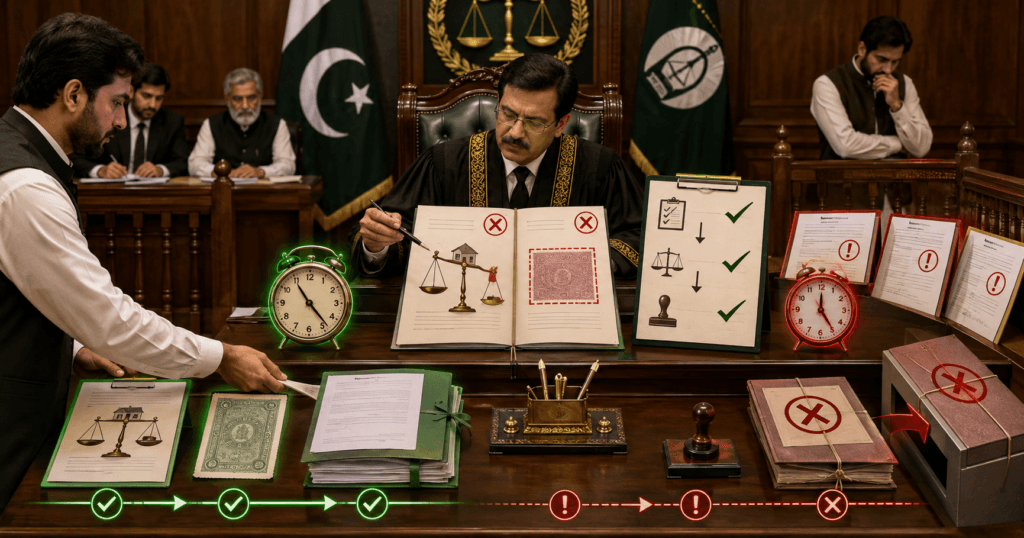
For Rejection of Plaint in Pakistan, court fee is not the same as valuation, although the two may be connected. Where the relief is properly valued but the plaint carries insufficient court fee, clause (c) applies.
The correct sequence is crucial. The court should determine the deficiency, require the plaintiff to supply the requisite stamp or court fee within a fixed period, and reject the plaint only after non-compliance.
The Supreme Court authority reported as PLD 1984 SC 289 treats the opportunity to make up the deficiency as mandatory under this clause, subject to the governing facts and applicable law.
Therefore, Rejection of Plaint in Pakistan should not be ordered merely because the first filing contains deficient court fee. The plaintiff must ordinarily receive a meaningful chance to cure the defect.
Continued defiance, bad faith, gross negligence, or unjustified failure may lead to rejection.
Readers may consult the official Court-Fees Act, 1870 while remembering that provincial amendments and schedules can materially affect the amount payable. (Pakistan Code)
Ground 4: The Suit Is Barred by Law
This is one of the most litigated grounds in Rejection of Plaint in Pakistan. The legal bar must ordinarily appear from the statements made in the plaint, read as a whole.
Common examples include:
- Limitation.
- Res judicata.
- A statutory bar on civil-court jurisdiction.
- Order II Rule 2 CPC.
- Estoppel where the necessary admitted facts are apparent.
- Withdrawal of an earlier suit without permission to bring a fresh suit.
- Failure to comply with a mandatory statutory notice where the bar is clear.
- A special law requiring another exclusive forum or remedy.
The word “law” is broad enough to include the Limitation Act and other binding statutory prohibitions. The official Limitation Act, 1908 should be read with the particular article governing the relief claimed. (Pakistan Code)
However, limitation is not automatically decided against the plaintiff whenever the defendant alleges delay.
If the plaint pleads a later date of knowledge, concealed fraud, acknowledgment, continuing wrong, disability, or another legally relevant fact, and those matters are disputed, the court may need evidence.
Rejection of Plaint in Pakistan is appropriate only when the bar is visible without deciding contested facts.
For a detailed example of a claim rejected because a decades-old property challenge was barred on the face of the plaint, readers can study our guide on the Limitation Act in Pakistan. That article explains PLD 2025 Lahore 581, where limitation, waiver, acquiescence, and third-party rights became decisive. (Qanooni Dastak)
Rejection of Plaint in Pakistan: Why PLD 2025 SC 302 Matters

The latest leading case used in this guide is Ahmed Ali Talpur v. Sub-Registrar Latifabad, Hyderabad and others, reported as PLD 2025 Supreme Court 302.
Background of the Father-Son Property Dispute
The plaintiff filed a civil suit concerning Bungalow No. A-26, Unit No. 3, Shah Latifabad, Hyderabad.
He claimed that his father had gifted the property to him through a declaration of oral gift dated 8 October 2007. He sought:
- Declaration of ownership.
- Cancellation of a later lease deed in favour of his father.
- Registration of the lease in his own name.
- Permanent injunction against transfer or dispossession.
The father applied for rejection of the plaint. He alleged:
- Lack of jurisdiction.
- Absence of locus standi.
- No cause of action.
- Undervaluation.
- Insufficient court fee.
- Misjoinder and non-joinder.
- Legal bars under the Specific Relief Act.
- Unclean hands and mala fide intentions.
The trial court rejected the plaint, and that result was maintained in appeal and second appeal before the matter reached the Supreme Court.
Why Rejection of Plaint in Pakistan Was Premature
The real dispute was factual: did the father voluntarily gift the property, or were the gift papers forged and manipulated by the son?
Even the government law officer accepted that this question required evidence. The Supreme Court held that such a controversy could not be decided summarily merely because the father possessed a registered lease while the son relied on an alleged unregistered gift and related allotment material.
For Rejection of Plaint in Pakistan, the judgment gives these controlling lessons:
- The court must meaningfully read the plaint rather than dispose of the application perfunctorily.
- An application must identify the exact clause and factual basis instead of using sweeping allegations.
- Disputed defence pleas are not evidence.
- Material outside the plaint may be considered only where it is available on record and admitted by the plaintiff.
- Mixed questions of law and fact should normally proceed to written statement, discovery, preliminary issues, or trial.
- Piecemeal rejection is not permitted if even one prayer remains maintainable.
- The court may exercise Order VII Rule 11 suo motu and need not wait for a written statement.
- Before rejection, the plaintiff must receive a right of audience.
- Rule 12 requires a reasoned order stating why the plaint is rejected.
Final Relief Granted by the Supreme Court
The Supreme Court set aside the trial court order and the judgments that had affirmed it.
The father was directed to file a written statement. The trial court was ordered to:
- Frame a preliminary issue on whether the gift deed was genuine or forged.
- Record evidence of the parties.
- Permit forensic or handwriting examination if required.
- Summon relevant officials or witnesses.
- Decide the controversy on merits within the stated timeframe.
The decision does not declare the son to be owner. It only holds that the dispute could not lawfully be ended through summary rejection.
This distinction is essential: survival of the plaint is not victory on the merits.
The Correct 8-Step Test for Rejection of Plaint in Pakistan
A court dealing with Rejection of Plaint in Pakistan should follow a disciplined sequence:
- Read the plaint as a whole, not isolated sentences.
- Identify the exact clause of Order VII Rule 11 relied upon.
- Treat material factual allegations as true only for the limited maintainability inquiry.
- Ignore disputed assertions in the written statement or rejection application.
- Consider annexures or outside material only to the extent legally permissible and admitted by the plaintiff.
- Ask whether the defect is fatal, apparent, and non-triable, or whether evidence is required.
- Give the plaintiff an opportunity to cure valuation or court-fee defects and a right of hearing before rejection.
- Pass a speaking order under Rule 12 with clear reasons.
This approach protects both sides. It prevents useless litigation but also stops Order VII Rule 11 from becoming a weapon for delaying a genuine suit through an early mini-trial.
Can Only Part of a Plaint Be Rejected?
Ordinarily, no.
Rejection of Plaint in Pakistan operates against the plaint as a whole. PLD 2025 SC 302 clearly states that the law does not permit piecemeal rejection. If one prayer is maintainable, the plaint cannot be rejected in parts.
This does not mean every prayer must ultimately succeed.
The court may later refuse a particular relief after issues and evidence, or it may deal with legally defective claims through another appropriate procedural provision. But Order VII Rule 11 should not be used to cut out selected prayers while allowing the same plaint to continue.
Rejection of Plaint in Pakistan vs Return and Dismissal
| Concept | Main Reason | Immediate Effect | Usual Next Step |
|---|---|---|---|
| Rejection of plaint | A defect under Order VII Rule 11, such as no cause of action or clear legal bar | The plaint is rejected; the order is treated as a decree for appeal purposes | Appeal, and in some cases a fresh plaint subject to law |
| Return of plaint | The court lacks territorial, pecuniary, or subject-matter jurisdiction and another court is competent | The same plaint is returned for presentation to the proper court | Present it before the competent forum with required endorsements |
| Dismissal of suit | The court decides the suit or disposes of it under another procedural rule | The suit ends by judgment or order on the relevant ground | Appeal, restoration, review, or other remedy depending on the order |
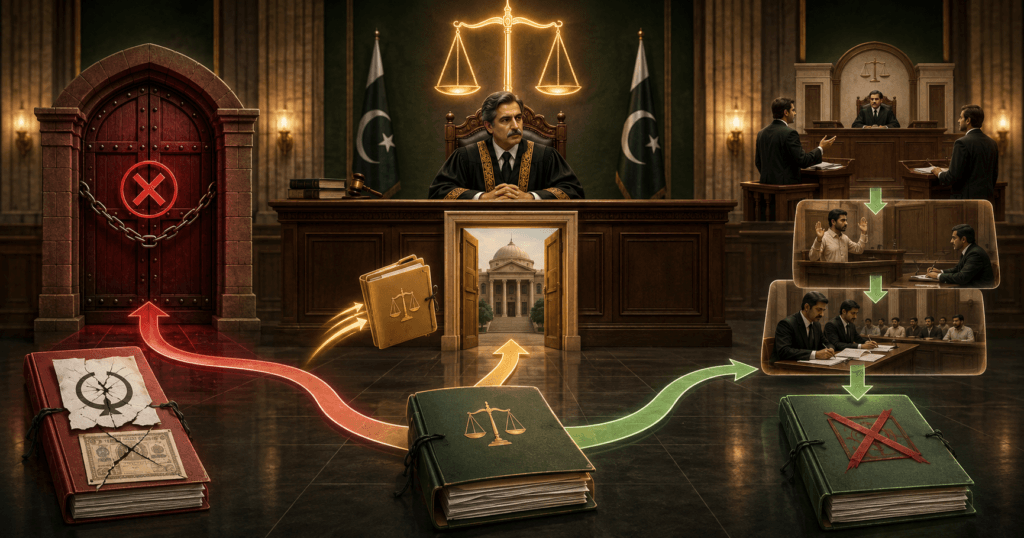
A court should not reject a plaint merely because it belongs before another competent court. In that situation, return under Order VII Rule 10 may be the proper course.
Similarly, rejection is not the same as dismissal after trial. The words matter because the available remedy and effect on a fresh suit are different.
At What Stage Can the Application Be Filed?
The CPC does not confine Order VII Rule 11 to one fixed moment.
An objection may arise before or after filing of the written statement, and the court may also notice the defect itself. PLD 2025 SC 302 confirms that the power is independent and the court need not wait for the written statement where the plaint is genuinely hit by the Rule.
Still, timing should not become a litigation tactic.
A defendant who waits unnecessarily and then files a vague application after years may fail to advance the object of early disposal. The application should precisely identify the fatal pleading and the statutory clause.
What Material May the Court Examine?

The general rule for Rejection of Plaint in Pakistan is that the court examines the plaint and reads it meaningfully.
The defence version is not presumed true. The defendant cannot convert disputed allegations into established facts merely by placing them in an application.
The Supreme Court has recognized a limited qualification: where material apart from the plaint is already on record and is admitted by the plaintiff, the court may consider it.
But if the material is disputed, requires proof, or creates a mixed question, the safer and lawful course is to frame issues and allow evidence.
This prevents two opposite errors:
- The court should not blindly ignore the plaintiff’s own admitted documents.
- The court should not conduct a full evidentiary comparison at the Rule 11 stage.
Can Amendment Prevent Rejection of Plaint in Pakistan?
Where the problem is a curable drafting defect and amendment is legally permissible, the court should consider whether justice can be served through amendment rather than immediate rejection.
This is especially relevant where a material fact, necessary relief, valuation detail, or clarification can lawfully be added without:
- Changing the fundamental nature of the case.
- Defeating an accrued legal right.
- Withdrawing a fatal admission.
- Creating a completely new cause of action.
Amendment cannot rescue a suit from every defect. It should not be used to manufacture a cause of action that did not exist, evade a final statutory bar, withdraw a fatal admission, or defeat limitation through an artificial pleading.
The court must distinguish between an honest curable omission and a legally dead claim.
Remedies After Rejection of Plaint in Pakistan
Appeal Against Rejection
An order rejecting a plaint is treated as a decree under the CPC. Therefore, the plaintiff may ordinarily file a regular appeal before the competent appellate court.
The correct forum and limitation period depend on:
- The court passing the decree.
- Local and provincial amendments.
- Valuation of the suit.
- The applicable limitation schedule.
- The nature of the original jurisdiction.
A person researching reported decisions may use the official Supreme Court of Pakistan Judgment Search. The Court’s public facilitation portal also provides access to case information, cause lists, and judgment-search services. (SCP)
Challenge to Refusal to Reject
An order refusing to reject a plaint is not itself a decree.
Depending on the circumstances and applicable provincial law, a revision under section 115 CPC may be examined where the statutory jurisdictional conditions are satisfied.
Constitutional jurisdiction is exceptional and should not be treated as a substitute for an available appeal or revision.
Fresh Plaint Under Order VII Rule 13

Rule 13 says that rejection of a plaint does not, by itself, prevent presentation of a fresh plaint concerning the same cause of action.
But this rule does not erase the reason for rejection.
For example:
- A valuation or court-fee defect may be cured.
- Omitted material facts may sometimes be properly pleaded.
- A curable drafting defect may be corrected.
- A jurisdictional presentation problem may be handled through the correct procedure.
- A limitation or res judicata bar cannot be removed by simply changing the title of the document.
A suit finally barred by limitation, res judicata, or another substantive law does not become maintainable merely because the plaintiff files a new document titled “fresh plaint.”
Therefore, Rejection of Plaint in Pakistan may leave the door open procedurally while the underlying legal bar continues to keep it closed.
Defendant’s Checklist for Rejection of Plaint in Pakistan
Before filing an application, the defendant should ask:
- Which exact clause of Order VII Rule 11 applies?
- Is the defect visible from the plaint itself?
- Am I relying on disputed facts that require evidence?
- Does the plaint admit the earlier judgment, transaction, date, or statutory bar?
- Is the objection actually about jurisdiction, requiring return instead of rejection?
- Has the plaintiff been given a required opportunity to correct valuation or court fee?
- Am I asking for impermissible partial rejection?
- Can I explain the objection in a short, precise, document-based manner?
A strong application is not the longest application. It identifies a fatal legal defect without trying to argue the entire defence case.
Plaintiff’s Checklist for Rejection of Plaint in Pakistan
A plaintiff facing Rejection of Plaint in Pakistan should examine:
- Whether the plaint clearly pleads the legal right and its infringement.
- The exact date and place where the cause of action arose.
- Why the right to sue was subsisting on the filing date.
- Whether limitation is answered with specific dates and facts.
- Whether fraud is pleaded with particulars rather than labels.
- Whether every necessary and consequential relief has been claimed.
- Whether valuation and court fee comply with the applicable provincial law.
- Whether annexed documents support or contradict the pleaded case.
- Whether the defendant’s objection raises disputed evidence or a mixed question.
- Whether amendment can cure a genuine omission.
For related drafting guidance, our articles on Civil Suit for Declaration, Gift Deed Law in Pakistan, and Inheritance Dispute in Pakistan explain cause of action, fraud, limitation, old documents, and property relief through recent Pakistani judgments. (Qanooni Dastak)
7 Costly Mistakes in Rejection of Plaint in Pakistan
1. Writing Conclusions Instead of Material Facts
Saying “the mutation is illegal” is not enough. The plaint should explain who acted, when the act occurred, how it affected the plaintiff, and which legal right was denied.
2. Ignoring Limitation
An old dispute needs precise dates of transaction, knowledge, denial, concealment, acknowledgment, possession, or other relevant facts.
3. Claiming Incomplete Relief
A plaintiff seeking declaration may also need cancellation, possession, injunction, or another consequential relief depending on the facts and the Specific Relief Act.
4. Contradicting Attached Documents
An annexure admitted by the plaintiff may be considered by the court and can expose a legal bar or destroy the pleaded cause.
5. Using Vague Fraud Allegations
Fraud must be pleaded through particulars. It should not be used as a decorative word to avoid limitation or hide missing facts.
6. Ignoring Valuation or Court-Fee Directions
Failure to obey a clear court direction to correct valuation or supply deficient court fee can result in rejection even where the underlying claim might otherwise be arguable.
7. Confusing a Weak Case With No Cause of Action
A plaintiff may have poor proof but still deserve a trial. Equally, emotional facts cannot replace a legally enforceable right and a properly pleaded cause of action.
The official Specific Relief Act, 1877 is relevant where a plaint seeks declaration, cancellation, injunction, possession, or other specific civil relief. (Pakistan Code)
Final Lessons on Rejection of Plaint in Pakistan
Rejection of Plaint in Pakistan protects courts and litigants from claims that are legally dead from the beginning.
It can save years where a plaint itself shows:
- No cause of action.
- Deliberate non-compliance with valuation directions.
- Failure to supply deficient court fee.
- An unmistakable limitation or statutory bar.
But the same power can cause serious injustice if the court decides disputed ownership, fraud, forgery, possession, or authenticity without evidence.
PLD 2025 SC 302 restores the balance. Courts must bury genuinely incompetent suits early, but they must not bury a triable dispute merely because one party appears to have a stronger document.
The safest rule is simple: read the plaint meaningfully, identify the exact statutory defect, separate admitted facts from disputed defence, permit cure where the law requires it, hear the plaintiff, and record clear reasons.
That is the difference between lawful case management and premature denial of justice.
FAQs About Rejection of Plaint in Pakistan
What is the main law governing Rejection of Plaint in Pakistan?
For Rejection of Plaint in Pakistan, the main provision is Order VII Rule 11 of the Code of Civil Procedure, 1908. It lists the grounds on which a civil court may reject a plaint.
What are the four grounds under Order VII Rule 11 CPC?
In Rejection of Plaint in Pakistan, the four principal grounds are:
Non-disclosure of cause of action.
Failure to correct undervaluation.
Failure to supply deficient court fee or stamp after an opportunity.
A suit appearing from the plaint to be barred by law.
Can the court reject a plaint without an application from the defendant?
Yes. In Rejection of Plaint in Pakistan, the court may act suo motu when the plaint is genuinely hit by Order VII Rule 11.
However, PLD 2025 SC 302 requires a fair opportunity of hearing and a reasoned order before rejection.
Can a plaint be rejected after the written statement is filed?
Yes. The Rule is not restricted to the period before the written statement.
The decisive question is whether the statutory defect exists and is apparent in the legally relevant material.
Does a weak case mean that the plaint should be rejected?
No. Rejection of Plaint in Pakistan cannot be based only on weak evidence, doubtful documents, or a strong defence.
These factors do not by themselves mean that the plaint discloses no cause of action. If the pleaded facts could support relief and the controversy requires proof, the suit should ordinarily proceed to evidence.
Can the court read the written statement while deciding the application?
The court should not treat disputed defence allegations as true.
The primary focus is the plaint. Admitted material already on record may be considered in a limited manner, but contested documents and mixed questions normally require trial.
Can limitation lead to rejection of a plaint?
Yes. Rejection of Plaint in Pakistan may follow where the limitation bar is clear from the plaint itself.
If the starting date, knowledge, fraud, acknowledgment, or another relevant fact is genuinely disputed and requires evidence, summary rejection may be inappropriate.
Must the court give time to correct valuation or court fee?
Clauses (b) and (c) expressly contemplate a court direction and a fixed time for correction or supply of the required stamp.
Rejection follows when the plaintiff fails to comply with that lawful opportunity.
Can only one prayer be rejected under Order VII Rule 11?
PLD 2025 SC 302 says no piecemeal rejection is permitted. If even one prayer is maintainable, the plaint cannot be rejected in parts under this Rule.
Is rejection of plaint the same as dismissal of suit?
No. Rejection concerns the plaint under Order VII Rule 11 and is treated as a decree for appeal.
Dismissal may follow trial, default, withdrawal, or another procedural ground and can have different consequences.
Is rejection the same as return of plaint?
No. A plaint is usually returned when it has been filed before a court that lacks jurisdiction but another court can entertain it.
Rejection concerns a defect such as no cause of action, non-compliance regarding valuation or court fee, or a clear legal bar.
Can a fresh suit be filed after rejection?
Order VII Rule 13 does not automatically bar a fresh plaint on the same cause of action.
Yet the plaintiff must cure the defect, and a continuing substantive bar such as limitation or res judicata cannot be avoided through simple refiling.
What did the Supreme Court decide in PLD 2025 SC 302?
The Supreme Court set aside rejection because the alleged gift, forgery, cancellation, and competing documents raised triable questions.
It remanded the case for a preliminary issue, evidence, possible forensic examination, and a decision on merits.
Disclaimer
This article is published for legal awareness and educational purposes. It is not legal advice or a substitute for professional representation.
Civil procedure, valuation, court fee, limitation, jurisdiction, and remedies may depend on the facts, the forum, and provincial amendments. A person facing rejection of a plaint or preparing an Order VII Rule 11 application should consult a qualified advocate without delay.