
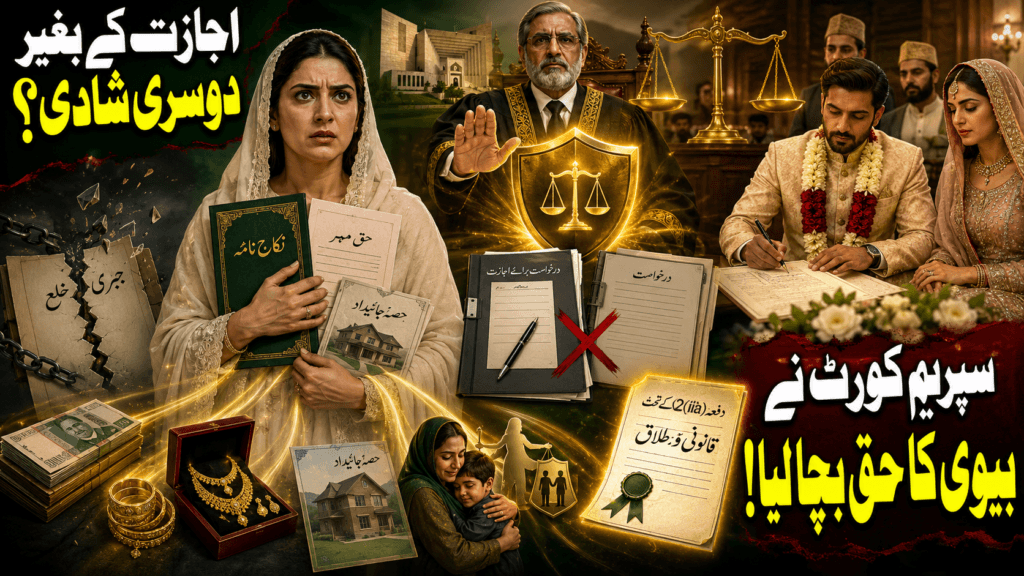
A second marriage can turn an already troubled relationship into a legal and emotional crisis. The first wife may suddenly face uncertainty about her marriage, dower, children, maintenance and future. Families often tell her that a husband can marry again whenever he wishes and that she has no effective remedy.
That is not the complete legal position. Second Marriage Law in Pakistan requires a husband, during the subsistence of an existing marriage, to obtain prior written permission from the Arbitration Council before contracting another marriage. In PLD 2025 Supreme Court 262, the Supreme Court protected a wife who had been pushed towards khula even though she had never asked for it. The Court applied the correct statutory ground, preserved her financial rights and clarified that an unauthorized additional marriage can give the existing wife a right to seek dissolution.
Table of Contents
IRAC: Why Unauthorized Second Marriage Gave Wife Dissolution Rights
| Element | Explanation |
|---|---|
| Issue | Whether the husband’s additional marriage without Arbitration Council permission gave the wife a valid ground for dissolution; whether a court could impose khula without her request; whether cruelty had been proved; and what would happen to dower, dowry, maintenance and visitation. |
| Rule | Section 6 of the Muslim Family Laws Ordinance, 1961 requires prior written permission of the Arbitration Council. Section 2(iia) of the Dissolution of Muslim Marriages Act, 1939 allows a Muslim wife to obtain dissolution when the husband takes an additional wife in contravention of that law. |
| Analysis | The husband married again while appeals were pending. He had neither applied to the Arbitration Council nor obtained its permission. The wife had not asked for khula, and the High Court had no proper evidentiary basis for dissolving the marriage on cruelty. |
| Conclusion | The Supreme Court dissolved the first marriage under section 2(iia), set aside the khula and cruelty findings, cancelled restitution of conjugal rights, and upheld dower, dowry articles, maintenance and visitation. |
Judgment at a Glance: Unauthorized Second Marriage and Wife’s Rights
| Point | Detail |
|---|---|
| Case | Dr. Faryal Maqsood and another v. Khurram Shehzad Durrani and others |
| Citation | PLD 2025 Supreme Court 262 |
| Court | Supreme Court of Pakistan |
| Bench | Syed Mansoor Ali Shah, Jamal Khan Mandokhail and Athar Minallah, JJ. |
| Petitions | Civil Petitions Nos. 308-P and 1388 of 2019 |
| Decision date | 23 October 2024 |
| Marriage date | 10 September 2007 |
| Child | Asadullah Durrani, born 18 December 2008 |
| Separation | 2012 |
| Suit filed | 28 July 2012 |
| Trial Court decree | 29 May 2014 |
| Appellate decision | 29 February 2016 |
| Core violation | Second marriage without applying for or obtaining Arbitration Council permission |
| Final result | Marriage dissolved under section 2(iia); financial and child-related decrees preserved |
The petitions arose from a Peshawar High Court judgment and were decided by a three-member Supreme Court Bench on 23 October 2024.
Editorial Accuracy Note
The reported headnote records the High Court judgment date as 3 April 2019, while the body of the Supreme Court order records it as 4 March 2019. This reported inconsistency should be kept in mind when citing the procedural history of Second Marriage Law in Pakistan.
Why This Judgment Changes the Conversation
Second Marriage Law in Pakistan is often discussed as if the only question is whether the first wife gave consent. The Supreme Court judgment shows that the legal position is wider.
The case involved five connected rights:
- The statutory permission required before an additional marriage.
- The wife’s independent right to seek dissolution.
- Protection against khula being imposed without her choice.
- Protection of dower and dowry rights.
- The need for evidence before cruelty is declared proved.
The decision is not a judgment against marriage itself. It is a judgment against ignoring statutory procedure and then placing the financial consequences on the first wife.
Second Marriage Law in Pakistan: The Marriage, Child and Breakdown
The facts behind Second Marriage Law in Pakistan began with an ordinary family relationship that later reached the Supreme Court.
Dr. Faryal Maqsood and Khurram Shehzad Durrani married on 10 September 2007. Their son, Asadullah Durrani, was born on 18 December 2008. Marital disputes later strained the relationship, and the spouses separated in 2012.
On 28 July 2012, the wife filed a family suit seeking recovery of the dower recorded in the Nikahnama and recovery of dowry articles. She alleged that the husband had orally divorced her.
The husband denied pronouncing divorce. However, he did not deny the dower recorded in the Nikahnama. He claimed that Rs.500,000 and 50 tolas of gold had already been paid and also admitted the house share recorded for the wife. Because he maintained that the marriage still existed, he sought restitution of conjugal rights.
What the Trial Court Decided
The early court record is important for understanding Second Marriage Law in Pakistan because it fixed the parties’ financial and marital claims before the additional marriage occurred.
The Trial Court framed nine issues, including whether the marriage had already ended through oral divorce and whether the husband was entitled to restitution of conjugal rights.
The wife could not prove the alleged oral divorce. On 29 May 2014, the Trial Court partially decreed the suit.
It granted:
- Rs.500,000 as dower;
- possession of the husband’s share in the house, or its market value;
- part of the claimed dowry articles, including 51 tolas of gold;
- maintenance;
- a visitation schedule for the child; and
- restitution of conjugal rights, subject to payment of prompt dower.
The claim for recovery of 50 tolas of gold as dower was dismissed because the evidence showed that this gold had already been delivered to the wife and remained with her.
Second Marriage Law in Pakistan: Do Not Confuse 50 Tolas with 51 Tolas

This distinction is essential.
| Item | Legal character | Court result |
|---|---|---|
| Rs.500,000 | Cash dower payable on demand | Decreed |
| 50 tolas of gold | Dower | Fresh recovery refused because it had already been delivered |
| Share in house | Property forming part of dower | Possession or market value decreed |
| 51 tolas of gold | Part of dowry articles | Included in partial dowry decree |
The figures may look almost identical, but they represented different legal claims. Second Marriage Law in Pakistan cannot be understood correctly without separating dower from dowry articles, bridal gifts and other property.
The Second Marriage Happened During the Appeals
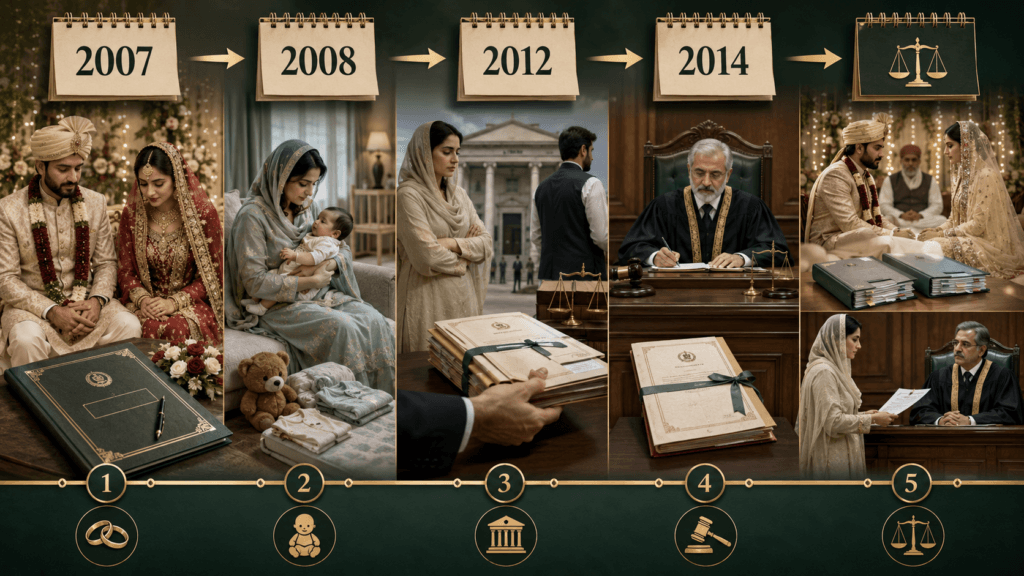
This procedural stage became the turning point under Second Marriage Law in Pakistan.
Both parties challenged the Trial Court decree before the Additional District and Sessions Judge-V, Peshawar.
While those appeals were pending, the husband contracted another marriage. The wife then raised an additional ground: the husband had taken a second wife in violation of section 6 of the Muslim Family Laws Ordinance, 1961, and this gave her a statutory ground for dissolution under section 2(iia) of the Dissolution of Muslim Marriages Act, 1939.
The appellate court considered the new ground but failed to decide it.
Instead, it dissolved the marriage through khula. This decision had a serious financial effect. The court held that the wife was not entitled to claim dower and ordered adjustment of the 50 tolas received as dower against the 51 tolas decreed as dowry.
The wife had never expressly or impliedly asked for khula. She had also never agreed to surrender her dower in exchange for dissolution.
The High Court Replaced One Wrong Ground with Another
The next stage shows why Second Marriage Law in Pakistan must be applied through the correct legal ground.
The husband did not challenge the appellate decree of khula. The wife approached the Peshawar High Court under Article 199 of the Constitution because the wrong label had affected her dower rights.
The High Court set aside the khula finding and restored the dower and dowry decree. However, it dissolved the marriage on the ground of cruelty.
The Supreme Court later held that this approach was also legally defective. The Trial Court had framed a specific issue about mental and physical cruelty, but the wife had failed to discharge the burden of proof on that issue. No fresh evidence was recorded later, and the High Court gave no proper reasons for reversing the factual position.
Second Marriage Law in Pakistan: What Section 6 Requires
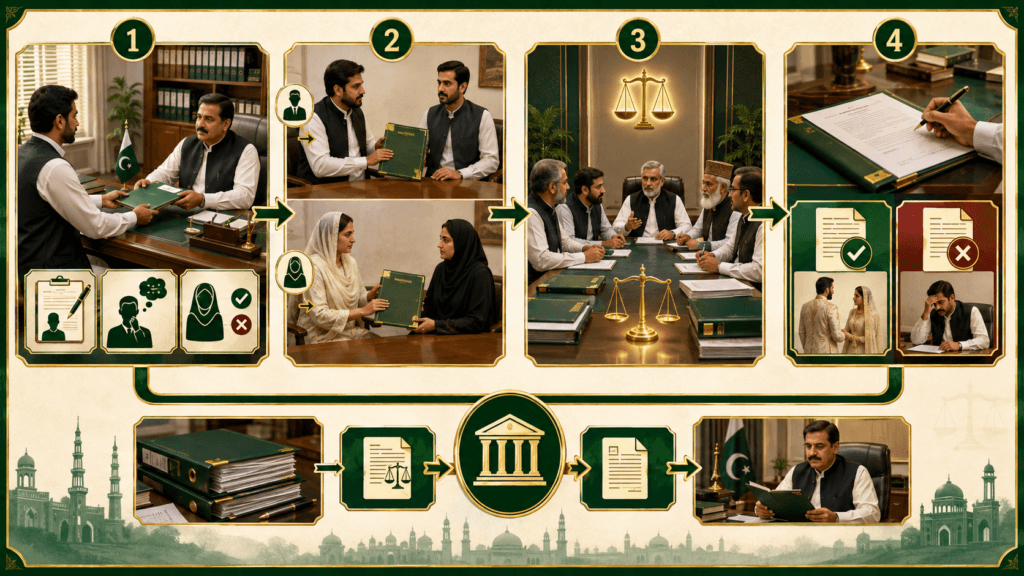
The official Muslim Family Laws Ordinance, 1961 regulates polygamy through section 6. (Pakistan Code)
During the subsistence of an existing marriage, a husband must not contract another marriage without prior written permission of the Arbitration Council.
The legal process is:
- The husband submits an application to the Chairman.
- He states the reasons for the proposed marriage.
- He discloses whether the existing wife or wives have consented.
- The Chairman asks the husband and existing wife or wives to nominate representatives.
- The Arbitration Council examines whether the proposed marriage is necessary and just.
- The Council records reasons for granting or refusing permission.
- An aggrieved party may seek revision before the concerned Collector.
The Supreme Court explained this complete procedure while deciding the case.
Readers needing a complete section-by-section explanation may also read our guide to the Muslim Family Laws Ordinance. The article explains marriage registration, polygamy, talaq, maintenance and dower in simple English. (Qanooni Dastak)
Second Marriage Law in Pakistan: Is the First Wife’s Consent Enough?
No. This is one of the most common misunderstandings in Second Marriage Law in Pakistan.
The husband’s application must disclose whether the existing wife has consented, but the statutory permission is granted or refused by the Arbitration Council.
This means:
- Verbal family approval is not Arbitration Council permission.
- A private agreement is not the same as prior written statutory permission.
- The wife’s consent is relevant to the application.
- The Council must still perform its legal duty and record reasons.
- Permission should be obtained before the proposed marriage.
The Supreme Court case was straightforward on this point. The husband had neither filed an application nor obtained permission.
What Happens If the Husband Marries Again Without Permission?
The consequences under Second Marriage Law in Pakistan are not limited to one remedy.
Under section 6, an unauthorized additional marriage may create serious consequences.
The husband becomes immediately liable to pay the entire dower due to the existing wife or wives, whether prompt or deferred. On complaint and conviction, he may also face imprisonment, a fine, or both under the applicable legal framework.
The wife may separately rely on section 2(iia) of the Dissolution of Muslim Marriages Act, 1939 as a ground for dissolution.
Second Marriage Law in Pakistan therefore creates three separate legal consequences:
- A financial consequence concerning the complete outstanding dower;
- A possible penal consequence after complaint and conviction; and
- A matrimonial consequence giving the existing wife a ground for dissolution.
These remedies should not be mixed together. Dissolution is not the same proceeding as criminal punishment, and payment of dower does not automatically decide every other family claim.
Second Marriage Law in Pakistan: Is the Second Nikah Automatically Void?
This judgment did not declare the second marriage void or cancel the second Nikah.
Its focus was the husband’s violation of section 6 and the resulting rights of the existing wife. The Supreme Court dissolved the first marriage under section 2(iia), preserved the wife’s financial relief and rejected the incorrect grounds used by the lower courts.
Therefore, it would be misleading to say that every second marriage without permission automatically disappears in law.
The violation creates statutory consequences, but the exact relief must be sought before the competent forum. This distinction is essential for an accurate understanding of Second Marriage Law in Pakistan.
Why Section 2(iia) Still Protects the Wife
The continuing force of section 2(iia) is central to Second Marriage Law in Pakistan.
The official Dissolution of Muslim Marriages Act, 1939 lists the grounds on which a Muslim woman may seek dissolution. (Pakistan Code)
Clause 2(iia) covers the situation where the husband takes an additional wife in contravention of the Muslim Family Laws Ordinance, 1961.
The husband’s side argued that this clause had lost legal force because the provision that originally inserted it was later omitted through the Federal Laws (Revision and Declaration) Ordinance, 1981.
The Supreme Court rejected that argument.
The Court explained that the amendment had already become part of the 1939 Act. Later removal of the amending provision did not erase the amendment already inserted into the main statute.
The saving clause in the 1981 Ordinance and section 6-A of the General Clauses Act, 1897 protected its continuation.
The Court described the removal of spent amending provisions as legislative “spring cleaning.” It also held that the contrary view in Syed Rashid Ali Shah v. Mst. Haleema Bibi, PLD 2014 Peshawar 226, was per incuriam because relevant saving provisions had not been considered.
The result was clear: clause 2(iia) remains a valid, effective and enforceable ground for dissolution.
Second Marriage Law in Pakistan: A Court Cannot Force Khula
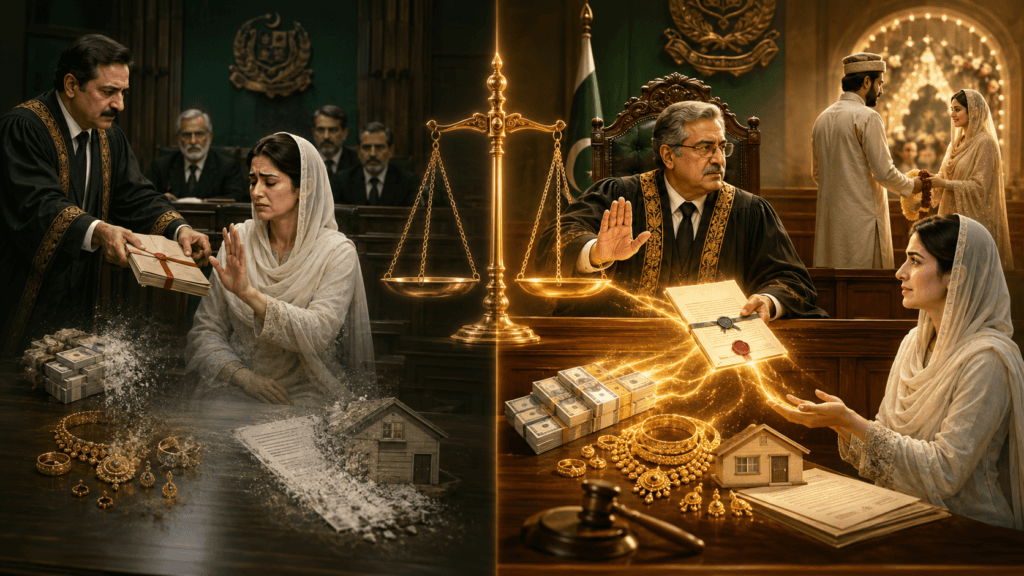
Khula is a right and privilege of the wife. A judicial khula may dissolve a marriage against the husband’s will, but it must arise from the wife’s demand or her express or implied consent.
A court cannot select khula on its own when the wife has not asked for it.
This matters because the legal ground can change the financial result. Treating a statutory dissolution case as khula may expose the wife to surrender or return of dower even though the husband’s own violation created a different ground.
The Supreme Court followed the five-member Bench decision in Mst. Khurshid Bibi v. Baboo Muhammad Amin, PLD 1967 SC 97.
It declined to follow the broader approach attributed to the later two-member decision in Muhammad Arif v. Saima Noreen, 2015 SCMR 804, because the larger Bench precedent had not been considered there.
For a separate explanation of financial consequences in khula cases, read our guide on Khula Law in Pakistan and Dower Return.
A broader discussion of misconduct, responsibility and Haq Mehr is available in Grounds for Khula in Pakistan. (Qanooni Dastak)
Cruelty Is a Valid Ground, but It Must Be Proved
This part of Second Marriage Law in Pakistan also protects both sides from findings based on assumption.
The Supreme Court accepted that cruelty may be physical or mental. Conduct that habitually harms a wife or makes her life miserable may support dissolution.
However, a valid legal ground still requires proper pleadings, evidence and reasons.
In this case:
- Cruelty was a specific issue before the Trial Court.
- The wife did not prove that issue.
- No new evidence was later recorded.
- The High Court was exercising constitutional jurisdiction.
- The High Court did not give adequate reasons for its contrary finding.
The Supreme Court therefore set aside dissolution on the ground of cruelty.
The decision does not weaken genuine cruelty claims. It confirms that courts must decide them on evidence rather than assumption.
Why the Nikahnama Became Decisive
A properly completed Nikahnama can determine the financial outcome under Second Marriage Law in Pakistan.
Second Marriage Law in Pakistan is closely connected with the Nikahnama because an unauthorized marriage may make the whole outstanding dower immediately payable.
The Supreme Court described Nikah as a social contract and treated the Nikahnama as the deed containing its terms. Entries in the Nikahnama carry a strong presumption of truth.
The Court also explained that the document must be read as a whole. A court cannot insert a condition that contradicts its express terms merely because the condition appears reasonable.
The relevant entries were:
- Column 13: Rs.500,000 cash dower payable on demand;
- Column 14: Left blank regarding prompt or deferred nature;
- Column 15: 50 tolas of gold jewellery recorded as present at the time of Nikah;
- Column 16: The husband’s share in a house registered in the wife’s name.
The cash amount was payable on demand. The gold and house share were treated as prompt categories. The husband had not denied these settlements in his written statement.
Second Marriage Law in Pakistan: Dower Is a Legal Right
Dower is a legal obligation. It may consist of cash, gold, property or a combination of assets.
Where the marriage contract does not specify whether dower is prompt or deferred, section 10 of the Muslim Family Laws Ordinance generally treats it as payable on demand.
That is why every couple should read the Nikahnama before signing it. Blank columns, vague property descriptions and missing payment details may create years of litigation.
In this case, the correct legal ground protected the wife from losing the dower relief already supported by the Nikahnama and concurrent findings of the courts.
Why the Case Was Not Sent Back for Another Trial
The Supreme Court used a practical approach to Second Marriage Law in Pakistan because the decisive violation was admitted.
The husband’s counsel argued that the matter should be remanded for further evidence.
The Supreme Court rejected this request because the husband had not applied to the Arbitration Council and had not obtained permission. His counsel also conceded this position after taking instructions.
A remand would therefore have prolonged the case without serving a useful purpose.
This is an important lesson in Second Marriage Law in Pakistan: when the statutory violation is admitted and the legal ground has already been raised and answered, unnecessary remand may only increase delay and expense.
Second Marriage Law in Pakistan: The Supreme Court’s Final Decision

The Supreme Court converted both petitions into appeals and allowed them in the stated terms.
It held that:
- The marriage stood dissolved under section 2(iia) of the Dissolution of Muslim Marriages Act, 1939.
- Dissolution through khula was illegal because the wife had not sought it.
- Dissolution on cruelty was unsustainable because it lacked the required evidentiary basis and reasons.
- Restitution of conjugal rights could not survive.
- The decrees concerning dower, dowry articles, maintenance and visitation remained effective.
The Court corrected the legal basis of dissolution instead of allowing the wife’s rights to depend on an artificial label.
Evidence a Wife Should Preserve
Effective use of Second Marriage Law in Pakistan depends on reliable documents, not rumours alone.
A woman dealing with an unauthorized additional marriage should preserve whatever lawful evidence is available:
- Original or certified copy of her Nikahnama;
- Husband’s second Nikahnama or certified marriage-registration record;
- Union Council or Arbitration Council record;
- Proof that no permission application was filed;
- Notices received from the Chairman, if any;
- Admissions in messages, pleadings or court statements;
- Documents relating to prompt and deferred dower;
- Proof of a house, gold or other property recorded as dower;
- Dowry list and supporting receipts;
- Maintenance orders and payment record;
- Birth certificates or B-Forms of children;
- Copies of earlier suits, appeals and court orders.
A certified public record is usually stronger than family rumours or social-media photographs alone.
Practical Steps for the Existing Wife
A person seeking relief under Second Marriage Law in Pakistan should separate verified facts from family allegations.
If a husband has contracted another marriage, the wife should first verify the facts through reliable documents.
She may then obtain legal advice on:
- Inspection or certified copies of marriage records;
- Verification of Arbitration Council permission;
- Recovery of full prompt and deferred dower;
- A complaint for the statutory violation, where maintainable;
- Dissolution under section 2(iia);
- Maintenance for herself or the children;
- Recovery of dowry articles or personal property;
- Custody and visitation arrangements;
- Protection of property recorded in the Nikahnama; and
- Preservation of admissions and official records.
Where the dispute also involves talaq, Union Council notice and the ninety-day process, readers may study our separate guide on Divorce Procedure in Pakistan. (Qanooni Dastak)
Seven Powerful Lessons from Second Marriage Law in Pakistan
- Prior written Arbitration Council permission is the central statutory requirement.
- The wife’s consent and the Council’s permission are legally distinct.
- An unauthorized second marriage can create a ground for dissolution.
- A court cannot impose khula without the wife’s request or consent.
- Cruelty must be proved through evidence and supported by reasons.
- The correct legal ground can protect dower and other financial rights.
- A second marriage without permission is not automatically declared void by this judgment.
Frequently Asked Questions About Second Marriage Law in Pakistan
1. What is Second Marriage Law in Pakistan?
Second Marriage Law in Pakistan mainly refers to section 6 of the Muslim Family Laws Ordinance, 1961. It requires prior written permission from the Arbitration Council before a husband contracts another marriage during an existing marriage.
2. Does a husband need the first wife’s consent?
The application must state whether the existing wife or wives have consented. However, the statutory permission is issued by the Arbitration Council. Consent and legal permission are related but different.
3. Can a husband marry again without Arbitration Council permission?
Doing so contravenes section 6 and may trigger financial, penal and matrimonial consequences.
4. Does an unauthorized second marriage become automatically void?
PLD 2025 Supreme Court 262 did not declare the second marriage void. It enforced the consequences of violating section 6 and dissolved the first marriage on the wife’s statutory ground.
5. Can the first wife obtain dissolution?
Yes. Section 2(iia) allows a Muslim wife to seek dissolution where the husband takes an additional wife in contravention of the Muslim Family Laws Ordinance, 1961.
6. Must the husband pay the whole dower?
A husband who contracts another marriage in violation of section 6 becomes immediately liable for the entire prompt and deferred dower due to the existing wife or wives.
7. Can a Family Court impose khula without the wife asking?
No. The Supreme Court held that judicial khula cannot be imposed when the wife has neither requested nor expressly or impliedly consented to it.
8. Can cruelty still be used as a ground for dissolution?
Yes. Cruelty may be mental or physical, but it must be established through evidence and supported by a reasoned finding.
9. Why did the Supreme Court protect the wife’s dower?
The lower appellate court had wrongly used khula, which affected her dower. The Supreme Court applied the correct statutory ground and upheld the existing decrees concerning dower and other relief.
10. What was the final result in PLD 2025 Supreme Court 262?
The marriage was dissolved under section 2(iia). Khula, cruelty and restitution findings were set aside, while dower, dowry articles, maintenance and visitation remained protected.
Conclusion: Second Marriage Law in Pakistan Does Not Leave a Wife Powerless
Second Marriage Law in Pakistan does not treat an additional marriage as a private decision without legal consequences.
A husband must follow the statutory permission process. If he ignores it, the existing wife may claim the full outstanding dower, pursue the available legal consequences and seek dissolution under section 2(iia).
PLD 2025 Supreme Court 262 also protects a deeper right: the wife must not be forced into khula when she relies on a different statutory ground. Courts must identify the real legal violation, respect the Nikahnama and preserve financial rights according to law.
Disclaimer
This article is for legal awareness and educational purposes only. It is based primarily on PLD 2025 Supreme Court 262 and the cited statutory provisions. It is not a substitute for legal advice.
Second Marriage Law in Pakistan may also interact with provincial procedure. Available relief can depend on the province, documents, pleadings, evidence and facts of each case.