
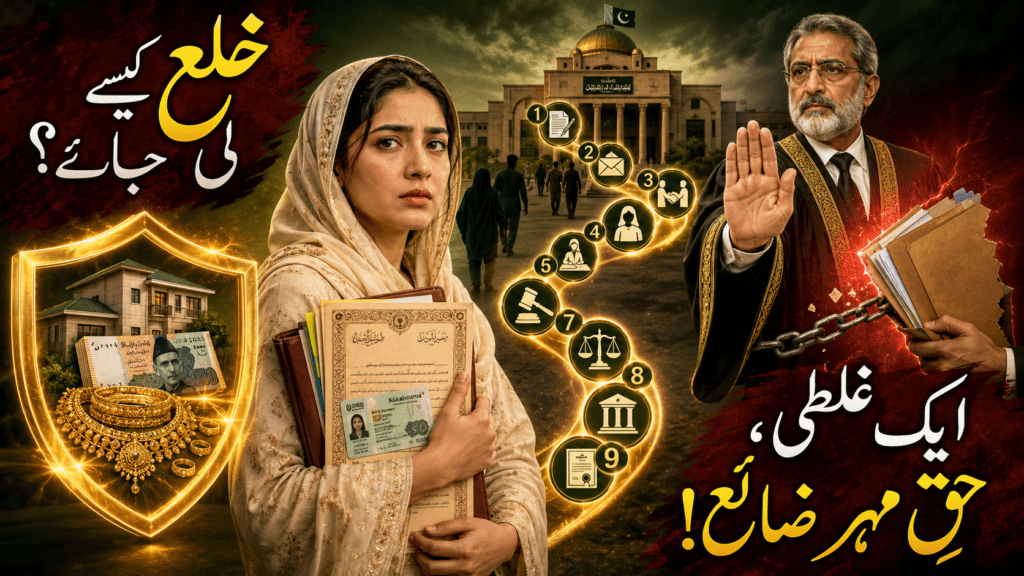
Ending a marriage is never a small decision. A woman may be facing cruelty, silence, financial neglect, family pressure, or a relationship that has become impossible to continue. At that stage, one wrong legal label can affect her dower, maintenance, property, and future marital status.
Khula Process in Pakistan is not simply about filing one paper and receiving a decree. A wife must understand whether she actually needs khula or dissolution on a statutory ground, which Family Court has jurisdiction, what documents should be preserved, how the husband will be served, what happens during reconciliation, and what steps follow the decree.
This guide explains the complete court route in simple English. It also examines the landmark Supreme Court judgment in Dr. Seema Hanif Khan v. Waqas Khan, reported as PLD 2026 Supreme Court 91. The judgment explains why a court must respect the wife’s consent and cannot silently convert her statutory dissolution claim into khula.
Table of Contents
Khula Process in Pakistan at a Glance
| Question | Simple answer |
|---|---|
| Where is the case filed? | Before the Family Court having territorial jurisdiction |
| Can the wife file where she ordinarily resides? | Generally, yes, in a suit for dissolution or dower |
| Is the husband’s agreement essential? | His refusal does not by itself defeat a judicial khula claim |
| Is the wife’s consent essential? | Yes. Khula cannot be imposed upon her |
| What documents are usually needed? | CNIC, Nikahnama, correct address, dower details and relevant supporting records |
| What if the husband does not appear? | The court may proceed ex parte after lawful service |
| What happens to dower? | It depends on the remedy, provincial law and facts of the case |
| What happens after the decree? | The decree is communicated to the concerned Chairman or Arbitration Council |
| How long can the case take? | It depends on service, court workload, evidence and connected claims |
The Family Courts Rules recognize the wife’s ordinary residence as an additional basis of territorial jurisdiction in suits for dissolution of marriage or dower. The applicable Family Courts Act then regulates filing, service, reconciliation, evidence, decree, and post-decree communication.
The First Legal Decision Can Save—or Cost—a Wife Her Rights

Before starting Khula Process in Pakistan, the wife and her lawyer should identify the correct remedy. This early assessment is the foundation of Khula Process in Pakistan.
“Khula” and “dissolution of marriage on statutory grounds” may both end a marriage, but they are not the same cause of action.
What Is Judicial Khula?
Khula is based on the wife’s voluntary and informed decision that she cannot continue the marital relationship.
The Family Court normally attempts reconciliation. If reconciliation fails and the wife remains clear that she cannot continue the marriage, the court may dissolve the marriage through khula under the applicable legal framework.
Detailed proof of physical cruelty is not a universal requirement for every pure khula claim. However, the financial consequences concerning dower must still be decided under the applicable law and facts.
What Is Statutory Dissolution?
Statutory dissolution is based on one or more grounds recognized by the Dissolution of Muslim Marriages Act, 1939.
These grounds include, subject to their legal requirements:
- Disappearance of the husband;
- Failure to provide maintenance;
- Imprisonment;
- Failure to perform marital obligations;
- Impotence;
- Certain illnesses;
- Cruelty;
- An additional marriage contracted in violation of law; and
- Other grounds recognized under Muslim law.
The Supreme Court explained that section 2 of the 1939 Act gives a Muslim woman an independent right to obtain dissolution when she establishes one or more statutory grounds.
Khula should not be confused with dissolution on a statutory ground. The official Dissolution of Muslim Marriages Act, 1939 identifies circumstances in which a Muslim wife may seek dissolution, including non-maintenance, cruelty and an additional marriage contracted in violation of law. Readers may also study our judgment-based guide on Grounds for Khula in Pakistan to understand how the reason for ending a marriage may affect the legal remedy, evidence and Haq Mehr.
Why Does the Difference Matter?
The distinction can have serious financial consequences.
In PLD 2026 Supreme Court 91, the wife sought dissolution on the grounds of cruelty, non-maintenance and unlawful second marriage. The Family Court instead gave her khula without her asking for it. It then required her to return or surrender valuable dower.
The Supreme Court held that this approach confused two separate remedies and unlawfully affected the wife’s financial rights.
IRAC: The Rule Every Family Court Must Remember
| IRAC Element | Explanation |
|---|---|
| Issue | Could a Family Court convert a wife’s suit for statutory dissolution into khula without recording her consent? What standard should govern proof of cruelty and other grounds? |
| Rule | Khula is a separate remedy based on the wife’s consent and autonomy. Statutory grounds are assessed on the civil standard of balance of probabilities |
| Analysis | The lower courts demanded excessive documentary proof, ignored surrounding circumstances and overlooked the husband’s admitted unlawful second marriage |
| Conclusion | The Supreme Court set aside the forced khula and dissolved the marriage because the husband had contracted another marriage in violation of law |
The Supreme Court also restored the wife’s dower and maintenance because those rights had been wrongly affected by the imposed khula.
Judgment at a Glance: PLD 2026 Supreme Court 91
| Point | Details |
|---|---|
| Case | Dr. Seema Hanif Khan v. Waqas Khan and others |
| Court | Supreme Court of Pakistan |
| Bench | Justice Ayesha A. Malik and Justice Naeem Akhter Afghan |
| Decision date | 19 September 2025 |
| Nikah | 31 May 2015 |
| Rukhsati | 9 April 2016 |
| Suit filed | 4 July 2017 |
| Dower | 200-square-yard plot, 30 tolas gold and Rs.500,000 |
| Agreed maintenance | Rs.10,000 per month under clause 17 of the Nikahnama |
| Family Court decision | Khula granted on 22 July 2019 without the wife requesting it |
| Supreme Court result | Forced khula set aside; marriage dissolved on unlawful second marriage; dower and maintenance protected |
The judgment records the marriage dates, dower, agreed maintenance, filing of the suit and the decisions of the courts below.
Khula Process in Pakistan: 9 Practical Court Steps
Step 1: Choose the Right Remedy Before Filing
The safest starting point in Khula Process in Pakistan is not merely saying, “I want a divorce.” The real question is:
Which legal route matches the facts of the marriage?
A Muslim wife may have one or more possible routes:
- Judicial khula because she genuinely cannot continue the marriage;
- Dissolution under the Dissolution of Muslim Marriages Act, 1939;
- Talaq-e-tafweez where the right of divorce was delegated to her in the Nikahnama; or
- Mubarat or mutual dissolution where both spouses agree to end the marriage.
Khula Process in Pakistan becomes risky when every case is automatically labelled as khula.
A wife alleging cruelty, long non-maintenance or an unauthorized second marriage should not lose a stronger statutory claim merely because “khula” is the more commonly used word.
The plaint should clearly state:
- The primary relief;
- Any lawful alternative relief;
- The legal grounds relied upon;
- The dower position;
- Maintenance claims;
- Dowry and personal-property claims; and
- Claims relating to minor children.
Poor drafting at the first stage can lead to years of unnecessary litigation.
Step 2: Identify the Correct Family Court
Khula Process in Pakistan requires filing before a Family Court with territorial jurisdiction.
Under the Family Courts Rules, relevant connecting factors may include:
- The place where the cause of action arose;
- The place where the parties reside;
- The place where they last resided together; and
- In a dissolution or dower suit, the place where the wife ordinarily resides.
The wife’s ordinary residence is therefore particularly important where she has left the matrimonial home and returned to her parents or another genuine residence. ([KP Code][1])
This stage of Khula Process in Pakistan becomes more complicated when:
- The husband lives in another city;
- The husband is living abroad;
- The marriage was solemnized in a different district;
- The wife recently changed her residence; or
- The husband’s exact address is unknown.
Before filing, confirm:
- The relevant district;
- The wife’s ordinary residence;
- The last shared residence;
- The husband’s present and permanent addresses; and
- Any local rules concerning distribution of family cases.
A false address should never be used to prevent the husband from receiving notice. It can delay the case and may later support an attempt to set aside an ex parte decree.
Step 3: Collect the Right Documents Before Filing
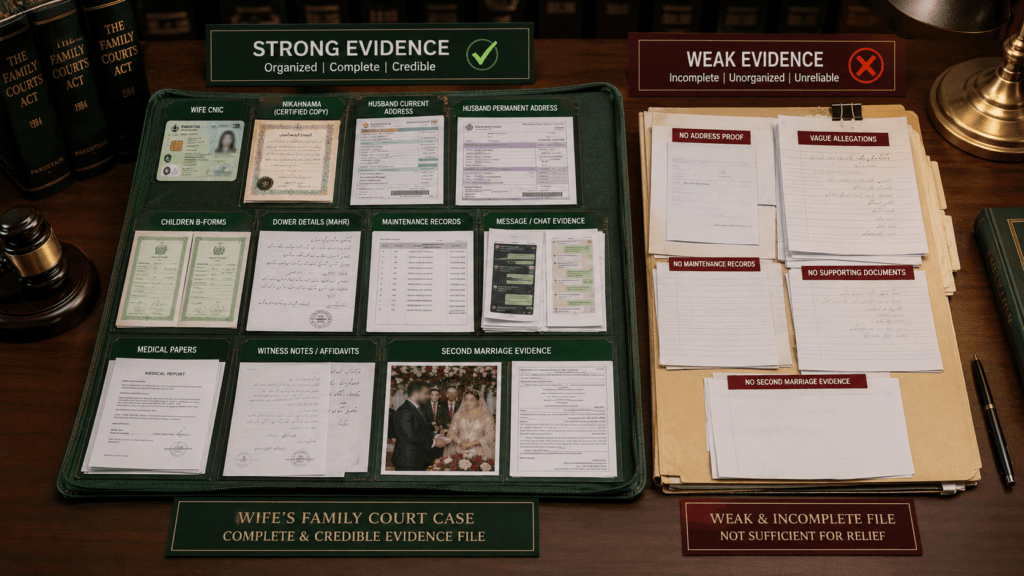
A well-prepared Khula Process in Pakistan file should usually contain:
- Wife’s CNIC copy;
- Original Nikahnama or certified copy;
- Marriage registration details;
- Husband’s present and permanent addresses;
- Husband’s available contact details;
- Details of prompt and deferred dower;
- Proof showing whether dower was paid;
- Children’s birth certificates or B-Forms;
- Maintenance records;
- Bank statements or payment history;
- List of dowry articles;
- Proof of the wife’s personal belongings;
- Messages, complaints or photographs, where relevant;
- Medical material, where available;
- Witness details;
- Evidence of a second marriage, where relevant;
- Record showing whether Arbitration Council permission existed; and
- Copies of earlier family, maintenance, criminal or domestic-violence proceedings.
Not every document is compulsory in every case.
A woman should not assume that Khula Process in Pakistan is impossible merely because she has no FIR or medical report. However, a clear and consistent account supported by available records is always stronger than vague allegations.
Where statutory cruelty is claimed, useful supporting material may include:
- A dated incident chronology;
- WhatsApp messages;
- Voice notes lawfully available to the claimant;
- Police applications;
- Medical records;
- Witnesses who observed injuries or surrounding events;
- Proof of expulsion from the home;
- Maintenance demands; and
- Evidence of repeated neglect or humiliation.
Step 4: Draft and File a Complete Family Suit
For Khula Process in Pakistan, the plaint should clearly identify:
- The wife and husband;
- The date and place of marriage;
- The Nikahnama;
- The dower terms;
- The date of rukhsati, where relevant;
- Details of children;
- The last matrimonial residence;
- When and why the parties separated;
- Attempts at reconciliation;
- The legal basis of dissolution;
- Previous litigation; and
- Every relief being claimed.
Depending on the facts and the applicable law, the suit may include claims concerning:
- Khula or statutory dissolution;
- Unpaid dower;
- Past maintenance;
- Current maintenance;
- Iddat maintenance;
- Dowry articles;
- Personal property and belongings;
- Child maintenance; and
- Appropriate custody or visitation relief.
Khula Process in Pakistan should deal with connected rights carefully rather than assuming that a decree ending the marriage will automatically decide every financial or child-related issue.
After submission, the court office normally checks the filing, assigns a case number and places the matter before the relevant Family Court.
The exact requirements for:
- Court fee;
- Copies;
- Affidavits;
- Lists of documents;
- Lists of witnesses; and
- Filing forms
may differ according to the province, district and applicable amendments.
Step 5: The Husband Must Be Lawfully Served
After Khula Process in Pakistan is formally instituted, the Family Court issues summons and sends the husband a copy of the plaint.
Service is not an empty formality. It gives the husband notice and a lawful opportunity to respond.
Depending on the applicable law, available modes may include:
- Court process server;
- Registered post;
- Courier service;
- Other approved modes; and
- Substituted service where ordinary service fails and the court is legally satisfied.
Newspaper publication should not automatically be treated as the first method in every case. It may become relevant where ordinary methods fail or the court orders substituted service.
A correct address makes Khula Process in Pakistan faster and legally safer.
Where the husband deliberately avoids service, the court examines the service reports and may take the next step permitted by law. However, where the address was false or incomplete, the resulting decree may face a stronger challenge.
Step 6: Written Statement or Ex Parte Proceedings

During Khula Process in Pakistan, if the husband appears, he may:
- File a written statement;
- Admit or deny the allegations;
- Produce relevant documents;
- Identify witnesses;
- Contest dower or maintenance;
- Raise a jurisdiction objection; and
- Make a connected claim permitted by family law.
A husband may claim restitution of conjugal rights where legally available, but that claim does not automatically defeat the wife’s right to seek khula or statutory dissolution.
If the husband does not appear despite proper service, the Family Court may proceed ex parte.
Ex parte means that the matter proceeds without the husband’s participation. It does not mean that the court may ignore:
- Proof of service;
- Jurisdiction;
- The wife’s statement;
- The correct legal remedy; or
- The evidence necessary for disputed connected claims.
The applicable Family Courts Act also provides a legal mechanism through which a defendant may apply to set aside an ex parte decree where summonses were not duly served or sufficient cause prevented appearance before the court. Readers can review the official Family Courts Act, 1964 on Pakistan Code for the statutory framework. This does not make every ex parte decree invalid; the applicant must satisfy the court that a legally recognised ground exists.
Step 7: The Court Attempts Reconciliation
Reconciliation is a central stage of Khula Process in Pakistan.
The court examines whether the marriage can be saved through a voluntary and lawful settlement. Reconciliation is not meant to:
- Force a woman back into an unsafe relationship;
- Pressure her to surrender legal rights;
- Excuse proven misconduct; or
- Keep the case pending through endless adjournments.
If both parties voluntarily reach a lawful settlement, the court may proceed according to that settlement.
If reconciliation fails, the next step depends on the remedy claimed.
In a Pure Khula Claim
The court should confirm that:
- The wife is making a voluntary choice;
- She understands what khula means;
- Her decision is settled;
- She understands the possible dower consequences; and
- The claim is not being imposed upon her.
In a Statutory Dissolution Claim
The court must decide the statutory grounds pleaded by the wife. It cannot avoid deciding those grounds merely by giving her khula.
Punjab’s official summary of the Family Courts framework confirms that failed reconciliation leads to the court deciding dissolution under section 10, subject to the applicable provisions concerning khula and dower. (Punjab Citizen Services Portal)
Step 8: Record the Wife’s Statement and Examine the Evidence

In a straightforward Khula Process in Pakistan claim, the wife’s clear statement and failed reconciliation may be decisive.
Where she also seeks relief based on:
- Cruelty;
- Non-maintenance;
- Unauthorized second marriage;
- Dower;
- Dowry articles;
- Personal belongings; or
- Other disputed facts,
the court may need to examine evidence.
What Is the Correct Standard of Proof?
Family disputes are civil proceedings. The Supreme Court held that statutory grounds under the Dissolution of Muslim Marriages Act must be examined on the balance of probabilities.
This means the court asks:
Which version appears more likely to be true after examining the complete evidence and surrounding circumstances?
The wife is not required to prove marital cruelty beyond reasonable doubt as if she were prosecuting a criminal case.
Is an FIR or Medical Report Always Essential?
No.
The Supreme Court explained that a woman’s entitlement does not depend on producing:
- An injury certificate for every incident;
- A police report for every slap;
- A medical report for every episode of trauma; or
- An eyewitness who was present inside the marital home.
However, this does not mean evidence is unimportant. The court should assess:
- Her testimony;
- Its consistency;
- Surrounding circumstances;
- Supporting witnesses;
- Available documents;
- The husband’s response; and
- The impact of the conduct on her life.
The Supreme Court criticized the lower courts for demanding documentary proof as a rigid condition and for ignoring mental and emotional mistreatment.
Step 9: Decree, Dower Decision and Post-Decree Formalities
At the decree stage of Khula Process in Pakistan, the court’s order should clearly state:
- The legal basis of dissolution;
- Whether the decree is based on khula or a statutory ground;
- The treatment of paid dower;
- The treatment of unpaid dower;
- Any maintenance awarded;
- Orders concerning dowry articles;
- Orders concerning personal belongings;
- Connected child-related relief; and
- Other enforceable directions.
Does Every Wife Return the Same Amount of Dower?
No.
The dower result may depend on:
- Whether the decree is based on khula or statutory dissolution;
- The applicable provincial law;
- Later judicial decisions;
- Whether the dower was prompt or deferred;
- Whether it was actually paid;
- The contents of the Nikahnama; and
- The evidence before the court.
This is why Khula Process in Pakistan should never be explained through a universal statement that every wife must return all dower or that every wife keeps it.
What Happens After the Court Decree?
After a Family Court dissolves a Muslim marriage, the certified decree is sent to the concerned Chairman or Arbitration Council under the applicable provincial law.
In Punjab, section 21-B requires the Family Court to send a certified copy to the concerned Chairman within the prescribed period, after which the Chairman proceeds under the Muslim Family Laws Ordinance, 1961. (Punjab Citizen Services Portal)
The wife should:
- Obtain certified copies of the decree;
- Confirm that the decree was sent to the correct council;
- Verify the date on which it was received;
- Attend or respond to council proceedings where required;
- Complete the statutory waiting process;
- Obtain the dissolution certificate; and
- Preserve the decree and certificate for future official use.
Khula Process in Pakistan does not end merely because the wife has received a photograph of the court order from her lawyer.
Can a Husband Stop Khula by Refusing Consent?
In Khula Process in Pakistan, a husband can:
- Appear in court;
- File a defence;
- Contest financial claims;
- Challenge jurisdiction;
- Participate in reconciliation; and
- Present relevant evidence.
However, his refusal alone does not give him an unlimited veto over a judicial khula claim.
The Family Court must still:
- Possess jurisdiction;
- Serve the husband lawfully;
- Give him an opportunity to respond;
- Attempt reconciliation;
- Record the wife’s voluntary position; and
- Pass a lawful and reasoned order.
Khula Process in Pakistan protects both sides through notice and hearing. It does not mean that a marriage must continue permanently because one spouse refuses to accept its breakdown.
How Long Does Khula Process in Pakistan Take?
The Family Courts Act contains an expeditious framework and refers to a six-month target for disposal of family cases. That is a statutory target, not a guaranteed completion date for every dispute. (Pakistan Code)
The actual duration may be affected by:
- Difficulty serving the husband;
- A wrong or foreign address;
- Court workload;
- Repeated adjournments;
- Contested dower;
- Property disputes;
- Evidence concerning cruelty;
- Maintenance claims;
- Dowry claims;
- Ex parte proceedings;
- An application to set aside an ex parte decree; and
- Delay in post-decree council proceedings.
A simple, properly served and uncontested matter may move faster than a case involving several financial and factual disputes.
A responsible lawyer or website should therefore not promise that every case will end within seven, ten or fifteen days.
What Happens to Haq Mehr After Khula?
Dower is one of the most misunderstood parts of Khula Process in Pakistan.
There is no safe nationwide answer that:
- Every wife must return the entire dower;
- Every wife must surrender a fixed percentage; or
- Every wife automatically keeps everything.
The court must first identify the legal basis of dissolution.
Where the Wife Voluntarily Seeks Khula
The court considers:
- Applicable provincial provisions;
- Whether dower was paid;
- Whether it was prompt or deferred;
- The Nikahnama;
- Relevant judgments; and
- The facts proved in the case.
Where the Wife Proves a Statutory Ground
A wife should not automatically be treated as if she voluntarily purchased her release through khula.
That was the central injustice corrected in PLD 2026 Supreme Court 91.
The wife’s dower included:
- A 200-square-yard plot;
- 30 tolas of gold; and
- Rs.500,000.
The Supreme Court held that she was not required to return those benefits because the marriage was dissolved on the husband’s unlawful second marriage rather than imposed khula.
Does Khula Cancel Child Maintenance or Custody Rights?
Khula Process in Pakistan does not automatically transfer custody to the father or end the child’s right to maintenance merely because the mother obtains khula.
The dissolution dispute and the child’s independent rights should be treated separately.
A mother should clearly plead:
- Child maintenance;
- Educational expenses;
- Medical expenses;
- Interim maintenance;
- Custody, where required; and
- A workable visitation arrangement.
In custody matters, the controlling consideration is the welfare of the child, not merely the competing claim of either parent. (Supreme Court of Pakistan)
Where children are involved, Khula Process in Pakistan should be planned as a complete family-law strategy rather than a single request to end the marriage.
Supreme Court Case Study: When a Wrong Khula Took Away a Wife’s Rights
The Supreme Court case gives Khula Process in Pakistan an important rights-based direction.
Dr. Seema Hanif Khan married Waqas Khan on 31 May 2015. The Nikahnama recorded:
- A plot;
- 30 tolas of gold;
- Rs.500,000 as dower; and
- Rs.10,000 monthly maintenance.
Rukhsati took place on 9 April 2016.
What Cruelty Did the Wife Allege?
The wife’s evidence described:
- The husband returning home very late;
- Male servants freely entering areas where she lived;
- Fear and distress inside the in-laws’ home;
- Indifference when she complained;
- Verbal and emotional abuse;
- Being thrown near pet dogs;
- Visible bruising around her lip;
- Lack of adequate food and maintenance;
- Her number being blocked;
- The husband remaining away until late at night; and
- Her removal from the house under police supervision.
She produced witnesses and referred to a police report dated 29 July 2016.
What Did the Husband Say?
The husband denied cruelty and portrayed the wife as:
- Disobedient;
- Career-oriented;
- Free-minded;
- Interested in education abroad; and
- Unwilling to perform marital obligations.
The Supreme Court found that the husband’s witnesses did not properly corroborate his claim that he had behaved well or that the wife was responsible for the marital breakdown.
The Unauthorized Second Marriage Changed the Case
The husband contracted another marriage on 29 April 2017 while his first marriage was still subsisting.
He had not obtained:
- The first wife’s consent; or
- Permission from the Arbitration Council.
The husband admitted contracting the second marriage. No lawful permission was produced.
The Supreme Court held that this violation attracted section 2(ii-a) of the Dissolution of Muslim Marriages Act, 1939. The unlawful additional marriage was independently sufficient for dissolution.
How Did the Family Court Go Wrong?
The wife filed her dissolution suit on 4 July 2017.
Instead of deciding her pleaded grounds, the Family Court granted khula on 22 July 2019.
It then:
- Directed her to return the gold;
- Directed her to return the plot;
- Treated Rs.500,000 as surrendered dower; and
- Limited maintenance to the iddat period.
Her appeal was dismissed on 12 October 2020. Her constitutional petition was dismissed by the Peshawar High Court on 27 May 2024.
Why the Supreme Court Rejected Forced Khula
The Supreme Court held that khula is a distinct cause of action rooted in the wife’s consent and autonomy.
A court cannot replace a statutory dissolution claim with khula merely because the wife no longer wishes to live with her husband.
The Court emphasized that:
- The wife’s consent must be recorded;
- She must understand the consequences;
- Her unwillingness to live with the husband is not automatic consent to khula;
- Filing a dissolution suit does not itself amount to requesting khula; and
- A court cannot override her choice and remove statutory protections.
The ruling gives Khula Process in Pakistan a vital safeguard: a court must listen to the legal relief the woman actually seeks.
Cruelty Does Not Require a Witness Inside the Bedroom
The lower courts expected medical or documentary proof and gave little weight to the wife’s evidence because her witnesses had not personally seen every act of violence.
The Supreme Court rejected that rigid approach.
It explained that cruelty may be:
- Physical;
- Mental;
- Emotional;
- Verbal;
- Environmental;
- Intentional;
- Unintentional;
- A single severe event; or
- A continuing pattern of conduct.
The Supreme Court recognized that domestic abuse often happens privately and may not have an independent eyewitness.
Khula Process in Pakistan should therefore not be turned into a criminal trial requiring proof beyond reasonable doubt.
The wife’s testimony and surrounding circumstances must be assessed on the balance of probabilities.
A Wife’s Career Is Not Legal Disobedience
The lower courts criticized the wife for wanting to pursue her career or education abroad.
The Supreme Court held that a wife’s desire to continue her education or career is an exercise of personal autonomy. It is not automatically misconduct or disobedience.
The Court also criticized language that described women as:
- Disobedient;
- Self-deserting;
- Responsible for compelling a husband to remarry; or
- Entitled to maintenance only if they remained obedient.
The Court held that such expressions can undermine dignity, equality and non-discrimination.
Final Relief: Dower, Property and Maintenance Restored

The Supreme Court converted the petition into an appeal and allowed it.
It set aside the decisions of the:
- Family Court;
- Appellate Court; and
- Peshawar High Court
to the extent of khula, dower and maintenance.
The marriage was dissolved because the husband had contracted another marriage in violation of law.
The wife was allowed to keep:
- The plot;
- 30 tolas of gold;
- Rs.500,000; and
- Maintenance of Rs.10,000 per month for the period during which the marriage remained legally subsisting.
The result shows why Khula Process in Pakistan must begin with accurate pleading and the correct legal remedy.
Common Mistakes That Can Damage a Khula Case
Mistake 1: Calling Every Case “Khula”
This may hide stronger statutory grounds and affect dower.
The plaint should distinguish voluntary khula from:
- Cruelty;
- Statutory non-maintenance;
- Unlawful second marriage;
- Desertion-related facts; and
- Other recognized grounds.
Mistake 2: Giving an Incomplete Address
Bad service causes delay and increases the risk of a later ex parte challenge.
Mistake 3: Ignoring the Nikahnama
The Nikahnama may contain:
- Prompt dower;
- Deferred dower;
- Property as dower;
- Delegated divorce;
- Monthly maintenance;
- Special conditions; and
- Other enforceable promises.
A readable original or certified copy should be obtained.
Mistake 4: Leaving Financial Claims for Later
Where legally appropriate, the wife should clearly claim:
- Unpaid dower;
- Maintenance;
- Dowry articles;
- Personal property;
- Child maintenance; and
- Other connected relief.
Mistake 5: Making Vague Allegations
“Cruel husband” is weaker than a dated and specific account explaining:
- What happened;
- When it happened;
- Where it happened;
- Who knew about it;
- What evidence exists; and
- How it affected the wife.
Mistake 6: Expecting a Guaranteed Timeline
Khula Process in Pakistan may be completed quickly in a simple matter, but no responsible guide can promise the same number of days for every case.
Mistake 7: Forgetting the Post-Decree Process
A court decree must be followed through the concerned council process. The final certificate should be obtained and preserved.
Practical Checklist Before Filing
- Read every relevant column of the Nikahnama.
- Decide whether the main remedy is khula or statutory dissolution.
- Check whether talaq-e-tafweez was delegated.
- Confirm the correct Family Court.
- Establish the wife’s ordinary residence.
- Obtain a certified Nikahnama if the original is unavailable.
- Prepare the husband’s correct addresses.
- Write a dated chronology of events.
- List paid and unpaid dower separately.
- Preserve maintenance records.
- Preserve evidence of cruelty where available.
- Obtain evidence of a second marriage where relevant.
- List dowry articles and personal belongings.
- Collect children’s documents.
- Disclose connected proceedings.
- Ask for clearly drafted primary and alternative relief.
- Keep copies of every document filed.
- Track the case after the decree reaches the council.
- Obtain the final dissolution certificate.
- Preserve the decree and certificate permanently.
Conclusion: End the Marriage Without Losing Legal Protection
Khula Process in Pakistan gives a Muslim wife a judicial route when married life can no longer continue. However, the strength of the process depends on:
- The correct legal remedy;
- Proper jurisdiction;
- Lawful service;
- Clear consent;
- Accurate pleadings;
- Supporting evidence;
- Correct treatment of dower; and
- Completion of post-decree formalities.
PLD 2026 Supreme Court 91 carries a powerful warning. Ending a marriage is not enough if the court uses the wrong legal basis and takes away the wife’s dower or maintenance.
A Family Court must respect:
- The wife’s words;
- Her consent;
- Her evidence;
- Her dignity;
- Her autonomy; and
- The remedy she actually invokes.
A well-prepared Khula Process in Pakistan claim should not merely ask:
“How quickly can I get a decree?”
It should also ask:
“Which legal and financial rights must remain protected when the marriage ends?”
That is the real purpose of Khula Process in Pakistan.
Frequently Asked Questions
What is Khula Process in Pakistan?
Khula Process in Pakistan is the judicial route through which a Muslim wife requests a Family Court to dissolve her marriage through khula. It normally involves filing the suit, service on the husband, reconciliation, recording the wife’s statement, passing the decree and completing post-decree formalities.
Can a wife obtain khula without her husband’s consent?
The husband’s refusal does not automatically stop judicial khula. The court must serve him, give him an opportunity to respond, attempt reconciliation and decide the wife’s voluntary request according to law.
Can the court grant khula when the wife asked for statutory dissolution?
The court cannot impose khula without the wife’s informed and voluntary consent. The Supreme Court has held that khula is a separate remedy and cannot replace a claim based on cruelty, non-maintenance or unlawful second marriage.
Which Family Court can hear a khula case?
Jurisdiction depends on the applicable rules and facts. In a dissolution or dower suit, the court within whose territorial limits the wife ordinarily resides may generally have jurisdiction.
Which documents are required?
Common documents include:
Wife’s CNIC;
Nikahnama or certified copy;
Husband’s correct address;
Dower details;
Children’s documents;
Maintenance records; and
Evidence supporting any additional statutory or financial claim.
What happens if the husband does not attend court?
If the husband has been lawfully served and still does not appear, the Family Court may proceed ex parte. The court must still confirm jurisdiction, service and the legal basis of the wife’s claim.
How long does Khula Process in Pakistan take?
The law contains a six-month disposal target, but actual time depends on service, court workload, evidence, connected claims, adjournments and post-decree proceedings.
Must the wife return the complete Haq Mehr?
Not in every case. The answer depends on:
Whether the marriage ends through khula or statutory dissolution;
Applicable provincial law;
Whether the dower was paid;
Whether it was prompt or deferred; and
The facts proved before the court.
Does khula cancel child maintenance or custody rights?
No. Child maintenance and custody are separate matters. Custody is determined primarily according to the welfare of the child, while the child’s maintenance claim does not automatically end because the mother obtained khula.
What should the wife do after receiving the decree?
She should:
Obtain certified copies;
Confirm that the decree reached the concerned Chairman or Arbitration Council;
Complete the applicable statutory process;
Obtain the final dissolution certificate; and
Preserve all documents for future official use.
Disclaimer
This article is for legal awareness and educational purposes only. It is not legal advice or a substitute for advice from a qualified family lawyer.
Family law may differ because of:
- Provincial amendments;
- Personal law;
- Facts of the marriage;
- Terms of the Nikahnama;
- Available evidence; and
- Later court judgments.
Anyone facing an urgent or case-specific matter should consult a licensed advocate practising in the relevant district.