
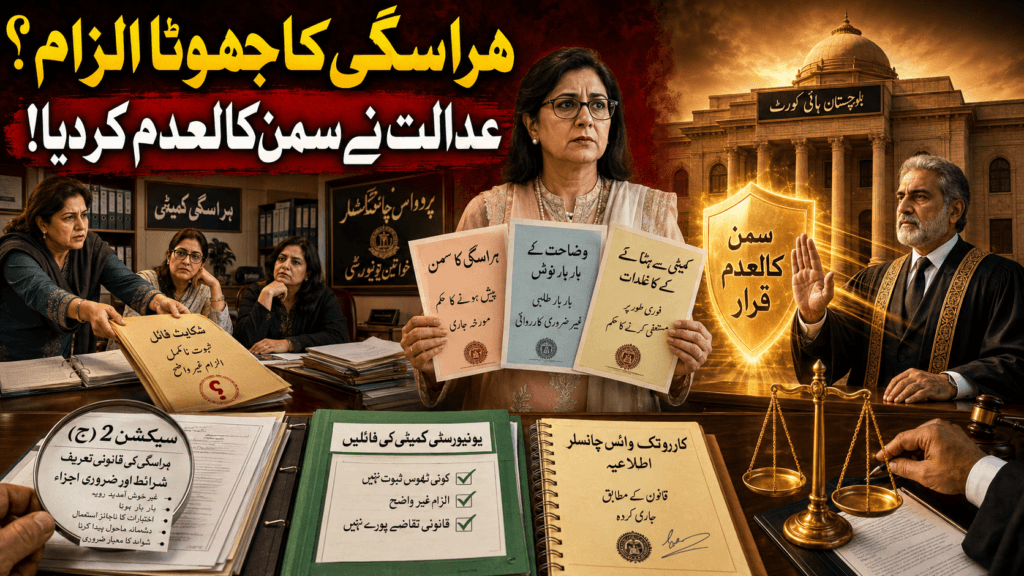
The Women Harassment Act Balochistan is meant to protect dignity and safety at work. It cannot be used as a weapon in a personal or administrative dispute. This important judgment involved a senior female professor who was summoned by a university Harassment Committee after a complaint accused her of harsh treatment, verbal orders and undignified behaviour.
The Balochistan High Court examined the actual allegations, the legal definition and the surrounding university conflict. The Court found that the committee had failed to apply its mind and declared the summons illegal, mala fide and void from the beginning. The case was decided in Prof. Dr. Naheed Haq v. Province of Balochistan and others, reported as PLD 2024 Balochistan 6.
Table of Contents
Why This Judgment Matters for Harassment Complaints in Balochistan
A genuine complainant must receive protection, privacy and a fair inquiry. At the same time, an accused employee cannot be summoned merely because an office dispute has been labelled as harassment.
Before proceeding under the Women Harassment Act Balochistan, the committee must identify the alleged conduct and decide whether it falls within the statute. A complaint’s title is not enough. Its facts must disclose a legally actionable case.
IRAC Analysis: Why the Harassment Summons Failed
| Element | Explanation |
|---|---|
| Issue | Whether the complaint disclosed actionable harassment and whether the university committee lawfully summoned the Pro-Vice Chancellor. |
| Rule | The committee must act within section 2(j), apply its mind to the allegations and follow lawful authority. Action affected by mala fides or lack of jurisdiction may be struck down under Article 199. |
| Analysis | The complaint contained general allegations about office directions, harsh words and undignified treatment. The Court found no allegation of sexual orientation or nature under the test it applied and considered the surrounding administrative conflict. |
| Conclusion | The petition was allowed. The summons and explanations were declared unlawful, and the petitioner was directed to be included in university committees according to law. |
Judgment at a Glance: Balochistan Workplace Harassment Case
| Point | Details |
|---|---|
| Case title | Prof. Dr. Naheed Haq v. Province of Balochistan and others |
| Citation | PLD 2024 Balochistan 6 |
| Case number | Constitution Petition No. 1639 of 2022 |
| Court | High Court of Balochistan |
| Jurisdiction | Constitutional jurisdiction under Article 199 |
| Bench | Justice Muhammad Hashim Khan Kakar and Justice Shaukat Ali Rakhshani |
| Author judge | Justice Muhammad Hashim Khan Kakar |
| Date of hearing | 19 June 2023 |
| Date of decision | 27 June 2023 |
| Petitioner | Prof. Dr. Naheed Haq |
| Institution | Sardar Bahadur Khan Women’s University, Quetta |
| Main law | Balochistan Protection Against Harassment of Women at the Workplace Act, 2016 |
| Key provisions | Sections 2(j) and 12 |
| Important precedent | Nadia Naz v. President of Pakistan, PLD 2021 Supreme Court 784 |
| Final result | Petition allowed; summons declared illegal, mala fide and void ab initio |
Background of the University Conflict
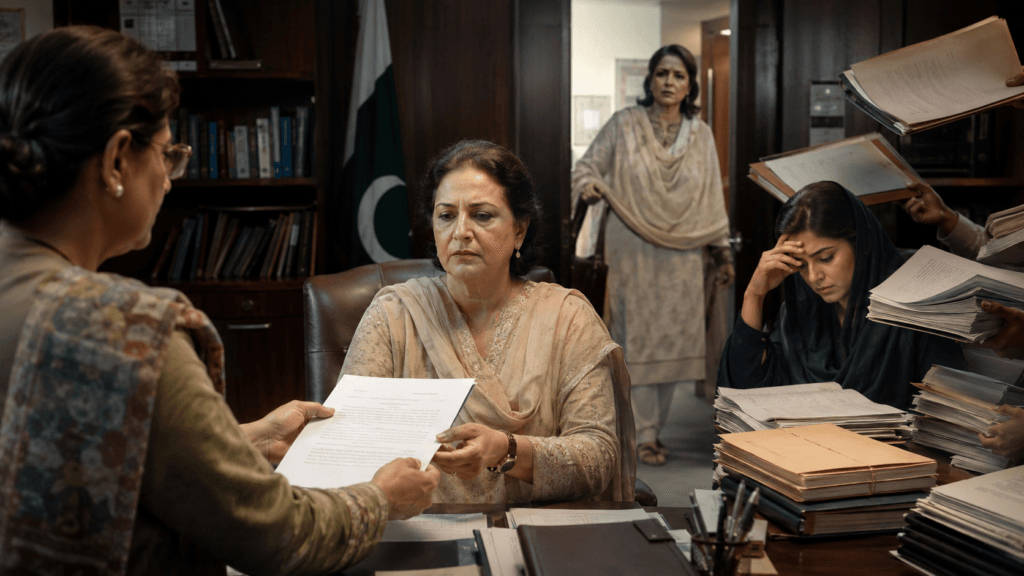
Prof. Dr. Naheed Haq was serving as Pro-Vice Chancellor of Sardar Bahadur Khan Women’s University, Quetta.
After the removal of the Vice Chancellor, she was given acting charge of Vice Chancellor through a notification dated 2 September 2021.
According to the petitioner, the respondent later returned as Vice Chancellor through a High Court judgment and developed a personal grudge against her. She alleged that:
- her monthly salary was revised;
- she was removed from different committees;
- repeated show-cause notices were issued; and
- she was summoned in a harassment complaint filed by Dr. Gul Ghutai, Chairperson of the Commerce Department.
The complaint was dated 13 September 2022. Summons were issued on 21 and 28 September 2022. The petitioner approached the High Court under Article 199 and challenged the complaint, summons, explanations, salary action and removal from committees. She argued that the Women Harassment Act Balochistan had been invoked without lawful grounds.
What Was Alleged in the Complaint?

The High Court examined the complaint itself.
The allegations included:
- calling the complainant into the petitioner’s office;
- treating her in an allegedly undignified manner;
- giving verbal orders; and
- using harsh or contemptuous language.
The Court held that these general allegations did not constitute actionable harassment under the legal test it applied.
It also found that the Vice Chancellor and members of the Harassment Committee had failed to apply their minds before entertaining the complaint and issuing summons.
This is the central lesson of the Women Harassment Act Balochistan judgment:
Jurisdiction depends on the facts written in the complaint, not merely on the label placed upon it.
Section 2(j) and the Meaning of Harassment

The provincial law largely followed the federal workplace-harassment statute, but section 2(j) contained additional wording.
Readers may examine the complete Balochistan Protection Against Harassment of Women at the Workplace Act, 2016, to understand its definitions, complaint procedure, and powers of the Inquiry Committee.
Along with unwanted sexual conduct and sexually demeaning attitudes, the provincial definition referred to:
- threats;
- blackmailing;
- mental torture;
- physical torture;
- attempted defamation; and
- defamation through modern techniques.
The High Court expressed concern that this wider wording could be misused when organisational heads applied it without proper care. It described the case before it as an example of such misuse.
However, the Court relied heavily on the Supreme Court’s decision in Nadia Naz. That case interpreted the federal definition then in force and held that ordinary misconduct was not actionable unless the conduct was shown to have a sexual nature.
Applying that approach, the High Court held that the university complaint did not allege sexual intention, sexual overture or conduct of a sexual nature.
The Women Harassment Act Balochistan could not, under the interpretation used in this judgment, be stretched to cover every unpleasant office exchange.
Difference Between Rude Conduct and Actionable Harassment
The Court did not say that harsh language is acceptable.
Its point was narrower: improper workplace behaviour and legally actionable harassment are not always the same thing.
A person may behave rudely, misuse administrative authority or violate service rules without necessarily committing the particular statutory wrong being investigated by a Harassment Committee.
The Court stated that generic workplace misconduct was not actionable by itself unless it satisfied the legal definition applied in the case.
This distinction protects genuine complainants because it keeps complaints focused on provable facts. It also protects accused employees from being placed under coercive proceedings without a legal foundation.
Section 12: Other Remedies May Still Exist
Section 12 of the Women Harassment Act Balochistan says that the provincial Act is in addition to other laws.
Conduct outside this particular statute may still be examined under:
- university law;
- service rules;
- disciplinary regulations;
- defamation law;
- criminal law; or
- constitutional law.
Ending a harassment proceeding therefore does not prove that every alleged act was proper.
It only means that the particular complaint could not continue under the legal test and jurisdiction applied in that proceeding. The High Court itself noted that section 12 preserves other legal remedies.
Why the High Court Found Mala Fides

The Court considered the wider sequence of events.
After the petitioner had held acting charge as Vice Chancellor, she faced:
- salary revision;
- removal from committees;
- repeated explanations;
- show-cause notices; and
- the harassment summons.
The Court observed that she appeared to have been made a scapegoat and discriminated against on a linguistic basis. It also found her removal from committees, despite her position as Pro-Vice Chancellor, contrary to law.
These circumstances, together with the vague complaint and lack of proper legal scrutiny, led the Court to declare the summons under the Women Harassment Act Balochistan mala fide.
This finding was specific to the facts of this case. Every unsuccessful harassment complaint is not automatically false or malicious.
What “Mala Fide” and “Void Ab Initio” Mean
Mala fide means that an action was taken in bad faith, for an improper purpose or because of an ulterior motive.
Void ab initio means that an action is legally invalid from the beginning.
Therefore, when the Court declared the summons void ab initio, it did not merely cancel them from the date of judgment. It treated them as legally defective from their inception.
Court’s Final Decision

The High Court allowed the constitutional petition arising from the Women Harassment Act Balochistan dispute.
It declared the petitioner’s summoning in the harassment complaint:
- illegal;
- mala fide; and
- void ab initio.
The explanations dated 20 May 2022, 29 June 2022 and, according to the operative order, 25 August 2022 were declared without jurisdiction and void.
There is an important reporting detail. The prayer portion refers to the third explanation as dated 26 August 2022, while the final order mentions 25 August 2022. The judgment therefore contains a one-day difference that should not be silently altered.
The Vice Chancellor was also directed to include the petitioner’s name in the relevant committees according to the Balochistan Universities Act, 2022.
The operative order did not separately state that her salary package was restored. That relief should therefore not be added to the decision by assumption.
Practical Lessons for Employees and Committees
A complaint under the Women Harassment Act Balochistan should give precise facts, including:
- dates and places;
- exact words or conduct;
- messages or emails;
- witnesses;
- threats or retaliation;
- relevant documents; and
- the effect on work.
The Women Harassment Act Balochistan should never be invoked through vague accusations alone. General labels can weaken even a genuine complaint.
An accused employee facing proceedings under the Women Harassment Act Balochistan should obtain the complaint, answer each allegation separately, preserve official records and promptly raise any jurisdictional or conflict-of-interest objection.
Before issuing summons, a Harassment Committee should identify:
- the exact conduct alleged;
- the applicable words of the current statute;
- whether the committee is lawfully constituted;
- whether any member has a conflict of interest;
- whether the dispute is actually administrative; and
- the reasons for allowing the complaint to proceed.
Fair procedure protects both a genuine complainant and an accused person.
Current-Law Caution
This Women Harassment Act Balochistan judgment interpreted the 2016 statute and was decided in June 2023.
The official Balochistan Code now lists the Balochistan Protection Against Harassment of Women at Workplace Act, 2016 (Amendment-2025), Act No. XIX of 2025, as promulgated on 1 August 2025. A present-day complaint should therefore be examined under the current amended text, not only the wording discussed in PLD 2024 Balochistan 6. (Balochistan Code)
Conclusion
The Women Harassment Act Balochistan is a shield for workplace dignity, not a tool for administrative rivalry.
The High Court protected that principle by examining the real allegations, the committee’s jurisdiction and the surrounding university conflict.
The lasting lesson is balanced: genuine complaints deserve serious protection, but no person should face coercive proceedings until the committee has applied its mind and found that the facts disclose a legally actionable case under the current law.
Disclaimer
This article is intended only for general legal awareness and education. It is not a substitute for professional legal advice and does not create a lawyer-client relationship. Workplace disputes depend on the current statute, amendments, service rules, documents, and facts of each case.
Frequently Asked Questions
What was decided in PLD 2024 Balochistan 6?
The High Court allowed the petition and declared the harassment summons illegal, mala fide and void from the beginning.
Who filed the petition?
Prof. Dr. Naheed Haq, Pro-Vice Chancellor of Sardar Bahadur Khan Women’s University, filed it.
What allegations appeared in the complaint?
They concerned calling the complainant into an office, alleged undignified treatment, verbal directions and harsh language.
Does every rude workplace act amount to harassment?
No. The conduct must satisfy the current statutory definition and fall within the committee’s jurisdiction.
What does void ab initio mean?
It means that the action is treated as legally invalid from its beginning.
Is every rejected complaint a false complaint?
No. A complaint may fail because of weak evidence or a legal defect. Mala fides require a separate factual finding.
Why was the Nadia Naz judgment relevant?
The High Court used that Supreme Court case to distinguish generic workplace misconduct from actionable harassment under the legal test applied at that time.
The earlier narrow interpretation was later reconsidered by the Supreme Court. Read our detailed guide on Workplace Harassment in Pakistan to understand how gender-based discrimination and sexually demeaning conduct were addressed in the review judgment.
Did the Court restore the petitioner to university committees?
Yes. The respondent was directed to include her according to the Balochistan Universities Act, 2022.
Did the High Court expressly restore her salary?
The operative order did not separately grant that relief, so it should not be claimed without qualification.
Is the Women Harassment Act Balochistan still exactly the same?
An official 2025 amendment is now listed. Current cases require examination of the amended statute.