

A woman may spend years building her education, career and professional reputation. Yet one senior officer, colleague or employer can turn her workplace into a place of fear through unwanted messages, repeated visits, humiliating remarks, gender-based discrimination or pressure linked with promotion and employment.
Many victims remain silent because they believe harassment means only physical contact. Others fear losing their job, receiving a bad performance report or being transferred after filing a complaint. Women harassment law in Pakistan answers these fears by creating complaint forums, evidence-based inquiries, confidentiality protections, penalties and appeal rights.
The law does not expect an employee to surrender her dignity in exchange for a salary. The Supreme Court of Pakistan has also made it clear that workplace dignity is connected with Article 14 of the Constitution. A person must be able to work with respect, safety and value.
This article explains the current legal framework, the 2022 amendments, the complaint procedure and the important Supreme Court judgment reported as PLD 2024 Supreme Court 795.
Table of Contents
Judgment at a Glance: Women Harassment Case in Pakistan
| Point | Details |
|---|---|
| Case | Raja Tanveer Safdar v. Mrs. Tehmina Yasmeen and others |
| Citation | PLD 2024 Supreme Court 795 |
| Court | Supreme Court of Pakistan |
| Decision date | 24 April 2024 |
| Bench | Justice Munib Akhtar, Justice Ayesha A. Malik and Justice Shahid Waheed |
| Judgment author | Justice Ayesha A. Malik |
| Main law | Protection against Harassment of Women at the Workplace Act, 2010 |
| Other laws | Defamation Ordinance, 2002 and PEEDA Act, 2006 |
| Constitutional provisions | Articles 13(a), 14 and 199 |
| Central question | Did three separate proceedings amount to double jeopardy? |
| Final result | Petition dismissed and leave refused |
The case arose from a Lahore High Court, Rawalpindi Bench order and was finally decided by a three-member Supreme Court bench.
IRAC: The Entire Judgment in One Table
| IRAC | Explanation |
|---|---|
| Issue | Whether proceedings for workplace harassment, defamation and departmental misconduct were multiple punishments for the same offence. The Court also considered whether the High Court could re-examine factual findings already recorded by the Ombudsperson and Governor. |
| Rule | Article 13(a) prohibits prosecution or punishment more than once for the same offence. The test is whether both proceedings have the same legal ingredients, substance and evidence—not merely whether they arise from connected facts. |
| Analysis | The defamation suit concerned damage to reputation. The PEEDA proceedings concerned official misconduct. The harassment complaint concerned workplace conduct and dignity. Each law protected a different legal interest and created a separate remedy. |
| Conclusion | Double jeopardy did not apply. The factual findings could not be reopened as a second appeal through constitutional jurisdiction. The petition was dismissed. |
Why Women Harassment Law in Pakistan Is More Powerful Than Many Employees Realise
The principal legislation is the Protection against Harassment of Women at the Workplace Act, 2010, read with the amendments introduced in 2022.
The law originally focused mainly on women working in conventional organisations. The amendments expanded its language, protected categories and definition of workplace. The current law now recognises that professional work does not happen only inside a permanent government office.
Anyone who wants to examine the exact statutory wording can read the official amended workplace harassment law. The amended definition covers broader categories of complainants, employees, employers, workplaces, and gender-based conduct.
Women harassment law in Pakistan now protects workers in many employment arrangements that were previously overlooked or misunderstood.
1. Who Can File a Workplace Harassment Complaint?

The amended law defines a complainant as any person aggrieved by an act of harassment who approaches an Inquiry Committee or the Ombudsperson.
The definition may include:
- a present employee;
- a former employee who was removed or dismissed;
- an employee who resigned;
- a parent or guardian where the complainant is a minor; and
- another person falling within the protected employment framework.
This means the remedy is no longer restricted only to a permanent female government employee.
An employee under the amended law may include:
- a regular employee;
- a contractual worker;
- a temporary or part-time worker;
- a freelance or gig worker;
- a student or intern;
- a trainee or apprentice;
- a performer or artist;
- a sportsperson;
- a domestic worker;
- a home-based worker;
- a volunteer; and
- a person working with or without remuneration.
The law expressly includes these different work arrangements.
Therefore, women harassment law in Pakistan may protect a university student during an internship, a domestic worker inside a private home, a freelancer working for an online business or a trainee working without salary.
The employment relationship and connection with the alleged conduct must still be shown through facts and evidence.
2. Harassment Is Not Limited to Physical Touching
One of the most dangerous misunderstandings is that no harassment case exists unless the accused physically touches the complainant.
The legal definition is much wider. Harassment may include:
- an unwelcome sexual advance;
- a demand or request for sexual favours;
- stalking;
- cyberstalking;
- sexual verbal communication;
- offensive written messages;
- unwanted visual material;
- physical conduct of a sexual nature;
- sexually demeaning attitudes;
- derogatory gestures or expressions;
- punishment for refusing an improper request;
- making sexual compliance a condition of employment; and
- discrimination based on gender.
Gender discrimination may amount to harassment even when it is not sexual in nature. The law considers whether the conduct reflects a discriminatory mindset and causes unequal or prejudicial treatment because of gender.
Women harassment law in Pakistan therefore examines the complete workplace environment, not only one physical act.
For a detailed explanation of how the Supreme Court broadened the meaning of harassment beyond physical conduct, readers may also study this related judgment on workplace harassment and gender-based discrimination.
3. Can One Serious Incident Amount to Harassment?
Yes. A complainant is not always required to prove a long pattern extending over several months or years.
The Code of Conduct recognises that a single incident may amount to harassment where it makes a person uncomfortable or creates fear or panic at the workplace.
A pattern of offensive conduct may be relevant in a hostile-environment case. However, where the incident is particularly serious, a single act may be sufficient.
For example, one serious incident involving physical contact, a direct demand for sexual favours, severe gender-based humiliation or an employment threat may create an immediate legal grievance.
This does not mean every rude sentence or ordinary workplace disagreement automatically becomes harassment. The forum must examine the nature, severity, context, work connection and effect of the conduct.
Women harassment law in Pakistan protects victims from serious misconduct while also requiring a fair and evidence-based determination.
4. Three Main Forms of Workplace Harassment

The statutory Code of Conduct identifies three important manifestations of harassment.
Abuse of Authority
Abuse of authority occurs when a person holding power demands sexual cooperation in exchange for a job benefit.
The promised or threatened benefit may relate to:
- promotion;
- salary increase;
- training;
- transfer;
- continued employment;
- favourable duty assignment; or
- another professional opportunity.
The misconduct becomes more serious when the accused controls the complainant’s career, attendance, evaluation, contract or salary.
Hostile Working Environment
A hostile working environment may arise when unwelcome conduct interferes with an employee’s work or creates an intimidating, humiliating, abusive or offensive atmosphere.
It may include repeated unwanted visits, offensive jokes, humiliating remarks, gender-based exclusion, cyberstalking, rumours or conduct that makes normal work difficult.
The Supreme Court has recognised that actions interfering with work performance or creating an intimidating, hostile or offensive environment may fall within the statutory definition of harassment.
Retaliation
Retaliation happens when an employee suffers adverse treatment because she rejected an improper demand, resisted harassment or filed a complaint.
It may appear as:
- denial of promotion;
- negative evaluation reports;
- unnecessary transfer;
- removal from important duties;
- workplace isolation;
- threats;
- false complaints;
- denial of training;
- professional gossip; or
- pressure to withdraw proceedings.
Women harassment law in Pakistan does not protect only against the original act. It also seeks to prevent pressure that stops a complainant from freely pursuing her case.
5. The Workplace Is No Longer Limited to an Office Building
The amended definition of workplace includes many locations and situations connected with employment or professional activity.
It may include:
- government departments;
- private companies;
- educational institutions;
- medical facilities;
- factories;
- courts;
- highways;
- sporting facilities;
- gymnasiums;
- studios;
- concerts;
- gigs;
- performance venues;
- client locations;
- open areas;
- online businesses;
- official visits; and
- work-related activities outside the office.
The crucial question is whether the situation was genuinely linked with work or professional activity.
For example, misconduct during an official tour, training session, professional event, online meeting or field visit may still fall within women harassment law in Pakistan.
The accused cannot automatically escape responsibility merely by arguing that the incident happened outside the main office building.
6. Where Can a Harassment Complaint Be Filed?

A complainant has two principal options.
She may file a complaint before:
- the internal Inquiry Committee of the organisation; or
- the appropriate Ombudsperson.
The law gives the complainant an option between these forums. She is not always required to complete the internal process before approaching the external forum.
A complainant dealing with a federal organisation may use the official online harassment complaint form. The form presently asks for basic personal details, department information, the accused’s particulars, the main allegations and an affidavit.
Before filing, the complainant should identify whether the organisation falls within federal or provincial jurisdiction.
A Punjab employee facing confusion about jurisdiction, implementation or the correct forum may also benefit from this practical guide on the powers and procedure of the Harassment Ombudsperson in Pakistan.
7. What Must Every Organisation’s Inquiry Committee Look Like?
Every covered organisation should constitute a three-member Inquiry Committee.
The committee must include:
- at least one woman;
- one member from senior management; and
- one senior employee representative or representative of the employees.
Where an organisation cannot appoint all members internally, one or more members may be selected from outside the organisation.
A chairperson must be designated from among the committee members.
Where the complaint is against a committee member, that member should be replaced for that particular inquiry. The accused person should not be allowed to participate in deciding the complaint against himself or herself.
Women harassment law in Pakistan requires a genuine inquiry mechanism, not merely a committee existing on paper.
An employer should clearly inform employees about:
- the names of committee members;
- the complaint submission method;
- the office or email where complaints may be filed;
- the Competent Authority; and
- the confidentiality process.
8. How Should a Strong Complaint Be Written?
A strong complaint tells a clear factual story. It does not rely only on emotional conclusions.
The complainant should explain:
- the date of every incident;
- the approximate time;
- the location;
- what the accused said or did;
- the work-related connection;
- whether anyone witnessed the incident;
- how the complainant responded;
- whether the conduct was repeated;
- whether retaliation followed; and
- what evidence supports each allegation.
For example, instead of writing:
“He continuously harassed me and made my life difficult.”
The complaint should explain:
“On 14 May at approximately 2:30 p.m., the officer entered my office without an official assignment, remained there after being requested to leave and sent two messages later that evening referring to my promotion.”
Specific facts allow the committee to compare the statement with messages, attendance records, witnesses and official documents.
Women harassment law in Pakistan becomes effective when the complaint is organised around facts that can be tested through evidence.
9. What Evidence Can Support a Harassment Complaint?
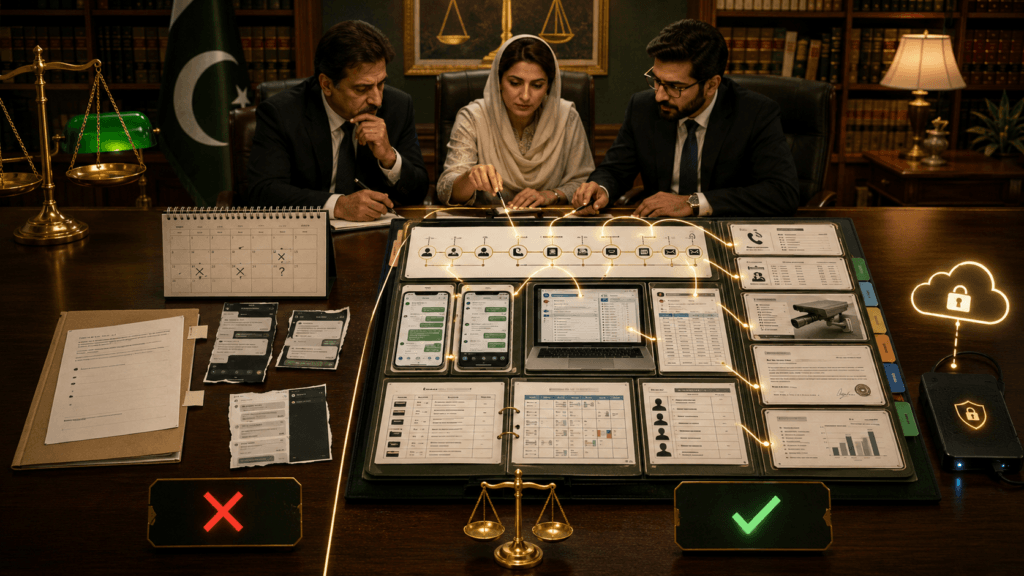
Workplace harassment frequently happens without independent eyewitnesses. This does not make a complaint impossible to prove.
Relevant evidence may include:
- WhatsApp messages;
- emails;
- call records;
- audio or video evidence;
- office CCTV;
- visitor registers;
- attendance records;
- duty rosters;
- meeting invitations;
- transfer orders;
- performance reports;
- earlier written complaints;
- witness statements;
- medical or counselling records;
- social-media messages;
- official letters; and
- evidence of retaliatory action.
The Inquiry Committee may require the production of documentary, audio and video evidence and may record witness evidence.
A complainant should preserve original files rather than relying only on cropped screenshots. The complete conversation, date, time, sender details and surrounding context may become important.
Digital material should not be edited or reconstructed. A secure backup should be maintained.
An allegation should never be exaggerated to make it appear stronger. A consistent and accurate statement is more valuable than an emotionally dramatic but contradictory version.
10. What Happens After the Internal Complaint Is Filed?
After receiving a written complaint, the Inquiry Committee should communicate the charges and statement of allegations to the accused within three days.
The accused should ordinarily submit a written defence within seven days. If no defence is filed without reasonable cause, the committee may proceed ex parte.
Both sides may produce oral and documentary evidence. Each party is entitled to cross-examine witnesses appearing against that party.
The committee should:
- maintain confidentiality;
- give both parties a reasonable opportunity to present their case;
- prevent adverse action against the complainant and witnesses;
- prevent the creation of a hostile environment;
- record its findings in writing; and
- provide reasons for its conclusions.
These procedural safeguards are expressly recognised by the law.
The Inquiry Committee should submit its findings and recommendations to the Competent Authority within thirty days from the initiation of the inquiry.
If the accused is found guilty, the Competent Authority should impose the recommended penalty within one week of receiving the recommendations.
Women harassment law in Pakistan therefore creates a structured process rather than leaving the complaint to informal office politics.
11. What Happens Before the Ombudsperson?
Where the complaint is filed directly before the Ombudsperson, a written show-cause notice should be issued to the accused within three days.
The accused ordinarily has five days after receiving the notice to file a written defence. Failure to respond without reasonable cause may result in ex parte proceedings.
The forum may:
- summon persons;
- record evidence;
- require documents;
- receive affidavits;
- require an organisation to provide relevant information; and
- issue a reasoned decision.
A complaint or appeal should be decided within ninety days under the amended statutory framework.
Women harassment law in Pakistan gives the forum powers similar to a civil court for specified evidentiary and procedural purposes.
12. Is the Inquiry Confidential?
Yes. Statements and evidence obtained during the inquiry should be treated as confidential.
The purpose is to protect:
- the dignity of the complainant;
- the accused’s right to a fair hearing;
- the integrity of the evidence;
- witnesses from workplace pressure; and
- the inquiry from public campaigning.
Confidentiality does not mean that the accused will never be informed about the allegations. Natural justice requires that the accused receive the material allegations and a fair opportunity to defend them.
It means the complaint should not become office gossip, social-media content or a method of public humiliation before the case is decided.
Both parties may be represented or accompanied by a colleague, friend or collective bargaining representative during the inquiry.
13. Can the Employer Transfer or Punish the Complainant?
The employer should not take adverse action against a complainant or witness merely because a complaint has been filed.
The Inquiry Committee must ensure that the employer or accused does not create a hostile environment to pressure the complainant.
However, every transfer, suspension or departmental action is not automatically retaliation. The forum will examine:
- the timing of the action;
- the employer’s stated reason;
- previous service records;
- treatment of comparable employees;
- supporting documents;
- whether ordinary procedure was followed; and
- whether the action began only after the complaint.
A complainant alleging retaliation should preserve transfer orders, show-cause notices, performance reports, emails and earlier service records.
Women harassment law in Pakistan protects against retaliatory pressure, but evidence must connect the adverse action with the complaint or refusal of harassment.
14. What Penalties Can Be Imposed?
The law provides both minor and major penalties.
Minor Penalties
Minor penalties may include:
- censure;
- withholding promotion;
- withholding increment;
- stoppage at an efficiency bar; and
- recovery of compensation from the accused’s salary or another source.
Major Penalties
Major penalties may include:
- reduction to a lower post;
- reduction to a lower pay scale;
- compulsory retirement;
- removal from service;
- dismissal from service;
- suspension or cancellation of a professional licence; and
- fine.
Part of the fine may be awarded to the complainant as compensation.
Where a complainant suffers trauma, the organisation may arrange psycho-social counselling, medical treatment or additional medical leave. Compensation may also be considered for loss of salary or other damage.
Women harassment law in Pakistan can therefore create serious professional and financial consequences when misconduct is proved.
15. What Legal Duties Does an Employer Have?
An employer cannot wait for a serious complaint before thinking about workplace safety.
Every covered organisation should:
- establish an Inquiry Committee;
- designate a Competent Authority;
- incorporate the Code of Conduct into its policy;
- display the Code at a visible location;
- display it in English and a language understood by most employees;
- create a confidential complaint channel;
- prevent retaliation; and
- implement final decisions.
An employee may approach the District Court where an employer fails to comply with the statutory duties. A non-compliant employer may face a fine ranging from Rs.25,000 to Rs.100,000.
Women harassment law in Pakistan is therefore also an employer-compliance law. Displaying one poster without maintaining a functional committee is not meaningful compliance.
The constitutional importance of equality and dignity is explained more broadly in this related discussion of women’s legal rights and personal dignity in Pakistan.
The Human Story Behind PLD 2024 Supreme Court 795
Mrs. Tehmina Yasmeen was serving as a Senior Special Education Teacher at the Special Education Centre, Taxila, District Rawalpindi.
Raja Tanveer Safdar was serving as District Officer, Social Welfare and Bait-ul-Maal, Chakwal.
On 3 June 2016, the petitioner wrote a letter to the District Officer Coordination, Chakwal. He alleged that Mrs. Tehmina Yasmeen, while serving as headmistress of the Government Institute for Blind, Chakwal, had sexually abused a blind teacher working on daily wages.
An inquiry was initiated against her on the basis of this letter. She was later exonerated from the allegation on 21 August 2017.
The dispute did not remain limited to one proceeding. It produced three separate legal actions.
Three Proceedings, Three Different Legal Wrongs
The Defamation Suit
Mrs. Tehmina Yasmeen filed a civil suit under the Defamation Ordinance, 2002.
She alleged that the false letter had damaged her professional reputation.
On 10 April 2019, the civil court decreed the suit in her favour and awarded Rs.1,000,000 as damages.
The legal wrong in this proceeding was damage to reputation.
The PEEDA Proceedings
She also filed a departmental complaint under the Punjab Employees Efficiency, Discipline and Accountability Act, 2006.
The departmental inquiry found the petitioner guilty of misconduct for making false and fabricated allegations through an official letter.
The penalty imposed was forfeiture of two years of past service.
The legal wrong in this proceeding was misconduct by a government employee.
The Workplace Harassment Complaint
A separate complaint was filed under women harassment law in Pakistan.
The respondent alleged that the petitioner unnecessarily visited her office on one pretext or another while acting as the focal person for disabled persons.
The Ombudsperson found the petitioner guilty of harassment on 4 September 2018 and imposed compulsory retirement.
His representation before the Governor Punjab was dismissed on 18 November 2019.
What Happened Before the Lahore High Court?
The petitioner challenged the Ombudsperson’s and Governor’s decisions before the Lahore High Court, Rawalpindi Bench.
He argued that:
- the harassment allegations were incorrect;
- the complainant had failed to prove the case;
- he had already been punished departmentally;
- the defamation suit had also been decided; and
- the separate punishments violated Article 13(a).
The Lahore High Court dismissed his constitutional petition on 27 October 2020 and maintained the orders passed against him.
He then approached the Supreme Court of Pakistan.
The Main Legal Questions Before the Supreme Court
The Supreme Court considered these central questions:
- Were the harassment, defamation, and PEEDA proceedings based on the same offence?
- Did the penalties amount to double jeopardy under Article 13(a)?
- Did each statute protect a different legal interest?
- Could the High Court reconsider the entire evidence as a second factual appeal?
- What connection exists between workplace harassment and constitutional dignity?
These questions made PLD 2024 Supreme Court 795 an important authority on women harassment law in Pakistan.
The Petitioner’s Argument: “I Have Been Punished More Than Once”
The petitioner’s central argument was that all three proceedings arose from the same allegations and factual background.
He maintained that:
- the PEEDA inquiry had already punished him;
- the harassment proceedings resulted in compulsory retirement;
- the defamation suit resulted in damages; and
- the combined consequences violated the protection against double punishment.
He also argued that no harassment case had been proved and that the respondent’s allegations were exaggerated.
What Does Double Jeopardy Actually Mean?
Article 13(a) of the Constitution states that no person shall be prosecuted or punished for the same offence more than once.
However, double jeopardy does not apply merely because:
- the parties are the same;
- the disputes are connected;
- some facts overlap; or
- the proceedings arise from a common background.
The real test is whether the offences have the same ingredients in law.
The Supreme Court explained that the second proceeding must relate to the same offence, the same essential legal ingredients and substantially the same required evidence.
Where proceedings are different in substance and law, the defence of double jeopardy does not apply.
Why the Supreme Court Rejected Double Jeopardy

The Supreme Court found that three special laws were operating in their separate fields.
The defamation case required proof that the petitioner’s statement damaged the respondent’s reputation.
The PEEDA proceedings required proof of misconduct by a government employee in his official capacity.
The harassment proceedings required proof that the petitioner caused workplace harassment or created conduct falling within the statutory definition.
Each proceeding had:
- a different legal purpose;
- different ingredients;
- a different forum;
- a different cause of action; and
- a different legal consequence.
Women harassment law in Pakistan also expressly operates in addition to other applicable laws rather than replacing every civil, criminal or departmental remedy.
The Supreme Court therefore held that action under one law did not automatically prevent action under the other laws.
Why Dignity Became the Heart of the Judgment
The most powerful part of the judgment was not only the discussion about penalties. It was the Court’s explanation of dignity.
The Supreme Court held that harassment affects one of the most basic and fundamental rights: the right to dignity.
Article 14 requires that a citizen be allowed to live and work with respect and value.
The Court identified these requirements of a dignified workplace:
- respectability;
- acceptability;
- inclusivity;
- safety;
- fairness; and
- equality.
It explained that the purpose of women harassment law in Pakistan is to promote fair treatment, non-discrimination, mutual respect and socio-economic justice.
The Court also connected these objectives with Articles 37 and 38 of the Constitution, which concern social justice and the social and economic well-being of citizens.
A job does not cancel a woman’s constitutional dignity. Her dignity enters the office with her.
Why the High Court Could Not Hear a Second Factual Appeal
The petitioner also wanted the High Court to reconsider whether the evidence actually proved harassment.
The Supreme Court explained that the Ombudsperson and Governor were the principal fact-finding forums in this statutory process.
Both forums could examine evidence and record factual conclusions.
After the Governor’s order, the High Court could not ordinarily use constitutional jurisdiction as if it were another appeal on facts.
Interference may still be justified where there is:
- lack of jurisdiction;
- a serious procedural irregularity;
- denial of fair hearing;
- an error of law;
- a finding unsupported by evidence; or
- a perverse conclusion.
However, a party cannot simply repeat factual arguments until a different forum accepts them.
The Supreme Court held that factual controversy normally ends after the Governor’s order unless a recognised jurisdictional or procedural defect exists.
This principle gives women harassment law in Pakistan both fairness and finality.
Final Decision: Compulsory Retirement Remained in Force
The Supreme Court found no legal defect in the Lahore High Court’s decision.
It held that:
- double jeopardy did not apply;
- the three proceedings dealt with separate legal wrongs;
- the causes of action were different;
- the Ombudsperson and Governor had determined the factual controversy;
- constitutional jurisdiction was not a second factual appeal; and
- no ground for interference was established.
The civil petition was dismissed and leave to appeal was refused.
The compulsory retirement imposed in the harassment proceedings therefore remained intact.
Appeal and Representation: Do Not Miss the Deadline
A party aggrieved by the Competent Authority’s decision may ordinarily file an appeal before the Ombudsperson within thirty days of receiving written communication of the decision.
The appellate forum may:
- confirm the decision;
- set it aside;
- vary it; or
- modify it.
A person aggrieved by an original decision of the Ombudsperson may make a representation to the President or Governor, as applicable, within thirty days.
The amended framework provides a ninety-day period for deciding the representation.
A complainant or accused should record the date on which the written decision was received. Waiting for informal negotiations may result in the statutory deadline being missed.
Practical Checklist for a Complainant
Before filing a complaint under women harassment law in Pakistan, prepare:
- A complete incident chronology.
- The accused person’s name, designation and department.
- Proof of employment or professional connection.
- Original messages, emails and documents.
- Names and contact details of witnesses.
- Relevant transfer, suspension or evaluation records.
- Earlier complaints made to management.
- Evidence showing retaliation, where alleged.
- A list of reliefs being requested.
- Copies of all documents for personal record.
The complainant should also request confidentiality and protection from adverse action.
Where immediate physical safety is at risk or the conduct may constitute a separate criminal offence, the complainant should obtain urgent case-specific legal advice instead of relying only on the workplace inquiry.
Practical Checklist for Employers
An organisation should not wait for litigation before complying with the law.
Management should:
- Verify that a valid three-member committee exists.
- Ensure at least one committee member is a woman.
- Designate the Competent Authority.
- Display the Code of Conduct.
- Create a confidential filing email or office.
- Train committee members in evidence and fair hearing.
- Record all proceedings and reasons.
- Protect both parties from public humiliation.
- prevent pressure on complainants and witnesses.
- Implement final orders promptly.
An employer that ignores a complaint, protects a powerful officer or punishes the complainant may increase its own legal exposure.
Common Mistakes That Can Weaken a Genuine Complaint
A valid grievance may become difficult to prove where the complainant:
- gives no dates or locations;
- deletes original messages;
- submits cropped screenshots without context;
- changes the account repeatedly;
- mixes unrelated office disputes with harassment;
- fails to explain the work connection;
- publicly discusses confidential evidence;
- pressures witnesses;
- files before the wrong forum; or
- misses the appeal deadline.
Another serious mistake is assuming that an unproved complaint is automatically false.
The Inquiry Committee may recommend action where allegations are found to be false and made with mala fide intention. Mere failure to prove every allegation does not automatically establish malicious conduct. The law requires a proper finding regarding falsity and bad faith.
Women harassment law in Pakistan must protect genuine complainants without removing the accused person’s right to a fair hearing.
Conclusion: A Salary Can Never Be the Price of Silence
Women harassment law in Pakistan is not limited to one office, one profession or one form of sexual conduct.
It protects a broader group of workers, including students, interns, freelancers, gig workers, domestic workers and former employees. It recognises cyberstalking, gender-based discrimination, hostile working environments, abuse of authority and retaliation.
PLD 2024 Supreme Court 795 adds an equally important lesson. Harassment, defamation and departmental misconduct may create separate proceedings because each law protects a different legal interest.
Most importantly, the Supreme Court placed dignity at the centre of the workplace.
A woman should not be forced to choose between her career and her self-respect. A safe workplace is not a personal favour from an employer. It is a legal obligation.
FAQs About Women Harassment Law in Pakistan
What is the main women harassment law in Pakistan?
The principal law is the Protection against Harassment of Women at the Workplace Act, 2010, read with the 2022 amendments and the statutory Code of Conduct.
Is workplace harassment limited to physical contact?
No. It may include unwanted messages, sexual communication, cyberstalking, gender discrimination, sexually demeaning conduct, retaliation and the creation of a hostile working environment.
Can a man file a complaint under the amended law?
The amended definition refers to any person aggrieved by harassment. The law is especially important for women but its current complaint framework is not restricted only to female complainants.
Can a former employee file a complaint?
Yes. The statutory definition includes certain former employees who were removed, dismissed or resigned.
Can an intern or domestic worker file a complaint?
Yes. The expanded definition of employee includes interns, trainees, domestic workers, home-based workers, students, freelancers and gig workers.
Can one incident be enough to prove harassment?
A single sufficiently serious incident may amount to harassment where it creates fear, panic or serious discomfort. The forum will examine its severity, context and evidence.
Is it compulsory to approach the internal committee first?
No. A complainant may choose between the organisation’s Inquiry Committee and the relevant Ombudsperson.
What is the time allowed for an internal inquiry?
The Inquiry Committee should submit its findings and recommendations within thirty days from initiation of the inquiry.
What penalties can be imposed?
Penalties may include censure, withholding promotion, compensation, reduction in post, compulsory retirement, removal, dismissal, professional-licence action and fine.
What did the Supreme Court decide in PLD 2024 SC 795?
The Supreme Court held that harassment, defamation and departmental misconduct proceedings addressed separate legal wrongs. Double jeopardy did not apply, and the petition was dismissed.
Can the High Court reconsider all factual evidence?
Not as a routine second appeal. Constitutional interference generally requires a jurisdictional defect, procedural impropriety, legal error or perverse finding.
Can an employer be fined for failing to constitute a committee?
Yes. Failure to comply with statutory employer duties may lead to District Court proceedings and a fine ranging from Rs.25,000 to Rs.100,000.
Disclaimer
This article is published for legal awareness and educational purposes only. It does not constitute legal advice or create an advocate-client relationship. The correct forum, limitation period and legal remedy may depend on the complainant’s organisation, province, employment status, evidence and individual circumstances.