
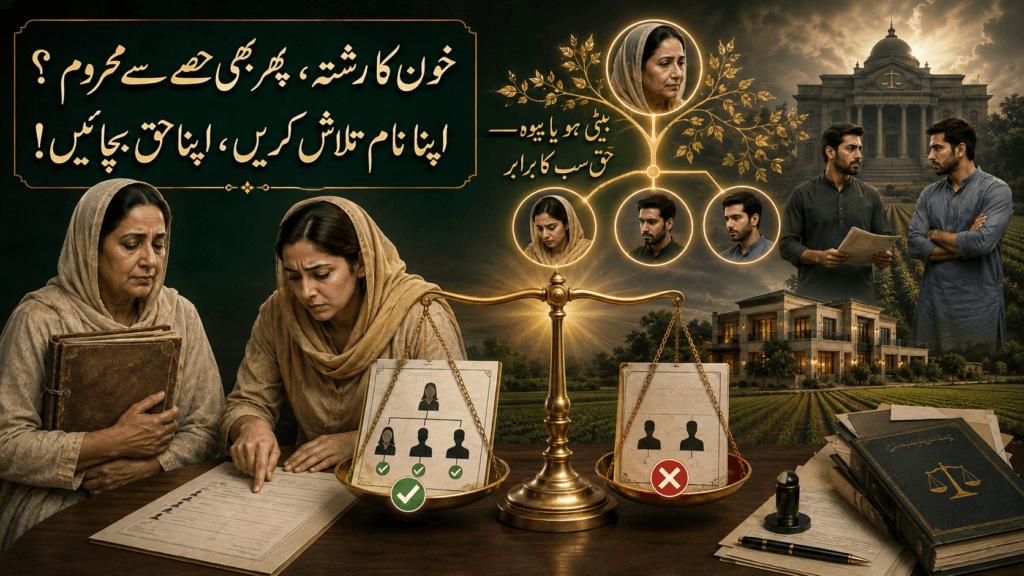
A father dies, and within days one family member takes control of the property papers. A married daughter is told, “You already received enough at your wedding.” A widow is told that the house belongs to the sons. A grandchild is ignored because his or her father died before the grandfather. Sometimes, an heir’s name simply disappears from an inheritance mutation.
Understanding Legal Heirs in Pakistan Law is essential because inheritance rights can arise immediately after death, even before the family completes mutation or succession paperwork.
But legal heirs in Pakistan law are not decided by family pressure, age, gender, physical possession, or by whoever keeps the original property documents.For ordinary families, Legal Heirs in Pakistan Law becomes especially important when one relative controls the documents, land, or bank accounts after a death.
For Muslims, inheritance opens on death and the estate devolves according to the applicable Muslim personal law. In PLD 1990 Supreme Court 1, the Supreme Court explained that a Muslim’s estate vests in the heirs upon death; a brother, father, husband or son does not become an intermediary who can decide whether another lawful heir should receive a share.
This guide explains who the legal heirs are, how common inheritance shares work, what a widow, husband, sons, daughters and parents may receive, when brothers and sisters inherit, what happens when a son or daughter dies before a parent, the rule of a will, and the difference between a Succession Certificate and Letter of Administration. It also explains the current NADRA route and what may happen when an inheritance dispute reaches court.
Important scope note: The share examples below mainly explain common Sunni/Hanafi Muslim inheritance situations in simple language. Exact shares depend on every surviving heir and the applicable personal law. Ahl-e-Tashih/Fiqh-e-Jafria rules can differ. Non-Muslim estates may also be governed by different succession rules. Never divide a disputed estate from one online table alone.
Table of Contents
Legal Heirs in Pakistan Law: The Quick Answer
A legal heir is a person legally entitled to inherit from a deceased person.
Under Legal Heirs in Pakistan Law, not every relative automatically receive an inheritance share; entitlement depends on the complete family structure and applicable personal law.
In a Muslim estate, possible heirs may include:
- Husband or wife;
- Sons and daughters;
- Father and mother;
- Grandchildren in relevant circumstances;
- Brothers and sisters where closer heirs do not exclude or alter their entitlement;
- Grandparents and other relatives in situations recognised by the applicable Muslim personal law.
However, being related to the deceased does not automatically mean that every relative receives a share.
A son may exclude some more distant relatives. A father may affect the entitlement of siblings. A daughter may receive a fixed share in one family structure but share the residue with a son in another.
That is why inheritance must be calculated from the complete family tree existing at the moment of death. A correct calculation under Legal Heirs in Pakistan Law therefore begins by identifying every surviving heir at the time of death.
The West Pakistan Muslim Personal Law (Shariat) Application Act, 1962 is an important statutory foundation for Muslim personal-law matters in Pakistan. The official Pakistan Code confirms the existence of the Act.
When Does a Legal Heir Become an Owner?
This is one of the most important principles of legal heirs in Pakistan law.
One of the key rules of Legal Heirs in Pakistan Law is that inheritance rights should not be confused with later entries in revenue or succession records.
A Muslim heir does not ordinarily become an heir only after a mutation is entered, a succession document is issued, or a family elder gives permission.
The Supreme Court in Ghulam Ali and others v. Mst. Ghulam Sarwar Naqvi, PLD 1990 SC 1 explained that succession opens upon the owner’s death and the estate legally devolves upon the heirs in their respective shares.
This distinction matters.
A succession certificate, Letter of Administration, inheritance mutation or other official record may be necessary to prove, administer, transfer or record rights. But paperwork should not be confused with the underlying question of who inherited when succession opened.
What This Means for a Family
If a father dies leaving sons and daughters, the eldest son does not automatically become the owner of everything simply because:
The practical lesson from Legal Heirs in Pakistan Law is simple: possession of property papers does not by itself make one family member the sole owner.
- He lives in the family house;
- He cultivates the agricultural land;
- Original documents are with him;
- He pays land revenue or utility bills;
- The sisters are married;
- The sisters live abroad;
- A wrong mutation records only the sons.
The actual rights must be determined under the applicable law.
What Must Be Paid Before an Estate Is Divided?
A common mistake is to divide every rupee immediately among heirs.
For this reason, understanding Legal Heirs in Pakistan Law requires families to identify the net estate before calculating the final shares of heirs.
For a Muslim estate, the estate must first be properly identified and liabilities considered. In general terms, the process involves:
Estate → proper expenses/liabilities → enforceable debts → valid bequest where applicable → inheritance distribution
The exact treatment of liabilities can depend on the facts, but heirs should not distribute an estate while ignoring lawful debts or a legally valid will.
This is particularly important where the deceased had:
- Bank loans;
- Personal debts;
- Unpaid business liabilities;
- Dower obligations;
- Tax liabilities;
- A valid wasiyat;
- Mortgaged property.
Inheritance is the distribution of the net estate legally available for succession, not simply everything found in the deceased’s name.
Who Are the Main Legal Heirs in Pakistan?
1. Widow’s Share in Her Husband’s Inheritance
Under the common Sunni Muslim rule:
| Situation | Widow/Widows’ Collective Share |
|---|---|
| Husband dies without a child or qualifying descendant | 1/4 |
| Husband dies leaving a child or qualifying descendant | 1/8 |
For families trying to understand Legal Heirs in Pakistan Law, the widow’s fraction must be calculated before the remaining estate is distributed among other entitled heirs.
Where there is more than one widow entitled to inherit, the relevant widow’s fraction is shared between them rather than each widow receiving a separate 1/4 or 1/8.
The Supreme Court’s discussion in PLD 1990 SC 1 also reproduces the traditional rule that a wife receives one-fourth where there is no issue and one-eighth where the deceased leaves issue.
Example
A Muslim man dies leaving:
- One widow;
- Two sons;
- One daughter.
The widow first receives 1/8.
The remaining 7/8 goes to the children under the applicable residuary rule. With sons and daughters together in this common Sunni example, each son takes twice the share of the daughter.
This does not mean that every man in every inheritance case always receives twice every woman.
That statement is an oversimplification.
2. Husband’s Share in His Wife’s Property
Under the common Sunni rule:
| Situation | Husband’s Share |
|---|---|
| Wife dies without a child or qualifying descendant | 1/2 |
| Wife dies leaving a child or qualifying descendant | 1/4 |
The husband’s entitlement under Legal Heirs in Pakistan Law also changes depending on whether his deceased wife left a child or other qualifying descendant.
For example, if a woman dies leaving her husband, one son and one daughter, the husband receives 1/4. The remaining estate is then divided between the son and daughter according to the applicable rule.
Again, the calculation changes if parents or other entitled heirs are also alive.
How Much Does a Son Inherit?
A son is usually a powerful residuary heir in Sunni Muslim inheritance law.
There is no universal statement that “a son always receives 1/2” or any other single fraction.
A common mistake about Legal Heirs in Pakistan Law is to assume that a son always receives one fixed fraction; his final entitlement depends on the other surviving heirs.
His actual entitlement depends on who else survives.
Son and Daughter Together
When sons and daughters inherit together as residuaries in the ordinary Sunni situation:
One son receives the equivalent of two daughters’ units.
For example:
A deceased man leaves:
- Wife;
- Two sons;
- One daughter.
After the wife receives 1/8, the balance of 7/8 is divided into five units:
- Son 1 = two units;
- Son 2 = two units;
- Daughter = one unit.
Therefore:
- Wife = 1/8 = 12.5%
- Each son = 7/20 = 35%
- Daughter = 7/40 = 17.5%
Total = 100%
This example is useful for learning the method, but a different family tree can produce different results.
How Much Does a Daughter Inherit?
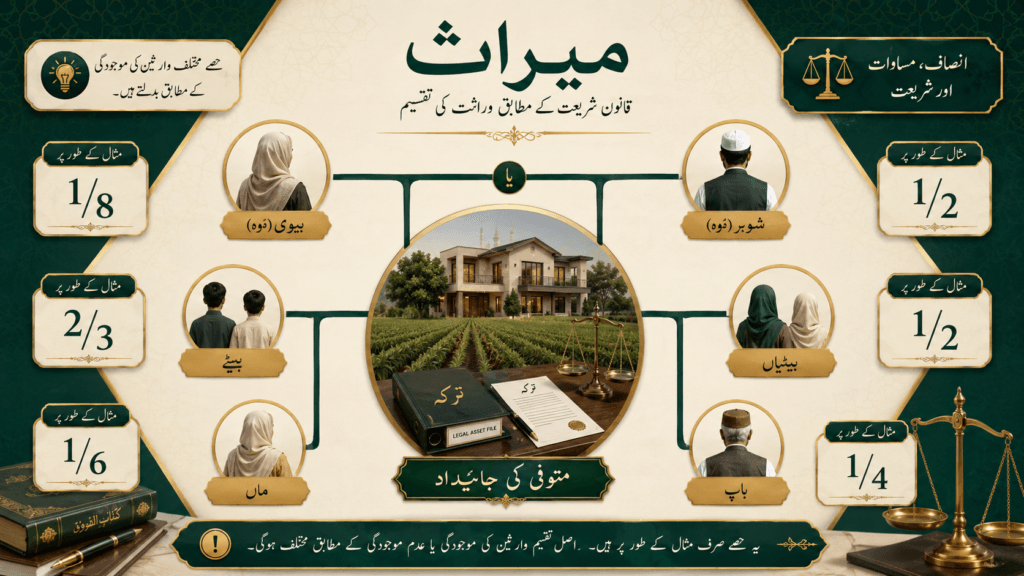
Daughters are legal heirs. Marriage does not erase that status.
The protection of daughters is a central part of Legal Heirs in Pakistan Law, and marriage alone does not remove a daughter from her deceased parent’s inheritance.
In common Sunni inheritance situations:
| Family Situation | Daughter’s Common Share |
|---|---|
| One daughter, no son | 1/2, subject to other heirs |
| Two or more daughters, no son | 2/3 collectively, subject to other heirs |
| Daughter with son | They take the residue, ordinarily with a 2:1 unit ratio between son and daughter |
The Supreme Court’s discussion in PLD 1990 SC 1 refers to the traditional rules that one daughter may receive one-half and multiple daughters, in the relevant situation, collectively receive two-thirds.
Does a Married Daughter Lose Her Inheritance?
No. Marriage by itself does not cancel a daughter’s inheritance.
A daughter does not lose her lawful share merely because:
- She has married;
- Her husband is wealthy;
- Her parents spent money on her wedding;
- She received jewellery or household goods;
- Brothers supported her after divorce;
- She lives in another city or country.
This principle becomes especially powerful when we examine PLD 1990 SC 1 later in this article.
Can Dowry or Wedding Expenses Replace a Daughter’s Share?
Family members sometimes say:
“You received jewellery.”
“We paid for your marriage.”
“We gave you furniture.”
“We supported you for years.”
“Therefore, you have no inheritance.”
That argument should never be accepted automatically.
In PLD 1990 SC 1, the brothers claimed that they had spent approximately Rs.100,000 on two marriages of their sister, around Rs.10,000 in a criminal case connected with the circumstances described in the judgment, and money on her maintenance. They relied on those matters to support an alleged relinquishment of her share.
The Supreme Court did not allow those circumstances to destroy the inheritance that had already accrued to her. The Court treated the alleged relinquishment in the circumstances of that case as void and ineffective.
That is a very different proposition from saying that no heir can ever legally transfer inherited property. Once inheritance has vested, a competent heir may in an appropriate case make a legally valid transfer, gift or family arrangement if all legal requirements are genuinely satisfied.
The lesson is narrower but extremely important:
Do not confuse family expenditure with an automatic legal surrender of inheritance.
What Share Do Mother and Father Receive?
Parents are frequently forgotten when families calculate only the widow and children.
Parents must also be considered carefully under Legal Heirs in Pakistan Law because the mother and father can remain legal heirs even where the deceased leaves children.
They can themselves be legal heirs.
Mother
In common Sunni/Hanafi rules, the mother may receive:
- 1/6 where the deceased leaves a child or in certain sibling situations;
- 1/3 in some cases where there is no child and the conditions reducing her share are absent.
There are also well-known special combinations involving a spouse together with both parents where the mother’s calculation is based on the residue rather than simply taking one-third of the whole estate.
Father
The father’s position also changes with the family tree.
Depending on the surviving descendants, he may:
- Receive a fixed 1/6;
- Receive a fixed share plus residue;
- Or become a residuary heir where the conditions permit.
Why Parents’ Shares Should Not Be Calculated in Isolation
Suppose a deceased person leaves:
- One daughter;
- Father;
- Widow.
It would be wrong to calculate each person by looking at a separate internet table without reconciling all heirs together.
In one common Sunni example:
- Daughter = 1/2
- Widow = 1/8
- Father = his applicable fixed entitlement plus the residue
The final distribution must add up to the complete estate.
Inheritance calculations are interconnected.
Do Brothers and Sisters Always Inherit?
No.
A brother or sister does not automatically inherit merely because the deceased had no will.
Sibling inheritance is one of the areas where simple online charts create serious errors.
Sibling shares are one of the more complicated areas of Legal Heirs in Pakistan Law because closer heirs can reduce or completely exclude their entitlement.
There are different categories, including:
- Full brothers and sisters;
- Consanguine/paternal brothers and sisters;
- Uterine/maternal brothers and sisters.
Their entitlement can change or disappear depending on the presence of:
- Children;
- Sons;
- Daughters;
- Father;
- Grandfather;
- Other siblings.
For example, in common Sunni law:
- One eligible uterine sibling may receive 1/6;
- Two or more eligible uterine siblings may collectively receive 1/3;
- One eligible full sister may in certain circumstances receive 1/2;
- Two or more eligible full sisters may in certain circumstances receive 2/3 collectively;
- A full brother and full sister may in the appropriate residuary situation divide the residue on a 2:1 unit basis.
But those figures cannot be applied until exclusion rules and all closer heirs are checked.
If a disputed estate includes siblings, grandparents, grandchildren or multiple branches of a family, a professional inheritance calculation is much safer than copying a single fraction.
Do Grandchildren Inherit in Pakistan?
Yes, grandchildren can have inheritance rights, but the legal route matters.
Grandchildren are another important part of Legal Heirs in Pakistan Law, particularly where their father or mother died before the person whose succession later opens.
One especially important Pakistani statutory rule is Section 4 of the Muslim Family Laws Ordinance, 1961.
The provision addresses the situation where a son or daughter of the person whose estate later opens has already died.
The children of that predeceased son or daughter who are alive when succession opens may receive, per stirpes, the share their parent would have received had that parent been alive.
You can read the official Muslim Family Laws Ordinance, 1961 on Pakistan Code.
Parliament also enacted the Muslim Family Laws (Amendment) Act, 2021 relating to Section 4, which is recorded on the official Senate Acts page.
For a broader explanation of this law, see our internal guide on the Muslim Family Laws Ordinance.
What Does “Per Stirpes” Mean?
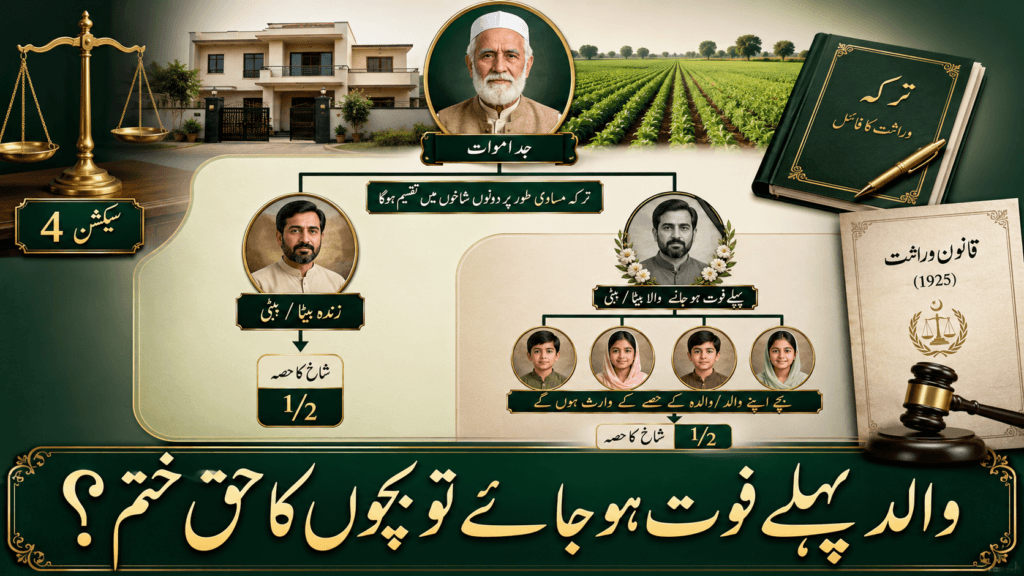
It means inheritance is approached branch by branch.
For Pakistani Muslim families, Legal Heirs in Pakistan Law cannot be properly understood without considering Section 4 of the Muslim Family Laws Ordinance, 1961.
Imagine a grandfather had two sons:
- Son A;
- Son B.
Son A dies before the grandfather but leaves children. Son B is alive when the grandfather dies.
Section 4 addresses the branch of Son A by looking at the share Son A would have received had he been alive.
The children of the predeceased child do not simply disappear from the succession merely because their parent died first.
What If a Daughter Dies Before Her Parent?
Section 4 is important because it refers to a predeceased son or daughter.
So the issue is not limited only to children of a predeceased son.
A family should not exclude grandchildren simply by saying:
“Your mother died before your grandfather, so you have nothing.”
The applicable Section 4 analysis must first be made.
What About Ahl-e-Tashih / Fiqh-e-Jafria Inheritance?
This deserves its own warning.
Do not take a Sunni inheritance calculator and automatically apply it to every Ahl-e-Tashih estate.
The 2021 amendment to Section 4 introduced provisions relevant to Ahl-e-Tashih succession, and personal-law treatment can differ from Sunni/Hanafi rules. The official Senate record confirms the Section 4 amendment in 2021.
Where an estate is governed by Fiqh-e-Jafria, the exact personal law and current statutory provisions should be examined before shares are calculated.
Can a Muslim Make a Will and Disinherit the Legal Heirs?
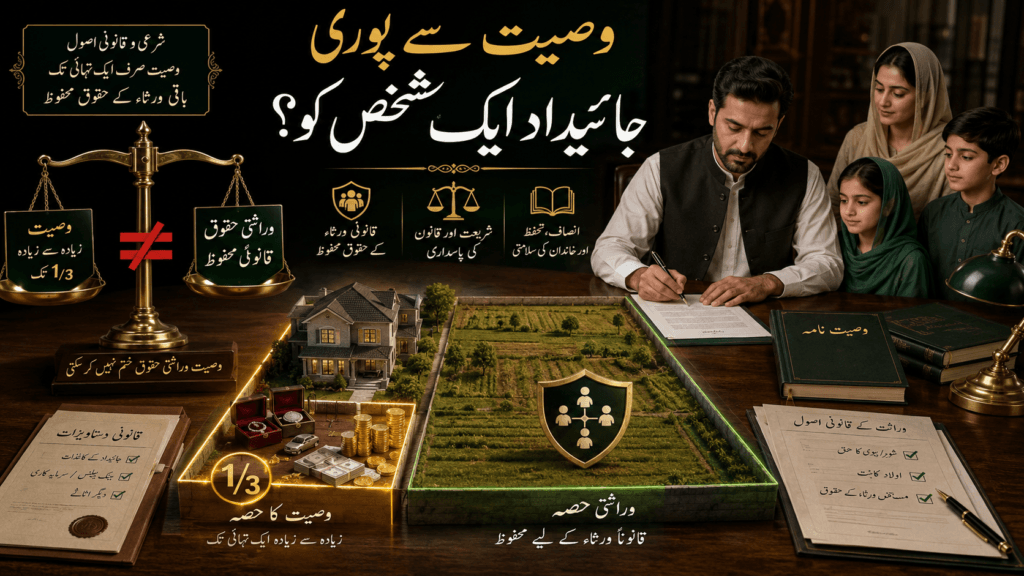
This is another major misunderstanding.
A will must also be understood within Legal Heirs in Pakistan Law because testamentary wishes and mandatory inheritance rights are not the same thing.
A person cannot safely assume:
“The property is mine, so I can write a will giving 100% to one child and leave everyone else with nothing.”
Under the commonly applied Sunni Muslim law of wasiyat, a person generally has testamentary freedom over up to one-third of the net estate without needing the heirs’ consent, subject to applicable legal rules.
A bequest exceeding the permissible one-third normally requires the consent of the affected heirs after succession opens.
A bequest in favour of an existing legal heir also raises additional consent rules under Sunni law.
Fiqh-e-Jafria rules can differ, so the exact personal law must be checked.
Is Registration of a Muslim Will Always Compulsory?
Do not assume that an unregistered document is automatically worthless or that registration alone makes every will valid.
Questions can arise about:
- Capacity of the testator;
- Free consent;
- Authenticity;
- Witnesses;
- The property covered;
- The one-third restriction;
- Whether the beneficiary is already an heir;
- Consent of other heirs;
- Applicable sect/personal law.
A carefully written and properly documented will greatly reduces future disputes.
For a Supreme Court-based discussion, read our detailed guide on a Will in Pakistan.
Can Parents Give Away Property During Their Lifetime Instead?
Inheritance and a lifetime transfer are different legal events.
Inheritance operates after death.
A genuine lifetime:
- Sale;
- Gift/hiba;
- Settlement;
- Transfer;
may be governed by a different set of legal requirements.
Therefore, an heir cannot challenge every lifetime transaction simply by saying, “I would have inherited that property later.”
At the same time, a suspicious document created to defeat lawful rights can raise questions of fraud, capacity, execution, possession, undue influence and the essential requirements of the alleged transaction.
The nature of the document matters.
Succession Certificate vs Letter of Administration in Pakistan
Many families use these two terms as if they mean exactly the same thing.
They do not.
The administrative side of Legal Heirs in Pakistan Law becomes important when heirs need access to bank assets, land, houses or other property after death.
Current NADRA guidance distinguishes them as follows:
| Document | Main Use Under Current NADRA Guidance |
|---|---|
| Succession Certificate | Movable property/assets |
| Letter of Administration | Immovable property/assets |
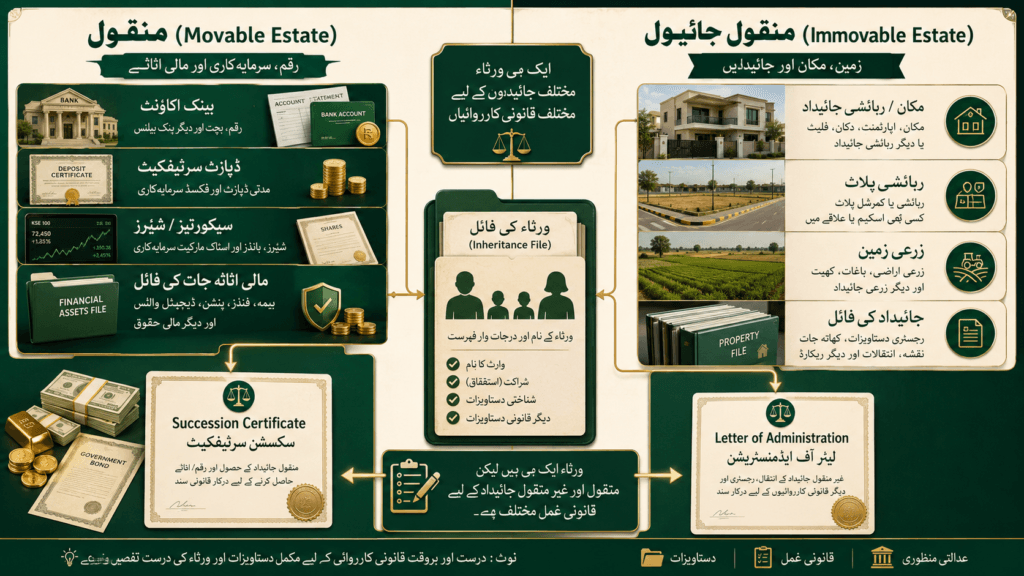
Common Movable Assets
These may include, depending on the case:
- Bank balances;
- Deposits;
- Certain securities;
- Receivables;
- Other movable financial assets.
Common Immovable Assets
These may include:
- House;
- Plot;
- Agricultural land;
- Commercial property;
- Other immovable property.
The Letters of Administration and Succession Certificates Act, 2020 is available on the official Pakistan Code website.
But there is an important jurisdictional point.
Pakistan does not have only one procedural statute operating identically in every province.
NADRA’s current official legal framework lists:
- Federal legislation of 2020;
- Punjab legislation of 2021;
- Sindh legislation of 2021;
- Khyber Pakhtunkhwa legislation of 2021;
- Balochistan legislation of 2022;
- Gilgit-Baltistan legislation of 2021.
Therefore, the correct procedure must be checked according to the relevant jurisdiction and property.
How to Get a Succession Certificate or Letter of Administration Through NADRA
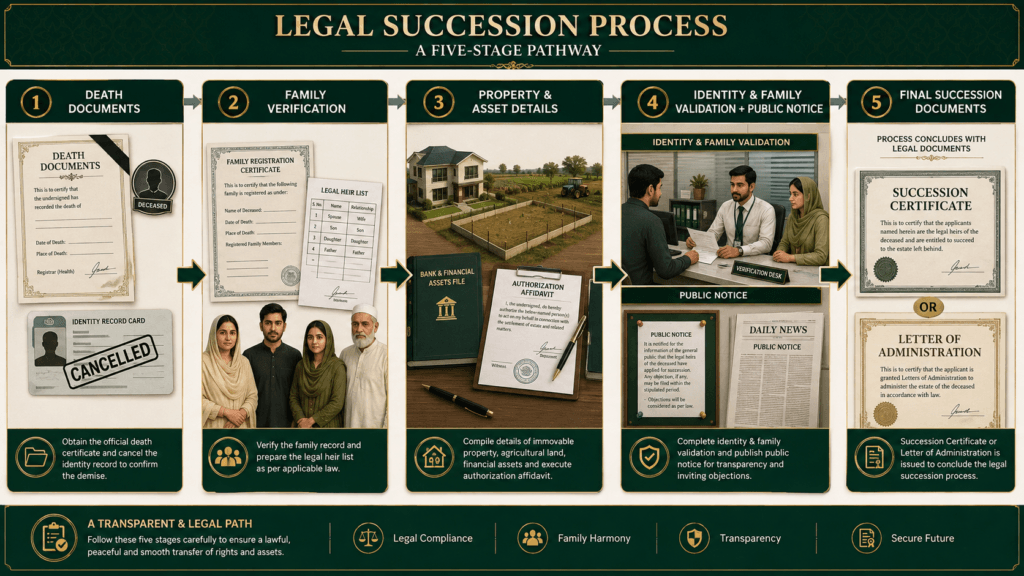
As of August 2026, NADRA states that the Federal and Provincial Governments have mandated it under their respective succession laws to issue Succession Certificates for movable property and Letters of Administration for immovable property to eligible legal heirs.
For many uncontested estates, Legal Heirs in Pakistan Law now works alongside the statutory NADRA succession process for obtaining the appropriate succession document.
NADRA describes a five-step route through designated succession facilities.
Step 1: Prepare the Documents
Current NADRA guidance lists these requirements:
- Death Certificate of the deceased;
- CNIC Cancellation Certificate issued by NADRA;
- Family Registration Certificate (FRC);
- List of legal heirs with copies of their CNICs;
- Details of movable and immovable property;
- Letter of Authorization/Affidavit attested by an Oath Commissioner.
Step 2: One Legal Heir Initiates the Application
NADRA states that one legal heir must visit a designated site after the required documentation is completed.
Its current guidance specifically states that in Sindh and Balochistan the process is through legal counsel only.
Step 3: NADRA Validates the Family Information
NADRA uses its citizen records, including the Family Registration Certificate, for validation of the legal heirs.
This is why incomplete or incorrect family registration data should be addressed rather than ignored.
Step 4: Publication and Opportunity for Objection
The process includes publication so that a claim is not quietly processed without the legally required opportunity for objections.
An objection or genuine heirship dispute may prevent a simple administrative route from resolving the entire controversy.
Step 5: Certificate or Letter Is Issued if the Case Qualifies
NADRA currently lists a processing time of 14 days after publication.
Current NADRA Fee
NADRA presently states:
- Rs.20,000, with an additional Rs.2,000 where applicable, for assets of Rs.100,000 or more;
- Rs.10,000 for assets below Rs.100,000.
Because government fees can change, always confirm the latest fee on the official NADRA Succession Certificate page before filing.
When Does an Inheritance Matter Need a Court?
NADRA provides an important administrative route, but it is not a substitute for a judicial determination where a genuine controversy requires evidence and adjudication.
A dispute under Legal Heirs in Pakistan Law may require judicial determination where heirship, title, a will, gift, relinquishment or another material fact is genuinely contested.
A matter may require intervention of the competent court where, for example, there is a serious dispute about:
- Who is or is not an heir;
- Authenticity of a marriage or relationship;
- A competing family tree;
- A disputed will;
- Fraud or forged documents;
- Ownership of the alleged estate;
- A contested lifetime gift or sale;
- Competing succession claims;
- A disputed relinquishment;
- Objections that cannot be resolved through the summary administrative process.
The exact forum and procedure depend on the nature of the controversy and the applicable federal or provincial law.
The safest rule is:
First identify the dispute. Then identify the correct legal forum.
Do not file every inheritance problem in the same office merely because all of them involve a deceased person.
Does a Succession Certificate Decide Ownership of Every Property Dispute?
Not necessarily.
There is a difference between:
- Identifying legal heirs and their entitlement for succession administration; and
- Deciding a contested title dispute.
This distinction is important under Legal Heirs in Pakistan Law because a succession document does not automatically resolve every separate dispute about ownership or title.
If someone says that the property never belonged to the deceased, that it was gifted years earlier, that a registered sale transferred it, or that another person owns it, the controversy may require separate adjudication.
A succession document should not be treated as a magic substitute for resolving every disputed title.
What If a Woman Is Deliberately Deprived of Inheritance?
Women’s inheritance is not a family favour.
Legal Heirs in Pakistan Law also protects the basic principle that a lawful heir should not lose property merely because another family member controls the documents or possession.
Women’s protection remains one of the most important public-awareness issues connected with Legal Heirs in Pakistan Law, particularly where daughters or widows are excluded from family property.
Pakistan also has statutory protections against depriving women of property rights. The official Pakistan Code hosts the Enforcement of Women’s Property Rights Act, 2020.
The exact remedy and forum depend on territorial jurisdiction and applicable federal or provincial law.
Depriving a woman of inheritance through deceitful or illegal means can also have criminal-law consequences under Pakistani law.
For a detailed judgment-based explanation of harmful customs and women’s inheritance protection, read our guide on Inheritance Law in Pakistan and Women’s Rights.
The following Supreme Court judgment shows how Legal Heirs in Pakistan Law operates when a lawful female heir is omitted from an inheritance mutation.
The Supreme Court Case Every Family Should Read: PLD 1990 SC 1
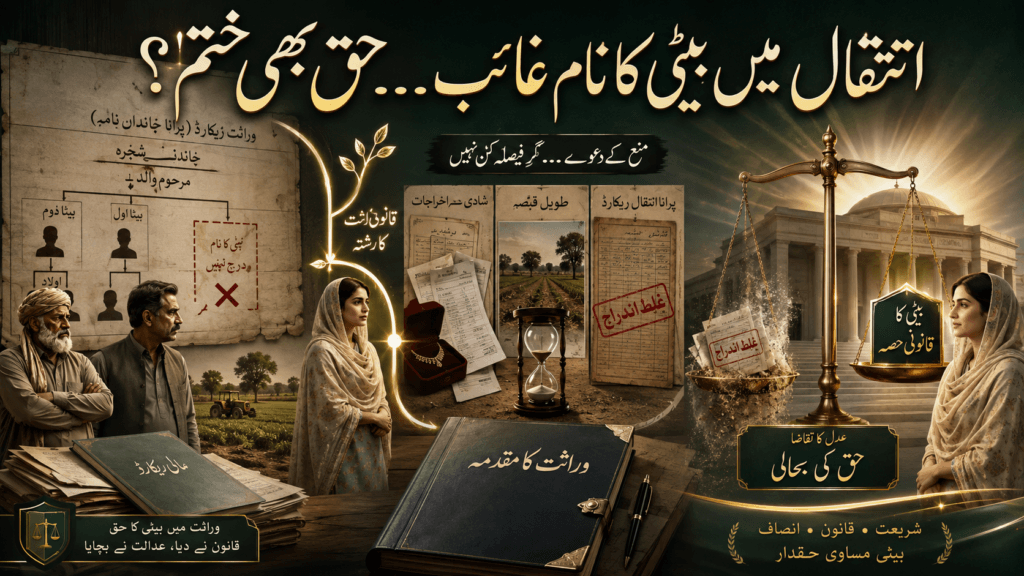
Ghulam Ali and Others v. Mst. Ghulam Sarwar Naqvi
This judgment gives the broad topic of legal heirs in Pakistan law a human face.
It shows what can happen when a daughter is a lawful heir but disappears from one part of the revenue record.
Judgment at a Glance
| Point | What Happened |
|---|---|
| Court | Supreme Court of Pakistan |
| Citation | PLD 1990 Supreme Court 1 |
| Case | Ghulam Ali and 2 others v. Mst. Ghulam Sarwar Naqvi |
| Decision date | 15 May 1989 |
| Main dispute | Sister omitted from inheritance mutation |
| Brothers’ pleas | Relinquishment, adverse possession, ouster, limitation and related objections |
| Supreme Court result | Petition dismissed |
The official reported case supplied for this article identifies the parties and decision as Ghulam Ali and 2 others v. Mst. Ghulam Sarwar Naqvi, decided on 15 May 1989.
Facts of the Case
The petitioners were three sons of Ghulam Ahmed Shah. The respondent was their sister.
Their father had died around 1903 and had left landed property in different estates.
According to the reported judgment, inheritance was properly reflected in other estates, but in disputed Mutation No. 1231, sanctioned on 20 July 1963, the sister’s name was omitted from the pedigree table.
The judgment records her disputed share as 7 kanals and 12 marlas.
That omission deprived her, in the record, of the Islamic share claimed in that property.
What Did the Brothers Say?
The brothers argued that their sister had relinquished the relevant inheritance.
They relied on money allegedly spent on:
- Two marriages arranged for her;
- A criminal case connected with the circumstances described in the judgment;
- Her maintenance.
The trial court had dismissed her suit, among other reasons, on the basis of relinquishment.
The appellate court set that finding aside. The brothers’ civil revision was then dismissed by the Lahore High Court, after which they approached the Supreme Court.
IRAC Analysis of PLD 1990 SC 1
Issue
Could the brothers defeat their sister’s inherited share by relying on:
- A wrong mutation;
- Alleged relinquishment;
- Long exclusive possession;
- Adverse possession;
- Ouster;
- Limitation;
- Estoppel or waiver?
Rule
The Supreme Court considered established inheritance and co-sharer principles.
A wrong mutation itself does not create title merely because it has remained in the revenue record for many years.
Possession of one co-sharer can, in appropriate circumstances, be treated as possession on behalf of the other co-sharers.
Mere non-participation in profits or an incorrect revenue entry does not by itself prove ouster.
Analysis
The Court examined the relationship between the brothers and sister, the inherited nature of the property, and the alleged relinquishment.
The judgment emphasized that inheritance had accrued to the sister when her father died.
The brothers could not turn an incorrect mutation and their own possession into automatic ownership against her.
The Court also rejected the purported relinquishment on the facts before it, treating it as void and ineffective and observing that the inheritance already accrued to the sister remained intact.
The Court further rejected the pleas of adverse possession, estoppel, waiver and ouster in the circumstances of the case.
Conclusion
The Supreme Court found no force in the petition and dismissed it.
Does a Wrong Mutation Destroy an Heir’s Ownership?
PLD 1990 SC 1 is particularly important on this point.
The judgment relied on earlier Supreme Court authority explaining that a wrong mutation does not itself confer proprietary rights merely because it appears in the revenue record.
This means families should distinguish:
Revenue entry from underlying legal title.
But there is another important warning.
Do not read this judgment as saying:
“An inheritance claim can never become time-barred, no matter what happens.”
Limitation in inheritance litigation can depend on:
- The relief claimed;
- Date of knowledge;
- Express denial;
- Nature of possession;
- Earlier transfers;
- Conduct of the parties;
- Fraud;
- Whether rights were openly repudiated;
- Applicable limitation provisions;
- Subsequent case law.
For that reason, anyone facing an old inheritance dispute should also read our detailed guide on Limitation in Inheritance Cases in Pakistan.
Do not delay a genuine claim simply because an old judgment protected another heir on different facts.
Can One Brother Keep the Entire Property Because He Has Possession?
Possession is important evidence, but it does not automatically answer inheritance.
The Supreme Court explained in PLD 1990 SC 1 that the possession of one co-sharer may operate for the benefit of the others and that the brothers’ possession could be treated as possession for the sister unless there had been the legally necessary repudiation/ouster.
The judgment also observed that mere failure to pay profits does not automatically prove ouster and that a male-only partition does not by itself necessarily eliminate the rights of female heirs.
Again, every later case must be examined on its own evidence.
Can a Sister Give Her Inheritance to Her Brothers?
This question requires care.
The answer is not simply “never.”
Once property has validly vested in an adult heir, that heir may potentially transfer it through a legally recognised transaction if all requirements are satisfied.
Depending on the transaction, issues may include:
- Free consent;
- Consideration;
- Gift requirements;
- Registration where legally required;
- Delivery/possession where relevant;
- Undue influence;
- Fraud;
- Genuine family settlement.
PLD 1990 SC 1 should not be misread as invalidating every voluntary post-inheritance transaction by a woman.
What the Supreme Court rejected was the alleged relinquishment in the circumstances before it, including the attempt to justify deprivation through marriage expenses and other family expenditure.
That distinction is legally important.
What Should You Do If Your Name Is Missing From Inherited Property?
Do not begin with confrontation. Begin with evidence.
A practical claim under Legal Heirs in Pakistan Law becomes much stronger when the heir first collects the family, property and succession records needed to prove the right.
1. Confirm the family tree
Obtain and preserve:
- Death certificate;
- CNIC records;
- Family Registration Certificate;
- Nikahnama where relevant;
- Birth records where necessary.
2. Identify the entire estate
Look for:
- Agricultural land;
- Residential property;
- Commercial property;
- Bank accounts;
- Vehicles;
- Securities;
- Business interests;
- Receivables.
3. Obtain property records
For land, obtain relevant copies of:
- Inheritance mutation;
- Jamabandi/record of rights;
- Fard;
- Pedigree table;
- Earlier ownership record;
- Transfer entries.
4. Check whether there was any alleged transfer
Ask whether anyone relies on:
- Gift;
- Sale;
- Relinquishment;
- Family settlement;
- Will;
- Power of Attorney.
Obtain the document instead of arguing about what relatives say it contains.
5. Preserve the date of denial
If another heir expressly refuses your share, preserve:
- Messages;
- Notices;
- Applications;
- Revenue proceedings;
- Replies;
- Any written acknowledgment or denial.
This can become important in limitation litigation.
6. Identify the correct forum
Depending on the dispute, the route may involve:
- NADRA succession proceedings;
- Revenue authorities;
- Civil court;
- Other competent statutory forum.
The correct forum depends on the remedy you actually need.
A Practical Inheritance Checklist After a Death
Before family conflict begins:
- Obtain the death certificate.
- Complete CNIC cancellation where required.
- Obtain the FRC.
- Prepare a complete list of surviving family members.
- Do not hide daughters, widows or grandchildren.
- List all movable and immovable assets.
- Identify debts and legal liabilities.
- Check whether a will exists.
- Obtain the relevant property record.
- Calculate shares only after identifying all surviving heirs.
- Apply for the appropriate Succession Certificate/Letter of Administration where required.
- Complete mutation or transfer formalities for immovable property.
- Keep copies of every signed document.
- Do not sign a blank relinquishment, affidavit or power of attorney.
- If a dispute has already arisen, obtain legal advice before delay creates further complications.
Common Myths About Legal Heirs in Pakistan Law
Myth 1: The eldest son becomes head and owner of the estate
Wrong.
Being the eldest son does not give him the legal power to erase other heirs.
Myth 2: A married daughter has already received her share
Wrong.
Marriage itself does not cancel inheritance.
Myth 3: A widow can live in the house but cannot own it
Wrong.
A widow can herself be an heir with a legally recognised fractional share.
Myth 4: Whoever has the mutation owns the property
Not necessarily.
PLD 1990 SC 1 itself demonstrates why an incorrect revenue entry should not be confused with lawful devolution of inheritance.
Myth 5: Grandchildren always get nothing if their parent died first
Wrong as a blanket statement.
Section 4 of the Muslim Family Laws Ordinance specifically addresses children of a predeceased son or daughter.
Myth 6: A will can give the entire Muslim estate to one favourite child
Not safely as a general rule.
Muslim testamentary restrictions and heirs’ consent can become decisive.
Frequently Asked Questions About Legal Heirs in Pakistan Law
Who are legal heirs in Pakistan?
Legal heirs are persons entitled under the applicable succession or personal law to inherit from the deceased. For a Muslim estate they may include the spouse, children, parents and, depending on the family structure, grandchildren, siblings and other recognised relatives.
Does a widow inherit her husband’s property?
Yes. Under the common Sunni rule, a widow generally receives 1/4 where the husband leaves no qualifying descendant and 1/8 where he leaves a qualifying descendant. Other heirs receive their separate shares.
Does a husband inherit from his wife?
Yes. Under the common Sunni rule, a husband generally receives 1/2 if his wife leaves no qualifying descendant and 1/4 if she does.
Does a daughter inherit after marriage?
Yes. Marriage does not by itself take away a daughter’s inheritance.
Can parents say they spent money on a daughter’s marriage instead of giving inheritance?
Marriage expenses should not automatically be treated as a substitute for inheritance. PLD 1990 SC 1 rejected the brothers’ attempt to rely on such expenditure to defeat the sister’s inherited right in the circumstances of that case.
Does a son always receive twice as much as a daughter?
No. The 2:1 rule applies in particular situations, especially when sons and daughters inherit together as residuaries. It is not a universal rule under which every male heir gets twice every female heir.
Can the deceased’s mother and father inherit when children exist?
Yes. Parents can still be heirs. Their exact fractions depend on the full family structure.
Do brothers and sisters inherit when a person dies?
Sometimes. Sibling rights depend heavily on whether children, father, grandparents and other heirs survive. They should not be calculated without checking exclusion rules.
Can grandchildren inherit if their father died before their grandfather?
Section 4 of the Muslim Family Laws Ordinance addresses children of a predeceased son or daughter and provides a branch-based statutory succession mechanism.
What if the deceased daughter died before her parent?
Section 4 is not limited only to a predeceased son. The provision also refers to a predeceased daughter.
Can a father disinherit a child through a will?
A Muslim cannot safely defeat the mandatory inheritance scheme simply by writing an unrestricted will. The one-third rule, bequests to heirs, consent and applicable personal law must be examined.
What is the difference between a Succession Certificate and Letter of Administration?
Current NADRA guidance describes a Succession Certificate for movable property and a Letter of Administration for immovable property.
What documents does NADRA require for succession?
NADRA currently lists the death certificate, CNIC Cancellation Certificate, FRC, list and CNIC copies of legal heirs, details of movable/immovable assets and an attested authorization/affidavit among the requirements.
How long does the NADRA succession process take?
Current NADRA guidance states 14 days after publication, assuming the matter can proceed through the administrative route.
Is NADRA procedure exactly the same throughout Pakistan?
The overall service is offered under federal and provincial succession laws, but the applicable legislation and some procedural requirements vary by jurisdiction. NADRA officially lists separate federal, Punjab, Sindh, Khyber Pakhtunkhwa, Balochistan and Gilgit-Baltistan succession laws.
Does a wrong inheritance mutation permanently destroy an heir’s claim?
Not automatically. PLD 1990 SC 1 held on its facts that the wrong mutation did not confer title and rejected the brothers’ related pleas. But limitation and later transactions can be fact-sensitive, so old disputes should be examined promptly.
Can a sister voluntarily transfer her inherited property?
Potentially yes, after inheritance has vested, if the transaction is genuine and all applicable legal requirements are satisfied. A suspicious or coerced “relinquishment” is a different matter.
Do these Muslim share tables apply to every Pakistani?
No. The examples in this guide explain common Muslim/Sunni-Hanafi situations. Ahl-e-Tashih personal law and non-Muslim succession can require different rules.
Final Word: A Name Missing From the Record Does Not Tell the Whole Legal Story
Inheritance disputes often begin with a piece of paper.
One heir sees a mutation and believes the matter ended decades ago.
Another sees a family house occupied by the eldest brother and assumes there is nothing left to claim.
A married daughter stays silent because she was taught that asking for inheritance will break the family.
But legal heirs in Pakistan law are determined by law—not merely by possession, family status or an incorrect document.
PLD 1990 SC 1 remains a powerful reminder of that principle. The sister in that case had been omitted from the disputed inheritance record, yet the Supreme Court rejected the attempts to defeat the right that had already accrued to her and ultimately dismissed the brothers’ petition.
The safest inheritance is not the one settled by silence.
It is the one settled after every legal heir is identified, every asset is disclosed, every liability is checked, every share is correctly calculated and every transfer is properly documented.
Ultimately, Legal Heirs in Pakistan Law is not only about fractions; it is about ensuring that every lawful heir is identified and no person loses property merely because another relative controls the record.
Disclaimer: This article is for legal awareness and general education. Inheritance shares can change with the complete list of surviving heirs, personal law, sect, province, property type, previous transfers and disputed facts. Do not use a simplified example as a final inheritance decree or legal opinion. Consult a qualified lawyer for a specific estate or disputed claim.