
A woman’s inheritance can disappear from paper with one wrong mutation—but does that mean her legal right also disappears?
Imagine a sister who trusts her brothers for years. She does not demand partition. She does not regularly visit the revenue office. For some time, her brothers even give her a share from the produce of family land. Then one day the payments stop. When she asks for her property, she is told:
“The mutation is decades old. The land is ours now.”
This painful situation lies at the heart of women inheritance rights in Pakistan and the Supreme Court judgment reported as 2023 SCMR 1901, Mohammad Boota (deceased) through LRs and others v. Mst. Fatima daughter of Gohar Ali and others.
The dispute was extraordinary. It involved tenancy rights in hundreds of kanals of land in Bahawalpur, inheritance mutations from 1952 and 1956, female heirs who had been excluded, two separate civil suits, decades of litigation, historical Muslim Personal Law, the Colonization of Government Lands (Punjab) Act, 1912, and a serious limitation objection.
The Supreme Court ultimately refused to interfere with the judgments protecting the female heirs.
This guide explains the complete judgment in simple English and then turns its legal principles into practical awareness for daughters, sisters, widows and families dealing with women inheritance rights today.
Table of Contents
IRAC Analysis of 2023 SCMR 1901
| IRAC | Supreme Court Analysis |
|---|---|
| Issue | Whether the female heirs could succeed to the disputed tenancy when Din Muhammad had died before section 19-A was inserted into the Colonization of Government Lands (Punjab) Act, 1912; whether section 20 could exclude female descendants; whether the appellants became original tenants because they later completed payment; and whether the women’s suits were barred by limitation. |
| Rule | The Court examined sections 19-A, 20 and 21 of the Colonization Act, section 5 of the Punjab Laws Act, 1872, the Muslim Personal Law legislation of 1937, 1948 and 1951, the West Pakistan Muslim Personal Law (Shariat) Application Act, 1962, and section 2-A inserted in 1983. It also examined Supreme Court precedents on Muslim succession, custom, mutations and limitation. |
| Analysis | The Supreme Court concluded that Shariat governed Muslim succession in Bahawalpur even before March 1951 because the 1948 Shariat Act had already applied Muslim Personal Law to succession, including agricultural land. The appellants had acquired their tenancy rights as legal heirs of Din Muhammad, so completing payment later did not make them original tenants. The sisters also asserted that they had received proceeds from the tenancy until their shares were later denied, which was relevant to limitation. |
| Conclusion | The Supreme Court found no merit in the appellants’ arguments, rejected the limitation objection on the facts before it, declined to interfere with the Lahore High Court judgments and dismissed both civil appeals. |
The central issue identified by the Court was whether succession was controlled by section 20 of the Colonization Act or by Shariat.
Judgment at a Glance: Women Inheritance Rights Case Snapshot
| Point | Details |
|---|---|
| Case | Mohammad Boota (deceased) through LRs and others v. Mst. Fatima daughter of Gohar Ali and others |
| Citation | 2023 SCMR 1901 |
| Court | Supreme Court of Pakistan |
| Bench | Umar Ata Bandial, C.J., Ayesha A. Malik and Athar Minallah, JJ. |
| Author Judge | Ayesha A. Malik, J. |
| Civil Appeal No. | 419 of 2011 |
| Second Civil Appeal | 1184 of 2019 |
| Connected Application | C.M.A. No. 1839 of 2011 |
| Hearing Date | 22 February 2023 |
| Decision Date | 22 August 2023 |
| Original Tenant | Din Muhammad |
| Location | Chak No. 29/DNB, Tehsil and District Bahawalpur |
| First Property | 200 kanals with residential Ihata No. 48 |
| Second Property | 194 kanals 13 marlas with Ihata No. 49 |
| Female Heirs Mentioned | Fatima Bibi, Mehr Bibi, Karam Bibi, Allah Rakhi and Fazal Bibi |
| Male Heirs Mentioned | Muhammad Boota and Jan Muhammad |
| Mutation No. 19 | 20 July 1952 |
| Mutation No. 21 | 4 June 1956 |
| Major Laws | Colonization Act, 1912; Muslim Personal Law legislation; Shariat Act, 1962; Limitation Act, 1908 |
| Core Holding | Shariat governed the Muslim succession in issue; old mutations and the appellants’ later payments did not defeat the female heirs’ claim |
| Final Result | Both appeals dismissed; no order as to costs; C.M.A. disposed of |
The case title, bench, appeal numbers and decision date appear at the beginning of the reported judgment.
Why This Judgment Matters for Women Inheritance Rights
This case was not simply about whether daughters should receive property.
The real legal question was much harder.
The appellants argued that the original succession had opened before 1951, when a historical provision of the Colonization Act appeared to give male descendants priority.
The female heirs said Shariat governed the succession.
So the Supreme Court had to examine more than a century of legal history to decide women inheritance rights correctly.
The judgment is especially important because similar arguments still appear in family disputes:
- “The mutation is very old.”
- “Women never received this land.”
- “This is our family custom.”
- “Only brothers cultivated the land.”
- “She never demanded anything.”
- “She was already given dowry.”
- “The brothers paid for the land.”
- “Her name was never in the revenue record.”
2023 SCMR 1901 shows that none of these statements should be accepted without examining the law, evidence, history of possession, mutation record and date of actual denial.
The Family Behind the 70-Year Property Dispute
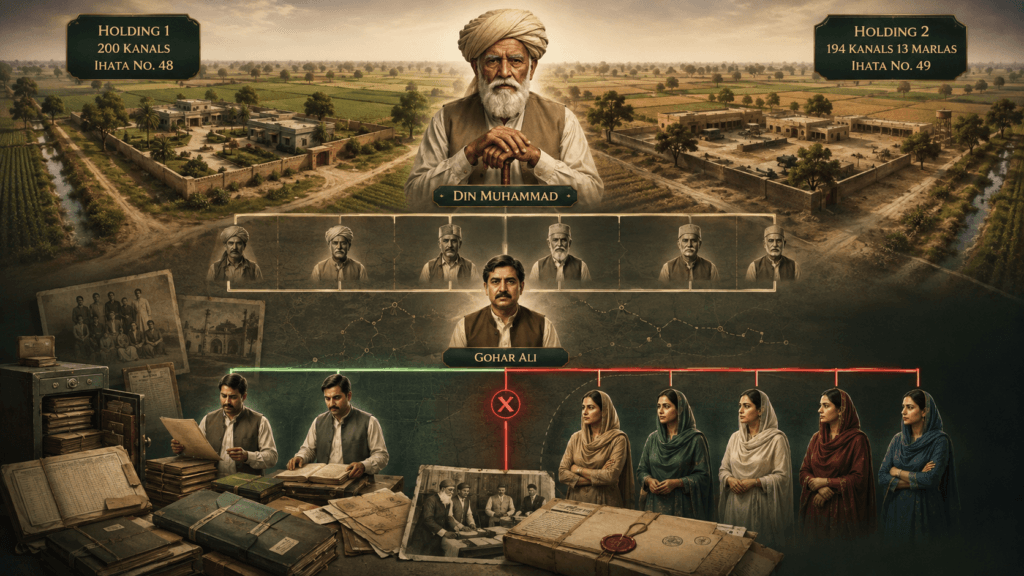
Din Muhammad had originally been awarded tenancy rights under an Abadkari Scheme.
The case involved two separate holdings:
- land measuring 200 kanals with residential Ihata No. 48; and
- land measuring 194 kanals 13 marlas with Ihata No. 49.
Both were located in Chak No. 29/DNB, Tehsil and District Bahawalpur.
Din Muhammad died without children.
He had two brothers:
- Nanak
- Manak
They also died.
The tenancy rights eventually came through the sons of those brothers, including Gohar Ali.
Gohar Ali had two sons:
- Muhammad Boota
- Jan Muhammad
He also had five daughters:
- Fatima Bibi
- Mehr Bibi
- Karam Bibi
- Allah Rakhi
- Fazal Bibi
The record showed that the tenancy rights passed to Muhammad Boota and Jan Muhammad while Gohar Ali’s daughters were excluded from succession.
That exclusion triggered the dispute that later became an important Supreme Court authority on women inheritance rights.
First Suit: Fatima and Mehr Challenge Mutation No. 21
Fatima Bibi and Mehr Bibi filed Suit No. 693 on 12 October 1985.
They challenged Inheritance Mutation No. 21 dated 4 June 1956.
The mutation had been sanctioned in favour of Muhammad Boota and Jan Muhammad on the basis of a Deputy Commissioner, Bahawalpur order dated 8 March 1956.
The sisters alleged that they had been deprived of their share in the tenancy.
But one fact became particularly important.
They said their brothers had been giving them their share from the tenancy proceeds for several years.
Then those payments suddenly stopped.
After that, their right to succession itself was denied.
This factual history later became highly relevant to women inheritance rights and limitation.
What Happened in the First Trial?
The Trial Court initially decreed the sisters’ suit on 30 April 1988.
Muhammad Boota and Jan Muhammad appealed.
On 8 April 1989, the appellate court remanded the case to the Trial Court for findings on two specific questions:
- Were the sisters entitled to succession to the tenancy?
- Was succession governed by the Colonization Act in a manner that excluded female legal heirs?
After remand, the result changed.
The Trial Court dismissed the sisters’ suit on 5 March 1990.
The appellate court maintained that dismissal on 6 June 1993.
It held that the succession was governed by section 20 of the Colonization Act.
Lahore High Court Reversed the Result
The sisters then approached the Lahore High Court, Bahawalpur Bench through civil revision.
The High Court allowed their revision on 7 April 2011.
Their suit was decreed.
The High Court relied on Shariat law and referred to Ghulam Ali and others v. Mst. Ghulam Sarwar Naqvi, PLD 1990 SC 1.
It also considered that the Deputy Commissioner order and mutation had been made after 1951.
The High Court therefore concluded that the sisters were entitled to their share according to Shariat.
That judgment became the subject of Civil Appeal No. 419 of 2011 before the Supreme Court.
Second Suit: Mutation No. 19 and 194 Kanals 13 Marlas
A second litigation track concerned the other property.
Fatima Bibi, Mehr Bibi, Allah Rakhi and Fazal Bibi filed Suit No. 64 on 2 April 1994.
This time they challenged:
- Deputy Commissioner order dated 22 August 1951; and
- Inheritance Mutation No. 19 dated 20 July 1952.
The disputed land measured 194 kanals 13 marlas.
The Trial Court decreed this suit on 30 April 2001.
The appellate court upheld the decree on 7 January 2002.
The legal heirs of Muhammad Boota and Jan Muhammad then filed Civil Revision No. 25-D-2002/BWP before the Lahore High Court.
The High Court dismissed the revision on 20 March 2014.
That matter became Civil Appeal No. 1184 of 2019.
Complete Litigation Timeline

| Date | Event |
|---|---|
| 22 August 1951 | Deputy Commissioner order relating to second property |
| 20 July 1952 | Mutation No. 19 sanctioned |
| 8 March 1956 | Deputy Commissioner order relating to first property |
| 4 June 1956 | Mutation No. 21 sanctioned |
| 12 October 1985 | Fatima and Mehr filed Suit No. 693 |
| 30 April 1988 | First suit decreed by Trial Court |
| 8 April 1989 | Matter remanded |
| 5 March 1990 | First suit dismissed after remand |
| 6 June 1993 | Appellate court maintained dismissal |
| 2 April 1994 | Second declaratory suit filed |
| 30 April 2001 | Second suit decreed |
| 7 January 2002 | Second decree upheld in appeal |
| 7 April 2011 | Lahore High Court allowed revision in first litigation |
| 20 March 2014 | Lahore High Court dismissed revision in second litigation |
| 29 April 2021 | Respondents proceeded ex parte; amicus appointed |
| 22 February 2023 | Supreme Court heard the matter |
| 22 August 2023 | Supreme Court dismissed both appeals |
This long timeline shows why women inheritance rights disputes should be addressed before they consume several generations.
Why Were the Respondents Ex Parte Before the Supreme Court?
The respondents did not appear before the Supreme Court.
They were proceeded ex parte through order dated 29 April 2021.
The Court nevertheless wanted proper assistance on the complicated historical legal issue.
Therefore, Barrister Umer Aslam, Advocate Supreme Court, was appointed as amicus curiae on the same date.
This is important.
The Supreme Court did not simply uphold the women’s case because the respondents were absent.
It independently examined the relevant statutes, historical legal framework and earlier Supreme Court authorities.
What the Appellants Argued Against Women Inheritance Rights
The appellants said Din Muhammad had died in 1950.
According to them, this was decisive.
Section 19-A was inserted into the Colonization Act only in 1951.
Therefore, they argued that succession had already opened before section 19-A made Muslim Personal Law applicable to tenancy succession.
Their argument was that section 20 controlled the inheritance.
Under that historical scheme, male lineal descendants received priority.
They therefore argued that the female descendants were excluded.
They also stressed that the relevant date should be the date of death of the original tenant, not the later date of the Deputy Commissioner’s order or mutation.
This argument required the Court to investigate the historical foundation of women inheritance rights in Bahawalpur.
Their Second Argument: “We Paid for the Land in 1958”
The appellants also raised an alternative plea.
They claimed Din Muhammad had not completed payment for the tenancy allotment.
According to them, the remaining amount was paid by the appellants in 1958.
They therefore argued that they should themselves be regarded as the original tenants.
If that argument succeeded, they said the sisters could not claim succession because the sisters had contributed nothing towards the purchase amount.
The Supreme Court rejected this argument.
What the Amicus Curiae Explained
The amicus gave the Supreme Court a wider historical picture.
He explained that before 1951, succession among Muslims in Punjab—including Bahawalpur—could already be governed by Muslim Personal Law.
Where someone wanted to defeat Shariat by relying on a local custom, that party had to prove:
- that the custom actually existed; and
- that the custom applied to the parties.
There was no established custom of that kind in this dispute.
The amicus relied upon Basheer Ahmed and others v. Mst. Fatima Bibi through LRs and others, 2020 SCMR 72 concerning the historical law applicable in Bahawalpur.
He also emphasized that the disputed mutations were sanctioned in 1952 and 1956, when the legal position regarding Shariat was even clearer.
The Supreme Court Asked an Even Bigger Question
The Lahore High Court had relied partly on the fact that the mutations were sanctioned after 1951.
The Supreme Court went further.
It asked:
What if Din Muhammad died before 1951? Was Shariat still the governing rule?
Answering that question required the Court to trace the law from 1872 onward.
That historical analysis became the heart of the judgment on women inheritance rights.
Punjab Laws Act, 1872: The Starting Point
Section 5 of the Punjab Laws Act, 1872 dealt with personal-law questions including:
- succession;
- special property of females;
- marriage;
- divorce;
- dower;
- adoption;
- guardianship;
- wills;
- legacies;
- gifts; and
- partition.
The rule recognized applicable custom provided it was not contrary to justice, equity and good conscience.
For Muslims, Muhammadan law was also recognized as a rule of decision.
Most importantly, a person relying upon a custom had to establish that custom and its applicability.
Muslim Personal Law (Shariat) Application Act, 1937
The Supreme Court next examined the 1937 legislation.
It provided for Muslim Personal Law to govern specified personal matters despite contrary custom.
However, the judgment notes that agricultural land remained an exception within that legal framework.
This agricultural-land problem later became crucial to women inheritance rights.
The 1948 Shariat Act Changed the Legal Position
The most important historical turning point identified by the Supreme Court was the Punjab Muslim Personal Law (Shariat) Application Act, 1948.
It was promulgated on 15 March 1948.
The Act provided that notwithstanding contrary custom or usage, succession—including succession to agricultural land where the parties were Muslims—was to be decided according to Muslim Personal Law.
That was crucial because the earlier agricultural-land exception was no longer available in the same way.
The Supreme Court treated this legislation as the key reason Shariat already governed the disputed succession before March 1951.
For current statutory research, readers can consult the official West Pakistan Muslim Personal Law (Shariat) Application Act, 1962 on Pakistan Code. Pakistan Code is maintained by the Ministry of Law and Justice.
What Changed Again in 1951?
The judgment records two important developments.
The Punjab Muslim Personal Law legislation was amended on 10 March 1951.
Separately, the Bahawalpur Muslim Personal Shariat (Application) Act, 1951 was promulgated on 4 March 1951.
It applied Shariat to Muslim personal-law matters in Bahawalpur, including succession.
Section 19-A was also inserted into the Colonization Act in 1951.
But the Supreme Court ultimately held that women inheritance rights in this dispute did not depend only on the 1951 changes because Shariat had already become applicable through the earlier legal framework.
West Pakistan Muslim Personal Law (Shariat) Application Act, 1962
The Supreme Court also examined the West Pakistan Muslim Personal Law (Shariat) Application Act, 1962.
The judgment records its promulgation on 31 December 1962.
The Act repealed earlier Shariat legislation identified by the Court.
Pakistan Code currently lists the 1962 Act as West Pakistan Act V of 1962.
Section 2-A was later inserted in 1983.
The Supreme Court discussed its purpose and earlier authorities holding that its language affected older succession disputes.
The important precedents included:
- Ghulam Haider and others v. Murad through LRs — PLD 2012 SC 501
- Hakim Ali and others v. Barkat Bibi — 1988 SCMR 293
- Muhammad Yousaf v. Karam Khatoon — 2003 SCMR 1535
The Court considered section 2-A important in finally settling historical controversies over customary succession.
Sections 19-A, 20 and 21 of the Colonization Act
The dispute cannot be understood without these three provisions.
Section 19-A
After its insertion, succession to the tenancy of a Muslim tenant was to devolve according to Muslim Personal Law (Shariat).
Sections 20 to 23 would not apply in such circumstances.
Section 20
Section 20 dealt with succession where an original tenant died.
Its historical order gave priority to:
- male lineal descendants in the male line;
- widow subject to statutory limitations;
- unmarried daughters subject to statutory limitations;
- certain nominated relatives; and
- persons nominated by the Collector from specified categories.
The appellants relied strongly on this section because of its male-line priority.
Section 21
Section 21 dealt with certain succession where the deceased tenant was not the original tenant, along with specified female tenancy situations.
In the relevant case, succession could operate as though the tenancy were agricultural land acquired by the original tenant.
The Supreme Court Examined Two Earlier Colonization Cases
Mst. Imam Bibi v. Allah Ditta — PLD 1989 SC 384
This case appeared helpful to the appellants.
The Supreme Court had previously interpreted section 20 in circumstances where Nizam Din, the original tenant, had died before section 19-A was inserted.
Imam Bibi did not inherit while the son did.
Umar Din v. Mst. Sharifan — PLD 1995 SC 686
The legal position was different here.
The succession involved a tenant who had himself acquired rights by succession.
Section 21(b), rather than section 20, applied.
The daughter could inherit.
But while analysing these authorities, the Supreme Court in 2023 SCMR 1901 identified a critical weakness:
those decisions had not examined the significant legal impact of the 1948 Shariat Act.
That distinction helped decide the present women inheritance rights dispute.
Supreme Court’s Central Finding: Shariat Applied Even Before March 1951

This was the core of the judgment.
The Supreme Court held that Muslim succession in Bahawalpur was governed by Shariat even before March 1951 in the circumstances under consideration.
The 1948 Shariat Act had expressly made Muslim Personal Law applicable to succession notwithstanding contrary custom.
The Court relied on several authorities:
| Precedent | Legal Relevance in 2023 SCMR 1901 |
|---|---|
| Government of Pakistan v. Brig. His Highness Nawab Muhammad Abbas Khan Abbasi — PLD 1982 SC 367 | Historical application of Shariat in Bahawalpur |
| Abdul Ghafoor v. Muhammad Shafi — PLD 1985 SC 407 | Effect and retrospective scope discussed in relation to section 2-A |
| Hakim Ali v. Barkat Bibi — 1988 SCMR 293 | Application of section 2-A |
| Mst. Imam Bibi v. Allah Ditta — PLD 1989 SC 384 | Earlier Colonization Act interpretation |
| Ghulam Ali v. Mst. Ghulam Sarwar Naqvi — PLD 1990 SC 1 | Relied upon by High Court concerning daughters’ inheritance |
| Umar Din v. Mst. Sharifan — PLD 1995 SC 686 | Section 21 and female succession |
| Muhammad Yousaf v. Karam Khatoon — 2003 SCMR 1535 | Custom had to be proved; Shariat position |
| Ghulam Haider v. Murad — PLD 2012 SC 501 | Purpose of section 2-A |
| Saeed-ud-Din v. Hafeez Begum — 2013 SCMR 1133 | Later payment and status of tenants |
| Mst. Gohar Khanum v. Mst. Jamila Jan — 2014 SCMR 801 | Erroneous inheritance mutation does not create lawful title contrary to inheritance law |
| Khan Muhammad v. Mst. Khatoon Bibi — 2017 SCMR 1476 | Inheritance, co-sharer status and fiscal nature of mutation |
| Shabla v. Jahan Afroz Khilat — 2020 SCMR 352 | Female inheritance and limitation where fraud is involved |
| Basheer Ahmed v. Mst. Fatima Bibi — 2020 SCMR 72 | Historical rule of decision in Bahawalpur |
| Saadat Khan v. Shahid-ur-Rehman — PLD 2023 SC 362 | Limitation and date of known denial |
The Court concluded that even before March 1951, Shariat governed Muslim succession in Bahawalpur because of the 1948 legislation.
Bahawalpur’s Political History Also Mattered
The Supreme Court did not ignore the constitutional history of the former State of Bahawalpur.
The judgment explains that Bahawalpur acceded to Pakistan in October 1947.
Its footnote identifies the Instrument of Accession as dated 3 October 1947.
Bahawalpur retained a degree of autonomy with its own government, legislature and judiciary until 1955.
It then merged into West Pakistan under the Establishment of West Pakistan Act, 1955.
After abolition of the One Unit arrangement in 1970, Bahawalpur became part of Punjab.
This historical background mattered because the Court had to determine which law governed women inheritance rights at the precise time succession opened.
Why the 1958 Payment Argument Failed
The appellants claimed they became original tenants because they completed payment in 1958.
The Supreme Court rejected that argument for two clear reasons.
First, the official record showed that they had obtained the disputed rights as legal heirs of Din Muhammad.
Their rights were recorded through:
- Deputy Commissioner order dated 22 August 1951;
- Mutation No. 19 dated 20 July 1952;
- Deputy Commissioner order dated 8 March 1956; and
- Mutation No. 21 dated 4 June 1956.
Second, under the statutory framework, Din Muhammad remained the original tenant.
The appellants were his successors.
Paying the remaining instalments later could not rewrite the legal source of their tenancy.
The Supreme Court found the alternative plea without merit.
Women Inheritance Rights and the Most Important Mutation Rule

Many Pakistani families make one dangerous assumption:
“The mutation is in my name, so I am the final owner.”
2023 SCMR 1901 shows why that can be wrong.
The Supreme Court referred to Mst. Gohar Khanum v. Mst. Jamila Jan, 2014 SCMR 801 and explained that an inheritance mutation erroneously entered in favour of a male heir does not create lawful title if it contradicts Shariat inheritance.
It also referred to Khan Muhammad v. Mst. Khatoon Bibi, 2017 SCMR 1476.
An heir becomes a co-owner/co-sharer when succession legally opens.
An inheritance mutation serves primarily to update revenue records for fiscal purposes.
Readers dealing specifically with a missing daughter in revenue records should also read Qanooni Dastak’s detailed guide on Inheritance Mutation in Pakistan, which explains another Supreme Court case where an old mutation omitted a daughter.
The lesson for women inheritance rights is crucial:
A wrong revenue entry should never be confused with the legal source of ownership.
But Is Mutation Unimportant? Absolutely Not
Although mutation does not automatically create title, it remains extremely important.
A mutation affects:
- the official revenue record;
- identification of heirs;
- later transfers;
- partition;
- possession disputes;
- agricultural income;
- third-party transactions; and
- future litigation.
Punjab Land Records Authority describes mutation as the official process for recording ownership changes arising from transactions including inheritance, gift, sale and court orders. Its current online services also provide mutation entry/attestation and certified record access.
Official link:
Punjab Land Records Authority — Mutation Information
If a daughter’s or widow’s name is missing, do not simply say:
“Mutation does not matter.”
Instead:
obtain the mutation, identify the error and act through the proper legal procedure.
Women Inheritance Rights and Limitation: Can a 40-Year Delay Be Ignored?
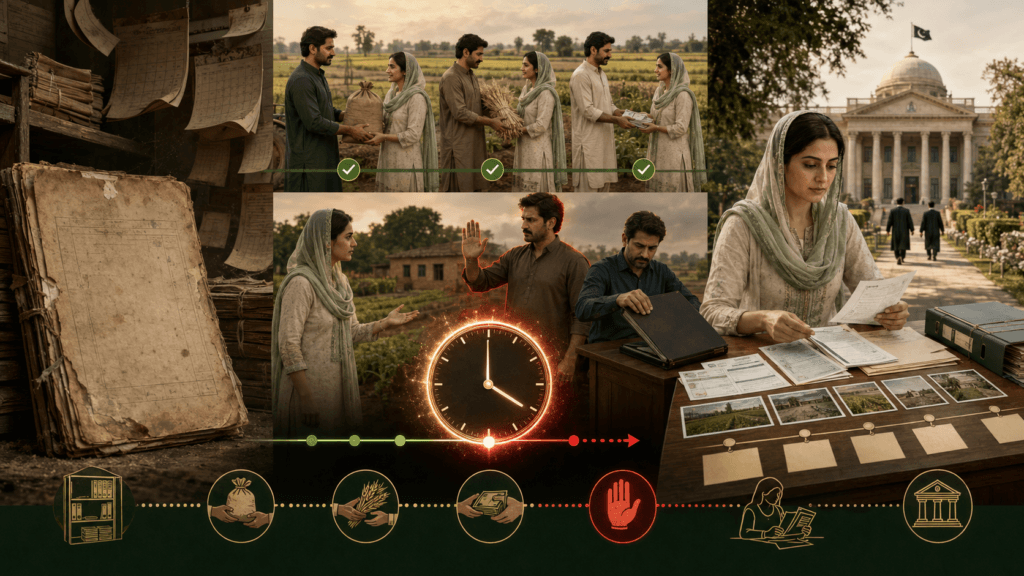
This is one of the most important parts of the judgment.
The disputed mutations were sanctioned in:
- 1952, and
- 1956.
But the suits were filed in:
- 1985, and
- 1994.
The appellants therefore argued that the cases were hopelessly delayed.
The Supreme Court disagreed on the specific facts before it.
The sisters maintained that their brothers had continued giving them a share from the tenancy proceeds.
They approached the courts after payments stopped and their succession rights were denied.
The Supreme Court considered that factual history important.
Does That Mean There Is Never Limitation in Women Inheritance Rights Cases?
No.
This is a very important legal warning.
Do not read 2023 SCMR 1901 as saying:
“Every inheritance claim remains alive forever.”
The Supreme Court itself referred to Saadat Khan and others v. Shahid-ur-Rehman and others, PLD 2023 SC 362.
A known, clear and hostile denial may become legally significant for limitation.
Your website already contains a detailed explanation of that opposite factual situation in Inheritance Dispute in Pakistan: 7 Costly Mistakes. In that case, an overt denial through compensation and refusal became central to limitation.
Readers facing old mutations should also study Limitation in Inheritance Cases in Pakistan, where the Lahore High Court’s approach to delay, knowledge, waiver and acquiescence is explained.
This makes women inheritance rights law more balanced:
A wrong mutation alone may not always start limitation, but a clear known denial can create serious limitation consequences.
The Practical Limitation Checklist
If a woman discovers an old inheritance problem, write down these dates immediately:
- Date of death of the original owner.
- Date succession legally opened.
- Date of inheritance mutation.
- Date the woman first obtained the mutation.
- Whether the family acknowledged her share.
- Whether crop income or rent was paid to her.
- Date those payments stopped.
- Date of first written or oral refusal.
- Date of any gift, sale or relinquishment.
- Date outsiders purchased the property.
- Date the alleged fraud became known.
- Date legal proceedings were started.
One date can determine the outcome of an otherwise valid women inheritance rights claim.
What Women Inheritance Rights Actually Mean in Pakistan
For Muslims, the present statutory framework continues to recognize Muslim Personal Law as the rule of decision in succession matters.
The official West Pakistan Muslim Personal Law (Shariat) Application Act, 1962 is available through Pakistan Code.
The practical meaning is simple.
A lawful female heir’s entitlement is not created by:
- the goodwill of brothers;
- family tradition;
- whether she is married;
- whether she is financially independent;
- whether she lives on the property; or
- whether relatives think she “needs” the money.
Inheritance must be decided according to the applicable law and complete family tree.
Basic Muslim Inheritance Examples for Women
Exact inheritance calculation depends on all surviving heirs, but several basic examples help explain women inheritance rights:
| Female Heir | Common Position |
|---|---|
| One daughter, no son | Generally entitled to one-half, subject to the complete heir structure |
| Two or more daughters, no son | Generally share two-thirds collectively, subject to other heirs |
| Daughter with son(s) | Children generally share the relevant residue with each son taking twice the share of each daughter |
| Widow where deceased leaves no child | Generally one-fourth |
| Widow where deceased leaves a child | Generally one-eighth |
| Mother | Share varies according to surviving descendants, siblings and other heirs |
| Sister | Depends heavily on the presence of parents, descendants, brothers and the category of sister |
This is why the popular statement “a woman always receives half of a man” is misleading.
Sometimes a male heir receives twice a corresponding female heir’s share, but Muslim inheritance has many different heir combinations.
A final distribution should therefore never be prepared from one relationship alone.
Married Daughter? She Is Still an Heir
Marriage by itself does not erase women inheritance rights.
A daughter does not become a stranger to her father’s estate simply because she marries into another family.
The same applies to the argument:
“Her husband is rich, so she does not need inheritance.”
Financial need is not the legal test for determining whether a lawful heir exists.
For another practical court-based discussion, read Daughter Share in Father Property in Pakistan.
Does Dowry Replace a Daughter’s Inheritance?
No automatic rule says:
“We gave her dowry, so her inheritance is finished.”
Wedding expenses, jewellery, furniture and customary gifts do not by themselves prove a lawful transfer or surrender of the daughter’s inheritance.
If relatives claim that she voluntarily surrendered property, the alleged transaction should be examined separately.
Was there a:
- gift?
- relinquishment?
- sale?
- family settlement?
- registered instrument?
- genuine consent?
- clear knowledge of consequences?
A social statement cannot replace legal proof.
Women Inheritance Rights and Family Settlements
Sometimes brothers argue:
“We already settled everything within the family.”
A genuine family settlement can have legal significance.
But the question is whether the woman:
- participated;
- understood what she was surrendering;
- agreed voluntarily;
- knew the property involved;
- knew the value and extent of her share; and
- completed any required legal formalities.
For a detailed explanation, read Family Settlement in Pakistan.
A family settlement should resolve women inheritance rights, not secretly remove women from property records.
Can Brothers Defeat Women Inheritance Rights Through a Gift?
Another common defence is:
“Father gifted everything to the sons while he was alive.”
A genuine lifetime gift can change what remains in the estate when the donor dies.
But courts do not necessarily accept the word “gift” merely because it appears in a mutation.
A valid Muslim gift generally requires proof of:
- declaration by the donor;
- acceptance by the donee; and
- delivery of possession.
Your detailed guide Hiba Law in Pakistan explains a recent Supreme Court ruling where an old gift mutation could not replace proof of the actual transaction.
Another useful internal resource is Valid Gift in Pakistan, which explains why a written gift claim can still fail if its legal ingredients are not proved.
For women inheritance rights, the practical rule is:
Never surrender merely because somebody produces a gift mutation. Examine the gift itself.
What If Someone Produces a Will?
A will is different from both inheritance and a lifetime gift.
Someone may tell a daughter:
“Your father wrote a will, so you receive nothing.”
Do not accept that statement without examining:
- the original will;
- who receives property;
- what portion of the estate is affected;
- whether the beneficiary is already an heir;
- the applicable Muslim-law restrictions; and
- whether any required consent is relevant.
Read Qanooni Dastak’s Will in Pakistan guide for a Supreme Court-based explanation of how testamentary conditions interact with Muslim Personal Law.
What About a Predeceased Daughter’s Children?
Section 4 of the Muslim Family Laws Ordinance, 1961 addresses a situation where a son or daughter of the deceased died before succession opened.
The official ordinance is available on Pakistan Code.
Official Punjab guidance explains that, in the circumstances covered by section 4, living children of a predeceased son or daughter receive the share their parent would have received.
This issue can substantially change a women inheritance rights calculation, so the full family tree should always be prepared first.
Constitutional Protection of Women’s Property
Inheritance is also connected with Pakistan’s broader constitutional protection of property.
The Constitution recognizes the right to acquire, hold and dispose of property and protects people against deprivation of property except according to law.
The current official Constitution can be accessed from the National Assembly’s official downloads page, which currently provides the Constitution as amended up to 21 November 2025.
Articles 23 and 24 concern property rights, while Article 25 protects equality before law and equal protection of law.
These constitutional principles provide an important background for protecting women inheritance rights, although the actual inheritance fraction still depends on the applicable succession law.
Depriving a Woman of Inheritance May Be a Criminal Offence
This is one of the most important awareness points.
Inheritance deprivation is not always merely a civil family dispute.
Official Punjab Commission on the Status of Women guidance explains that under section 498-A of the Pakistan Penal Code, depriving a woman of inheriting movable or immovable property through deceitful or illegal means is punishable with:
- five to ten years’ imprisonment;
- fine of Rs.1,000,000; or
- both.
Official reference:
PCSW — Prevention of Anti-Women Practices
This does not mean every disagreement about women inheritance rights automatically becomes a criminal offence.
The criminal ingredients must still be established through facts and evidence.
But deliberate fraudulent deprivation cannot safely be dismissed as:
“It is just a family matter.”
Punjab Enforcement of Women Property Right Act, 2021
Punjab provides an additional statutory remedy for women deprived of ownership or possession.
The official Punjab Commission on the Status of Women explains that the Punjab Enforcement of Women Property Right Act, 2021 protects women’s property rights against violation through harassment, coercion, force or fraud.
An aggrieved woman may file a complaint before the Ombudsperson Punjab.
Where further inquiry is required, the Ombudsperson may refer the matter to the concerned Deputy Commissioner.
The official guidance states that the Ombudsperson may preferably pass an order within 60 days.
Official link:
Punjab Enforcement of Women Property Right Act, 2021
This is a major practical protection for women inheritance rights in Punjab.
Federal Women’s Property Rights Law
Pakistan Code also lists the Enforcement of Women’s Property Rights Act, 2020 as Act XII of 2020.
Readers dealing with property falling within the Act’s territorial and jurisdictional scope should consult the actual legislation rather than assuming that Punjab’s procedure applies everywhere.
Official link:
Enforcement of Women’s Property Rights Act, 2020 — Pakistan Code
This distinction matters because women inheritance rights may involve different enforcement mechanisms depending upon where the property is situated.
Punjab Revenue Safeguards for Female Heirs
Punjab’s Women Development Department explains that legal reforms were introduced because female heirs were frequently being omitted from inheritance proceedings.
Current official guidance states that during inheritance mutation:
- statements of at least two respectable persons concerning legal heirs should be recorded; and
- CNIC and B-Form references were made mandatory to reduce the risk that a lawful heir is omitted.
The reforms also require partition proceedings to begin after inheritance mutation instead of leaving joint ownership unresolved indefinitely.
Official link:
Women Development Department Punjab — Inheritance Legal Initiatives
These safeguards show why women inheritance rights should be protected at the mutation stage itself—not only after decades of litigation.
What Happens After Inheritance Mutation in Punjab?
Getting a woman’s name entered in the mutation is important, but it may not be enough.
She may still own only an undivided share.
Official PCSW information regarding sections 135-A and 142-A of the Punjab Land Revenue Act explains that after an inheritance mutation is sanctioned, the Revenue Officer is to move toward partition proceedings and invite the joint owners to submit an agreed private partition scheme.
If brothers are occupying the whole agricultural holding and refusing to separate a sister’s share, read:
Partition of Inherited Land in Pakistan
That guide explains why possession of one particular portion does not automatically defeat another heir’s lawful share.
If Your Name Is Missing From the Punjab Land Record
Do not rely only on what relatives tell you.
Obtain the actual land record.
Punjab Land Records Authority currently provides official services for:
- Fard;
- mutation information;
- mutation copies;
- correction of land records;
- service-centre access; and
- complaints.
Useful official links:
Get Fard — Punjab Land Records Authority
Mutation / Intiqal Information
The PLRA complaint portal currently allows citizens to lodge and track complaints concerning land records and related services.
What Documents Should a Deprived Woman Collect?
For women inheritance rights, evidence should come before confrontation.
Create one file containing, where applicable:
| Document | Why It Matters |
|---|---|
| Death Certificate | Establishes death and helps determine when succession opened |
| FRC / Family Record | Helps identify family relationships |
| CNICs of heirs | Confirms identity |
| Old Fard / Jamabandi | Shows previous ownership |
| Current Fard | Shows present recorded ownership |
| Inheritance Mutation | Shows who was entered as heir |
| Earlier Mutations | Reveals historical transfers |
| Registry / Sale Deed | Shows claimed transfers |
| Gift Deed / Gift Mutation | Relevant if brothers rely on Hiba |
| Relinquishment Document | Determines whether a share was allegedly surrendered |
| Family Settlement | Shows any agreed division |
| Power of Attorney | Important where another person handled property |
| Rent Records | Can show acknowledgment of share |
| Crop-Proceeds Evidence | May show continuing acknowledgment |
| Bank Transfers | Can prove payments |
| Messages / Letters | Can show acknowledgment or denial |
| Revenue Orders | Establish administrative history |
| Court Orders | Establish previous litigation |
| Timeline | Helps determine limitation |
NADRA’s current official succession guidance likewise lists documents such as death certificate, FRC, legal-heir CNICs and asset information among requirements for its succession process.
What If a Power of Attorney Was Misused?
A woman may give a brother or relative a power of attorney because she lives abroad or cannot manage the property herself.
That document should not become a licence to take her property.
If an attorney allegedly transfers the woman’s land to himself or close relatives, obtain:
- original power of attorney;
- registration record;
- mutation;
- sale deed;
- consideration evidence; and
- possession record.
Your detailed guide on Power of Attorney Misuse in Pakistan explains a Supreme Court case involving a woman’s property and alleged misuse by her brother.
Power-of-attorney misuse can directly threaten women inheritance rights where a female heir lives away from inherited property.
Seven Red Flags That a Woman May Be Losing Her Inheritance
1. Nobody Will Show Her the Mutation
If relatives repeatedly refuse to show the land record, obtain it independently.
2. She Is Asked to Sign Blank Papers
Never sign or thumb-mark an unread document.
3. She Is Told Dowry Was Her “Full Share”
That social statement alone does not settle inheritance.
4. Her Name Is Missing From the Fard
Immediately investigate the inheritance mutation and previous ownership record.
5. An Old Gift Suddenly Appears
Check declaration, acceptance, possession, witnesses and mutation history.
6. She Is Recorded as Owner but Receives Nothing
She may require partition, possession, income recovery or another remedy.
7. She Is Told “Family Honour” Requires Relinquishment
A voluntary transfer is different from pressure.
These warning signs do not automatically prove wrongdoing, but they justify immediate investigation of women inheritance rights.
Never Sign a Relinquishment Without Understanding It
A common danger appears when a sister is told:
“Sign here. It is only for the inheritance mutation.”
The document may actually be:
- relinquishment;
- gift;
- sale;
- family settlement;
- power of attorney; or
- acknowledgment of payment.
Before signing anything affecting women inheritance rights, check:
- Complete property description.
- Khewat/Khasra details.
- Exact share being transferred.
- Name of the recipient.
- Whether consideration is mentioned.
- Whether transfer is permanent.
- Whether possession is also being transferred.
- Whether the woman receives a copy.
- Whether she has obtained independent advice.
A genuine voluntary transfer and a transfer obtained through deception are legally very different.
Women Inheritance Rights and Succession Certificates
Land mutation is not the only inheritance procedure.
A deceased person may also leave:
- bank accounts;
- securities;
- investments;
- vehicles;
- businesses;
- receivables;
- houses; or
- other assets.
NADRA’s current official guidance states that succession certificates relate to movable property while letters of administration relate to immovable property under the applicable succession legislation.
Readers can also consult Qanooni Dastak’s Succession Certificate guide for a court-based explanation of how succession proceedings can become contested.
Where Should a Woman Go if Her Share Is Denied?
There is no single forum for every women inheritance rights dispute.
| Problem | Possible Starting Route |
|---|---|
| Name omitted from Punjab land mutation | Relevant Revenue Authority / PLRA process |
| Computerized record does not match source record | PLRA correction procedure |
| Brother refuses to distribute inherited land | Revenue partition or appropriate civil remedy depending on property |
| Title disputed through gift/sale/relinquishment | Competent court or revenue authority depending on relief |
| Deprivation of ownership/possession in Punjab through coercion, force, harassment or fraud | Ombudsperson Punjab |
| Deceitful or illegal deprivation potentially falling under PPC 498-A | Appropriate criminal-law process |
| Joint inherited agricultural land | Revenue partition |
| Joint urban immovable property | Applicable Punjab partition law/court procedure |
| Bank accounts/securities | Applicable succession-certificate procedure |
| Legal heir living overseas | POA / authorized representation depending on proceeding |
| Old claim | Immediate limitation assessment |
Official PCSW guidance says a woman whose father has died and whose brother is not giving her inheritance may approach relevant revenue authorities such as the Halqa Patwari, Tehsildar and Collector, and it also identifies civil-court recourse where required.
Punjab Women’s Helpline 1043
A woman who does not know where to begin can use an official government guidance channel.
The Punjab Women’s Toll-Free Helpline 1043 operates 24/7 and specifically handles:
- property disputes;
- inheritance rights;
- gender discrimination; and
- related legal issues.
Official link:
Ministry of Human Rights Helpline 1099
The Ministry of Human Rights maintains an official awareness page specifically titled Women Inheritance Rights and directs people seeking further assistance to 1099.
Official link:
Ministry of Human Rights — Women Inheritance Rights
The helpline can be useful for initial legal guidance and referral.
10 Common Myths About Women Inheritance Rights
| Myth | Reality |
|---|---|
| “She is married, so she cannot inherit.” | Marriage itself does not cancel a lawful Muslim heir’s entitlement. |
| “She received dowry.” | Dowry alone does not automatically replace inheritance. |
| “Her brothers are poor.” | Financial need does not by itself decide heirship. |
| “The mutation is 50 years old.” | Age alone does not answer title or limitation; facts of knowledge and denial matter. |
| “Brothers cultivated the land.” | Physical possession alone does not automatically destroy another co-heir’s rights. |
| “The Patwari entered only sons.” | A wrong revenue entry does not automatically become lawful title. |
| “Father gifted everything.” | The alleged gift must withstand legal and evidentiary scrutiny. |
| “She never demanded rent.” | Silence alone may not prove relinquishment, although delay can become legally important after clear denial. |
| “She signed something years ago.” | The nature, validity and voluntariness of the document must be examined. |
| “Inheritance disputes are only civil.” | Certain deceitful or illegal deprivation can engage criminal law, including PPC section 498-A. |
Practical 10-Step Action Plan
If women inheritance rights appear to have been denied:
Step 1: Do Not Sign Anything
Preserve your existing position first.
Step 2: Obtain the Death Certificate
Determine when succession opened.
Step 3: Prepare the Complete Family Tree
Do not omit daughters, widows, mothers or children of predeceased sons/daughters.
Step 4: Obtain the Fard and Mutation
Never rely only on oral information.
Step 5: Collect Historical Records
Get previous mutations, Jamabandi, registries and related documents.
Step 6: Identify Every Later Transaction
Check gifts, sales, relinquishments, partitions and powers of attorney.
Step 7: Build a Date-by-Date Timeline
Especially identify the first clear denial.
Step 8: Preserve Acknowledgment Evidence
Crop proceeds, rent, bank transfers and messages can matter.
Step 9: Identify the Correct Forum
Revenue authority, court, Ombudsperson and criminal forum are not interchangeable.
Step 10: Do Not Delay After Clear Denial
Limitation can destroy a genuine claim if an overt denial is ignored for too long.
What 2023 SCMR 1901 Ultimately Teaches
This judgment does not say that women win every inheritance dispute.
It says something more legally important.
A court must examine:
- the actual source of ownership;
- the governing succession law;
- the historical statutory framework;
- whether a claimed custom was proved;
- whether a mutation was legally correct;
- whether possession acknowledged other co-heirs;
- whether later payments changed legal status;
- when denial actually occurred; and
- whether limitation has run.
That is a much stronger foundation for women inheritance rights than an emotional slogan.
Supreme Court’s Final Decision
The Supreme Court concluded that Shariat governed the Muslim succession in dispute even before March 1951 in Bahawalpur because of the effect of the 1948 Shariat legislation and the historical legal framework examined in the judgment.
The appellants could not become original tenants merely because they completed outstanding payment later.
Their own record showed that they had obtained tenancy rights as successors of Din Muhammad.
The Supreme Court also rejected the limitation objection in light of the facts concerning payment of proceeds and subsequent denial.
It therefore found no ground to interfere with the Lahore High Court judgments.
The result was:
- Civil Appeal No. 419 of 2011 — dismissed
- Civil Appeal No. 1184 of 2019 — dismissed
- No order as to costs
- C.M.A. No. 1839 of 2011 — disposed of
Final Awareness Message
A woman should not discover twenty years after her father’s death that her name was never entered in the inheritance mutation.
A sister should not be forced to exchange land for “family honour.”
A widow should not sign papers she does not understand.
And a decades-old mutation should never be treated as the end of the discussion without asking:
Was the succession itself lawful?
2023 SCMR 1901 provides a powerful lesson for women inheritance rights.
The female heirs were facing mutations from the 1950s.
Yet the Supreme Court looked behind those entries.
It examined Shariat, historical statutes, tenancy law, limitation, payments, possession and the legal basis through which the male heirs claimed the property.
The judgment therefore teaches Pakistani families one simple rule:
Do not allow a revenue entry to replace the law.
If an inheritance problem arises:
Get the record. Check every heir. Preserve evidence. Identify the first denial. Understand limitation. Use the correct legal forum.
Because inheritance should be distributed according to law—not according to who is strongest inside the family.
Frequently Asked Questions About Women Inheritance Rights
Can a married daughter inherit from her father?
Yes. Marriage itself does not extinguish a Muslim daughter’s lawful inheritance entitlement.
Her exact share depends on all surviving heirs.
Can brothers exclude their sisters from agricultural land?
They cannot lawfully exclude a sister merely by claiming that agricultural land traditionally belongs to males.
2023 SCMR 1901 itself involved historical tenancy/agricultural succession and the Supreme Court held that Shariat governed the Muslim succession before it.
Can a 50-year-old inheritance mutation be challenged?
Potentially, yes.
But the result depends on facts including knowledge, fraud, acknowledgment, actual denial, relinquishment, possession, later transactions and limitation.
Is there no limitation in women inheritance rights cases?
No. That statement is too broad.
In 2023 SCMR 1901, the sisters succeeded against the limitation objection on the particular facts of their case.
Other cases show that limitation can become decisive after a clear and known denial.
Does mutation create ownership?
An inheritance mutation records revenue entitlement, but the Supreme Court has repeatedly distinguished mutation from the underlying legal source of title.
An incorrect mutation cannot automatically make an unlawful succession lawful.
Does dowry cancel inheritance?
No. Dowry or wedding expenses do not by themselves automatically cancel a woman’s inheritance share.
Can a financially independent daughter inherit?
Yes.
Financial independence does not by itself remove a lawful heir from succession.
Can a woman voluntarily give her inheritance to her brother?
A competent adult woman can enter into a lawful voluntary property transaction.
But consent, knowledge, legal formalities and evidence matter.
Fraud, coercion and deception create a different issue.
What if a woman signed a document without reading it?
Obtain a certified copy immediately.
Determine whether it was:
a gift;
relinquishment;
sale;
settlement; or
power of attorney.
Then seek advice based on the document and surrounding evidence.
Is depriving a woman of inheritance a criminal offence?
It can be.
PCSW’s official guidance states that PPC section 498-A punishes deceitful or illegal deprivation of women from inheritance with five to ten years’ imprisonment, a fine of Rs.1 million, or both.
Where can a woman complain in Punjab?
Depending on the problem, she may need:
revenue authorities;
civil court;
Ombudsperson Punjab; or
an appropriate criminal-law forum.
The correct forum depends on the relief sought.
Can brothers’ long possession end a sister’s share?
Not automatically.
Among co-heirs, possession and limitation require careful factual analysis.
A clear repudiation of the other heir’s title can, however, become legally significant.
What if brothers are refusing partition?
If inherited land remains joint, a lawful heir may pursue the applicable partition procedure.
In Punjab, official law provides mechanisms for partition after inheritance mutation.
What if my name is missing from computerized land records?
Obtain the manual/source record and mutation.
PLRA currently provides a formal Correction of Land Records procedure for errors involving names, ownership data, Khewat, Khasra and related entries.
What is the first thing a woman should do after discovering inheritance deprivation?
Do not sign anything.
Obtain:
death certificate;
FRC/family information;
inheritance mutation;
current Fard;
old Jamabandi;
transfer documents; and
evidence showing when the denial became known.
Then obtain case-specific legal advice.
Disclaimer
This article is written for legal awareness and educational purposes only.
It does not provide case-specific legal advice.
Inheritance shares, limitation, title, jurisdiction and remedies depend upon factors including:
- complete family tree;
- religion;
- province;
- property type;
- date of death;
- date of mutation;
- possession;
- acknowledgment;
- previous gifts or sales;
- relinquishment documents;
- third-party rights;
- fraud;
- knowledge; and
- applicable statutory law.
Always have the original documents reviewed before filing a suit, signing a relinquishment, transferring property or accepting a family settlement.
Recommended Internal Links Used in This Article
- Inheritance Mutation in Pakistan
- Inheritance Dispute in Pakistan
- Limitation in Inheritance Cases in Pakistan
- Partition of Inherited Land in Pakistan
- Hiba Law in Pakistan
- Valid Gift in Pakistan
- Will in Pakistan
- Family Settlement in Pakistan
- Succession Certificate
- Power of Attorney Misuse in Pakistan
- Daughter Share in Father Property in Pakistan